What Does a Revolut-Style App Cost to Build?
A Revolut-style app typically costs from roughly $150k for a focused MVP to well over $1M for a multi-currency, regulated product, driven mostly by compliance and integrations.
On this page
Short answer
A Revolut-style app usually costs between roughly $150,000 for a focused MVP and $1M or more for a regulated multi-currency product. Most of the budget goes to compliance, banking and card integrations, and back-office operations rather than the mobile UI.
What drives the cost of a Revolut-style app?
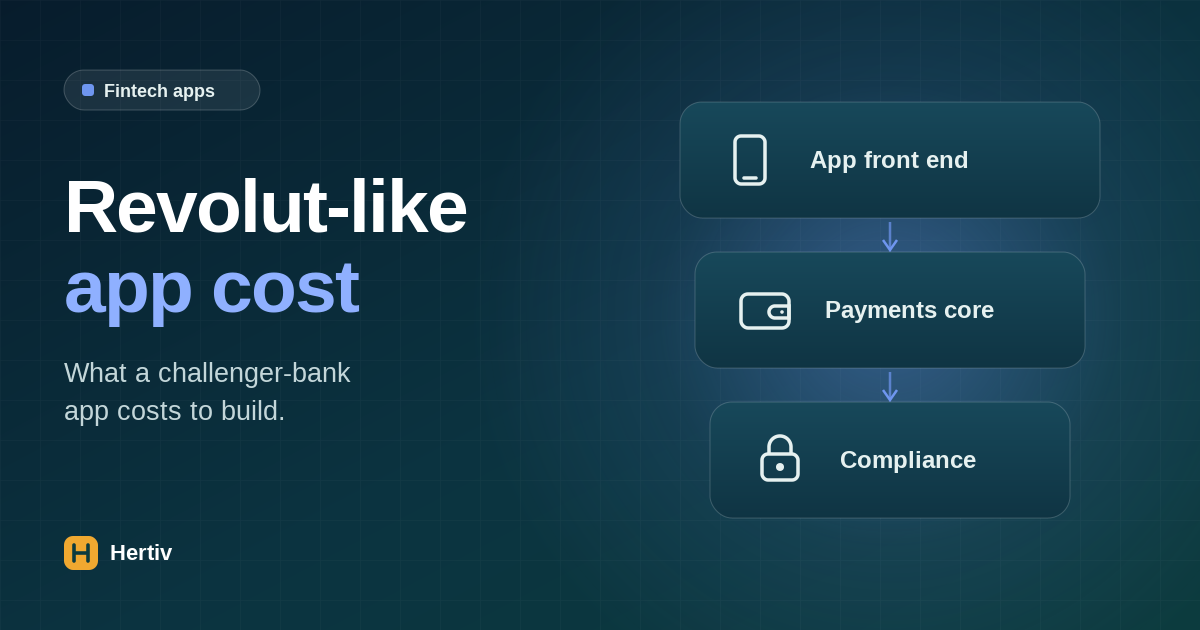
A Revolut-style app is a regulated financial product, so cost is set by compliance, integrations and ledger correctness, not by screen count. The mobile front end is a small share of the budget.
The main cost drivers:
- Licensing and regulatory scope. Holding client money, issuing cards and offering credit each need different approvals. Working through a licensed partner is faster and cheaper than applying for your own licence.
- Banking and card integrations. Accounts, payments, card issuing and FX rates come from partners, each with onboarding, contracts and engineering work.
- KYC and AML. Identity checks, sanctions screening and transaction monitoring need vendors plus internal review flows.
- The ledger. Every balance, fee and refund must reconcile exactly. This is where teams underestimate effort.
- Operations back office. Support agents, risk analysts and finance staff need tools to see and act on customer accounts.
- Security. Strong authentication, device binding, tamper detection and audit logs are baseline.
A useful rule: for every screen a customer sees, expect several internal screens and integrations behind it. If you are weighing this against other product bets, our cost guides put the ranges side by side.
Typical cost ranges by scope
Scope, not feature count, sets the range. The figures below are typical ranges for planning that vary with regulation, partners and team location.
| Scope | What it includes | Typical range (USD) |
|---|---|---|
| Focused MVP | One currency, one card issuer, one KYC vendor, basic spend controls | ~$150k–$350k |
| Mid-scope product | Multi-currency accounts, peer transfers, budgeting, web and mobile | ~$350k–$700k |
| Broad product | Crypto or stock trading, business accounts, lending, multiple regions | $1M+ |
| Ongoing run cost | Compliance, fraud, support, infrastructure, releases | Often a large share of build cost per year |
Treat these as planning anchors, not quotes. A single licence decision can move a project by hundreds of thousands. The same logic applies to adjacent builds: our breakdown of MVP cost shows how a narrow first release keeps spend controlled.
Which features cost the most?
Compliance, the ledger and partner integrations cost the most, while budgeting charts and notifications are comparatively cheap. Budget attention accordingly.
- Identity and AML: vendor fees, review tooling and case management. Ongoing cost, not one-off.
- Card issuing and processing: onboarding plus per-transaction fees paid to the issuer and processor.
- Ledger and reconciliation: double-entry accounting, fee handling, refunds, dispute states. Underfunding this causes expensive fixes later.
- Multi-currency and FX: rate sourcing, margin logic and regulatory treatment per market.
- Trading (crypto or stocks): separate licences, custody arrangements, market data and risk controls.
- Fraud and risk engine: rules, device signals and manual review queues.
- Support tooling: agents need a full view of balances, cards and disputes to resolve issues.
Build cost versus partner cost
The sticker price of development is only part of the total. Partner fees and compliance salaries often exceed it within a year or two.
Building everything yourself is rarely sensible. Banking-as-a-service providers, card issuers, KYC vendors and FX providers sell the regulated plumbing. You pay integration effort up front, then per-account or per-transaction fees.
Compare options on four axes:
- Time to market. Partner-led launches are faster but constrain what you can change.
- Unit economics. Per-transaction fees scale with usage; check them against your intended customer segment.
- Control. Partners limit product design, pricing and sometimes customer data access.
- Exit cost. Migrating a card programme or ledger later is expensive. Choose partners you can live with.
A common pattern is a hybrid: partner for licences and card issuing, own the customer experience, ledger and risk logic. That keeps the parts that differentiate you in-house.
How to scope a first release
The cheapest path to a credible Revolut-style product is a narrow, single-market release with one partner stack. Expand once usage and compliance processes are proven.
- Pick one customer and one job. For example, freelancers in one country who need a multi-currency account and a card.
- Choose the licence route. Work under a partner's licence unless you have a clear reason and budget for your own.
- Fix the partner stack. One KYC vendor, one issuer, one FX source. Resist adding a second of anything early.
- Build the ledger properly. Double-entry, auditable, with reconciliation from day one.
- Ship internal tools with the app. Support and risk staff cannot operate without them.
- Plan the compliance run cost. Budget for monitoring, reporting and staff before launch, not after.
Example (hypothetical): a team budgets $300,000 for build and $250,000 for the first year of compliance staff, partner fees and infrastructure, for a total first-year commitment of $550,000. If you want a technical partner for the build, our custom software development team works this way.
Common mistakes that inflate the budget
Most overruns on fintech builds come from scope and sequencing, not from engineering skill. Avoiding these keeps the budget predictable.
- Copying the whole feature list. A competitor's app reflects years of regulatory work. Start with the job your users actually need.
- Treating compliance as a later phase. Retrofitting KYC and monitoring into a live product is costly and risky.
- Underestimating the ledger. Reconciliation bugs surface at scale and are hard to unwind.
- Skipping internal tools. Without back-office screens, support cannot function and costs rise.
- Choosing partners on price alone. Migration and limited control later outweigh early savings.
- No run-cost plan. Compliance and fraud monitoring are permanent line items.
Key takeaways
- The app screens are the cheap part; licensing, KYC/AML and ledger correctness dominate cost.
- A single-currency MVP with one card issuer and one KYC vendor is the realistic first scope.
- Banking-as-a-service and card-issuer partnerships cut build time but add per-transaction fees.
- Multi-currency, crypto and stock trading each add a separate regulated workstream.
- Ongoing compliance, fraud monitoring and support usually cost more per year than the initial build.
Frequently asked questions
Can I build a Revolut-style app without a banking licence?
Yes, in most markets you can operate under a licensed partner such as a banking-as-a-service provider or card issuer. You handle the customer experience while the partner holds funds or issues cards. This is faster and cheaper, but it limits product control and adds per-transaction fees.
How long does a fintech app like this take to build?
A focused MVP with one partner stack typically takes several months of engineering, plus partner onboarding and compliance review time that runs in parallel. Broader products with multiple currencies, trading or lending take considerably longer and depend heavily on regulatory approvals.
What are the ongoing costs after launch?
Expect compliance staff, fraud monitoring, partner and processor fees, infrastructure, security reviews and customer support. For most fintech products these recurring costs are substantial and should be budgeted before launch, since they continue regardless of feature development.
Is it cheaper to use a white-label fintech platform?
Often yes for a first launch, because the regulated plumbing and back office already exist. The trade-off is less control over product design and pricing, and per-account or per-transaction fees. Many teams start white-label and bring the ledger and risk logic in-house over time.
Which features should I cut from the first version?
Cut crypto or stock trading, lending, multi-region support and multiple currencies beyond what your first customer needs. Keep accounts, cards, transfers, KYC and the ledger. Those core pieces must be right from the start because they are hardest to change later.
How much does the mobile app itself cost compared to the backend?
The mobile app is usually a modest share of the total because the complexity sits in integrations, compliance and the ledger. A useful planning heuristic is that every customer screen implies several internal screens, services and partner integrations behind it.


