Restaurant Digital Transformation: Where to Start
Restaurant digital transformation connects ordering, payments, kitchen work and marketing into one system. Start with online ordering and one point of sale.
On this page
Short answer
Restaurant digital transformation is the process of replacing paper tickets, phone orders and disconnected tools with software that connects ordering, payments, the kitchen, inventory and marketing. It is not about buying the newest technology, but about removing the manual steps that slow service down, cause errors and hide information about what the business is doing.
What is restaurant digital transformation?
Restaurant digital transformation is the use of digital tools to run a restaurant as one connected system, from the moment a customer orders to the moment the kitchen restocks. It covers online ordering, point of sale, kitchen displays, reservations, loyalty and the data that ties them together.
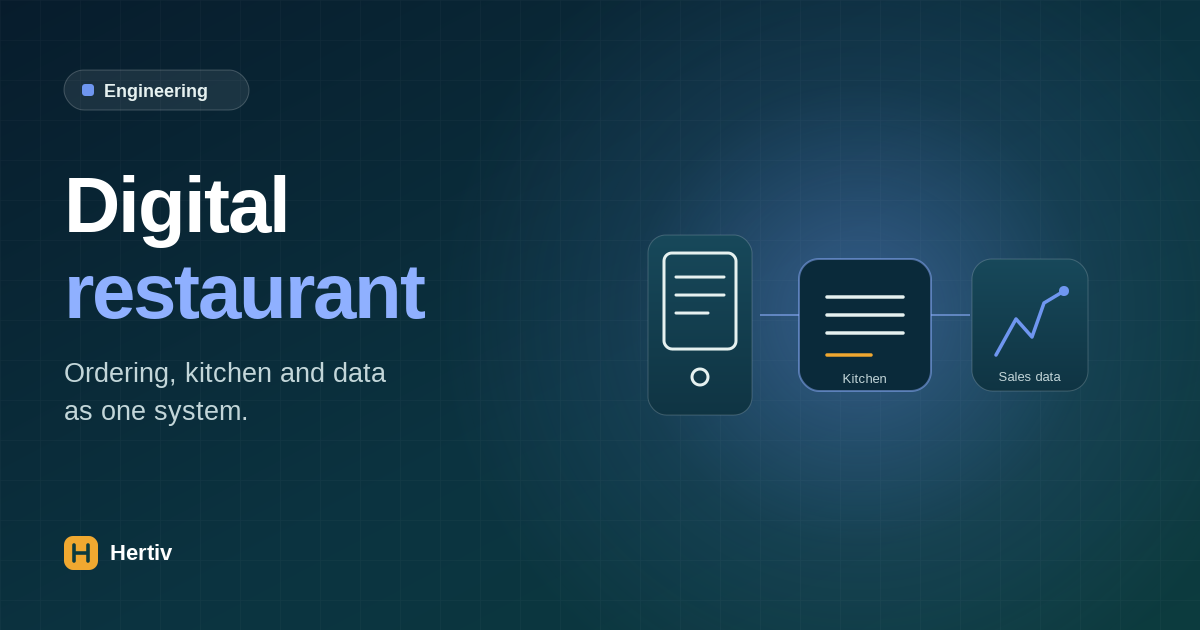
Most restaurants already use some technology, such as a card terminal or a delivery app. Transformation happens when those tools stop being separate and start sharing data. An online order should reach the kitchen screen without retyping, a payment should update the day's sales, and a loyalty visit should be visible at the till.
The goal is practical: faster service, fewer errors, less waste and a clearer picture of what sells. A restaurant that knows its best-selling dishes, its busiest hours and its most loyal customers can plan staff, stock and menus with facts instead of guesses. Our guide to why restaurants need a mobile app covers one piece of this picture.
Which systems matter most in a restaurant?
The systems that matter most in a restaurant are the point of sale, online ordering, the kitchen display, payments and reservations. Together they form the core of the operation, and everything else builds on them.
The point of sale is the centre. It records every order, takes payments and produces the sales data the rest of the business needs. If the point of sale is slow or unreliable, every other system suffers, so it should be the first thing to get right.
Online ordering and delivery connect the restaurant to customers who never walk in. A direct ordering channel keeps the customer relationship and the margin, while delivery marketplaces bring reach at a higher fee. Most restaurants need both, but the direct channel should be the one that grows.
The kitchen display replaces paper tickets with a screen that shows orders in sequence, flags allergies and tracks preparation time. It cuts the errors that come from handwriting and shouting, and it gives the kitchen a clear view of the queue. Reservations and loyalty sit on top of these, filling tables and bringing customers back.
How do the systems fit together?
The systems fit together when orders, payments, kitchen work and customer data flow through one shared record instead of being retyped between tools. The table below shows the main connections and what breaks when they are missing.
| Connection | What flows | What breaks without it |
|---|---|---|
| Ordering to kitchen | Orders and modifiers | Retyped tickets and wrong dishes |
| Point of sale to payments | Totals and payment status | Manual reconciliation at close |
| Kitchen to inventory | Ingredients used per dish | Stockouts discovered too late |
| Ordering to loyalty | Customer visits and points | Regulars treated as strangers |
| Sales to reporting | Daily sales by dish and hour | Menus planned on guesswork |
The test is simple: if a member of staff has to type the same information twice, the systems are not connected. Each double entry is a chance for an error and a minute of staff time that could have gone to the customer.
What does digital transformation cost a restaurant?
Digital transformation costs a restaurant the price of its software subscriptions, hardware and staff training, and the honest way to judge it is against the time and errors it removes. Most restaurants start small and add tools as each one proves its value.
A point of sale system and a kitchen display are usually the first purchase, followed by online ordering. Hardware such as tablets, printers and card terminals is a one-off cost, while software is a monthly subscription. Training is the cost owners most often forget, and it matters more than the software price: a system the staff cannot use quickly is a system they will work around.
Delivery marketplaces charge a fee on each order, so a restaurant should compare that fee with the cost of its own ordering channel. A direct channel costs less per order but needs marketing to bring customers to it. The right mix depends on how much of the restaurant's trade comes from delivery.
Start with a budget for one system, measure the result for a month, and only then buy the next. A restaurant that buys everything at once usually ends up with tools nobody has time to learn. The restaurant app development cost guide covers the price of building a custom app when off-the-shelf tools no longer fit.
How do you roll it out without disrupting service?
You roll out restaurant technology without disrupting service by changing one thing at a time, training staff before launch, and keeping a fallback for the first weeks. A restaurant cannot close for a week to install software, so the rollout has to fit around service.
Start with the system that causes the most daily pain, which is usually the point of sale or the kitchen display. Run the new system alongside the old one for a few days if possible, so staff can compare and the team can fix problems before the old system goes away.
Train in short sessions during quiet hours, and name one person on each shift who can answer questions. A short written guide at each station helps more than a long training day, because staff learn by doing during service.
Keep the paper fallback ready for the first month. If the internet drops or a tablet fails, the restaurant must still be able to take orders and serve food. A system that cannot fail gracefully is not ready for a busy Friday night.
Example (hypothetical): a 60-seat bistro goes digital
Example (hypothetical): a 60-seat bistro serves about 200 covers a day and takes phone orders on a busy line. Staff retype each phone order into the till, and the kitchen works from paper tickets that are hard to read during the dinner rush.
The owner starts with a point of sale and a kitchen display. Online ordering follows, with a simple page that takes orders directly and sends them to the kitchen screen. The phone line stays, but staff enter phone orders into the same system instead of writing them down.
After a month, the numbers change. Online orders add 30 orders a day at an average of $22, which is $660 a day in extra sales. Ticket errors fall from about 12 a day to 3 a day, and the kitchen can see the queue clearly during the rush. The owner then adds loyalty, because the system now knows who the regulars are.
What are the common mistakes?
The most common mistakes in restaurant digital transformation are buying too much at once, ignoring staff training, and choosing tools that do not talk to each other.
- Buying everything at once. Five new systems in one month means nobody learns any of them properly.
- Skipping training. Staff who cannot use the system quickly will work around it, and the data will be wrong.
- Disconnected tools. Systems that do not share data force double entry, which is where errors start.
- No fallback plan. A restaurant that cannot serve food when the internet drops has a fragile operation.
- Ignoring the customer. Technology should make ordering and paying easier for the customer, not add steps.
How to start in four steps
You can start restaurant digital transformation in four steps, beginning with the system that causes the most daily pain and expanding only when each step works.
- Map the daily pain. List where orders get lost, where staff retype information, and where the kitchen waits.
- Fix the point of sale first. A reliable till and kitchen display are the foundation for everything else.
- Add direct online ordering. Give customers a way to order without a marketplace fee.
- Use the data. Review sales by dish and hour each week, and adjust the menu and staffing to match.
Each step should pay for itself before the next one starts. If a step does not save time or money within a month, find out why before buying more software. If you need a custom system, a partner for custom software development can build one around the way your restaurant actually works.
Key takeaways
- Digital transformation connects ordering, kitchen, payments and marketing into one system
- Fix the point of sale and kitchen display first; they are the foundation
- Systems that do not share data force double entry, which is where errors start
- Roll out one change at a time and keep a paper fallback for the first month
- Judge each step by the time and errors it removes, not by the features it adds
Frequently asked questions
Do small restaurants need digital transformation?
Yes, but at a small scale. A single point of sale, a kitchen display and a simple online ordering page can transform a small restaurant without a large budget. The goal is to remove manual steps, not to buy enterprise software.
Should a restaurant build a custom app or use off-the-shelf tools?
Most restaurants should start with off-the-shelf tools, because they are cheaper and faster to set up. A custom app makes sense when the restaurant has a specific workflow or brand experience that standard tools cannot support.
How do delivery marketplaces fit into digital transformation?
They bring reach and new customers, but they charge a fee on each order and own the customer relationship. Most restaurants use marketplaces for discovery while building a direct ordering channel for repeat customers.
What is a kitchen display system?
A kitchen display system replaces paper tickets with a screen that shows orders in sequence, flags allergies and tracks preparation time. It reduces errors from handwriting and gives the kitchen a clear view of the queue.
How long does restaurant digital transformation take?
A single system can be live within weeks, while a full transformation takes months of gradual changes. The safest approach is one system at a time, with each step tested during real service before the next begins.
What data should a restaurant track first?
Start with sales by dish, sales by hour and the number of orders from each channel. Those three numbers show what sells, when the restaurant is busy and where customers come from.


