7 Reasons Your Business Needs a Mobile App
A mobile app puts your business on the phone your customers already carry, with direct contact, faster service, loyalty, sales and data no website can match.
On this page
Short answer
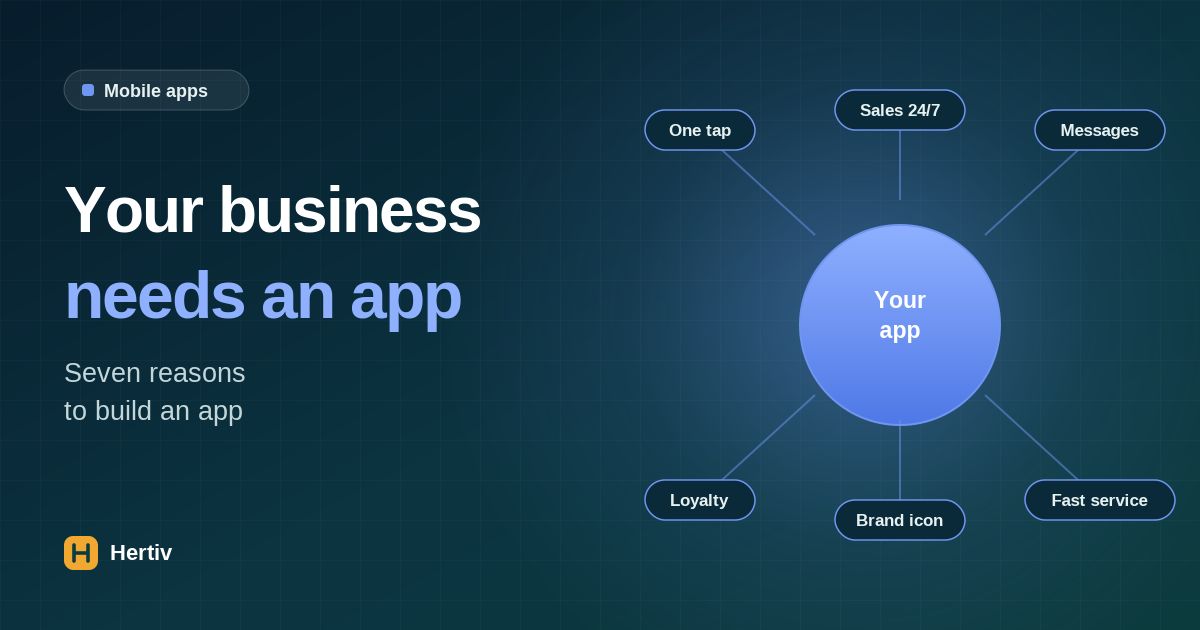
Your business needs a mobile app for seven clear reasons: your customers live on their phones, an app gives you a direct line to them, it makes repeat business easier, it speeds up service, it shows you how customers behave, it sells while you sleep, and it keeps your brand in sight every day. Each reason below explains the gain and what it takes.
Why does a business need a mobile app?
Most customers now reach for a phone before a computer, and a phone rewards the businesses that are already on it. A website can be found, but an app can be opened in one tap, can send a reminder, and can remember who the customer is. That difference is small in any single moment and large over a year of small moments.
An app is not right for every business, and it is not free to build or to keep running. The seven reasons below are the ones that justify the cost, and they are worth checking against your own customers before you commit. The table gives the short version, then each section looks at one reason in detail.
| Reason | What it gives you | Who gains most |
|---|---|---|
| 1. Customers live on phones | One-tap access, no searching | Shops, clinics, services |
| 2. A direct line to customers | Messages that reach them | Businesses with repeat visits |
| 3. Repeat business and loyalty | Rewards and saved preferences | Cafes, salons, gyms, shops |
| 4. Faster service | Booking and ordering in seconds | Clinics, restaurants, delivery |
| 5. You learn how customers behave | Real usage data | Any business that wants to improve |
| 6. Sales while you sleep | Orders outside opening hours | Shops and booking businesses |
| 7. Your brand stays visible | An icon on the home screen | Businesses fighting for attention |
<h3>1. Your customers live on their phones: best reason to be one tap away</h3> <h3>2. A direct line to your customers: best reason to be heard</h3>
1. Your customers live on their phones: best reason to be one tap away. A phone is the first screen most people check in the morning and the last one at night. An app sits on that screen, one tap from opening, while a website needs a search, a link and a wait.
For a business a customer uses weekly, that difference decides whether they come back or drift to a competitor that is easier to reach. An app can remember the customer, their last order and their preferences, so the second visit is faster than the first. That matters most for businesses with repeat visits: a clinic, a cafe, a gym or a local shop.
If your customers visit once and never return, an app earns its keep more slowly.
Pros:
- One-tap access. No search, no link, no waiting.
- Remembers the customer. Repeat visits get faster.
Cons:
- Needs a reason to open. An app nobody opens is a wasted build.
- Must be maintained. Phones and stores change, and the app must keep up.
2. A direct line to your customers: best reason to be heard. An app can send a short message straight to a customer's phone: a booking reminder, a delivery update, a new offer. Email is easy to miss and social posts reach only a fraction of followers, but a message from an app the customer chose to install is far more likely to be seen.
The key is restraint. A reminder before an appointment is welcome; three offers a week are not, and customers will switch the messages off. Plan the messages like a shopkeeper plans a conversation: useful, short and only when there is something worth saying. One good message a week beats five noisy ones.
Pros:
- Messages that reach people. Reminders and updates land on the phone.
- No middleman. You talk to your own customers directly.
Cons:
- Easy to overdo. Too many messages get switched off.
- Needs permission. Customers must agree to receive them.
<h3>3. Repeat business and loyalty: best reason to keep customers coming back</h3> <h3>4. Faster service: best reason to cut the wait</h3>
3. Repeat business and loyalty: best reason to keep customers coming back. An app can carry a loyalty card that never gets lost: points, stamps or rewards that build up with every visit. It can also remember what a customer likes, so a regular's usual order is one tap away. That memory is what turns a one-time buyer into a regular, and regulars are the steadiest income a small business has.
Loyalty works best when the reward is simple and reachable. A free coffee after nine visits is clear; a points system nobody understands is not. Keep the rule on one screen, show progress every time, and make the reward worth the effort. The app only carries the scheme: the offer itself has to be good.
Pros:
- Rewards that build up. Points and stamps encourage the next visit.
- Saved preferences. A regular's usual order is one tap away.
Cons:
- Needs a good offer. A weak reward will not change behaviour.
- Takes time to pay off. Loyalty builds over months, not days.
4. Faster service: best reason to cut the wait. An app lets a customer book, order or pay before they arrive. A clinic patient books a slot in seconds instead of calling during office hours. A restaurant regular orders ahead and picks the food up without queuing. A delivery customer tracks the order instead of phoning to ask where it is.
Speed helps both sides. The customer waits less, and the business takes fewer calls and handles more orders with the same staff. The work is in getting the details right: clear time slots, honest delivery times and a way to fix a mistake quickly. A fast app with wrong times is worse than a slow phone call that gets it right.
Pros:
- Less waiting. Booking, ordering and payment happen in seconds.
- Fewer calls. Staff spend less time on the phone.
Cons:
- Details must be right. Wrong times or prices damage trust fast.
- Needs a fix path. Customers need a quick way to correct a mistake.
<h3>5. You learn how customers behave: best reason to stop guessing</h3> <h3>6. Sales while you sleep: best reason to stay open</h3>
5. You learn how customers behave: best reason to stop guessing. An app shows what customers actually do: which items they view, which they buy, when they order and where they stop. A website can show some of this, but an app ties it to a signed-in customer, so you can see patterns over time instead of one-off visits.
That data is useful only if someone reads it. A weekly look at the numbers, even for half an hour, beats a dashboard nobody opens. Look for the simple things first: the most ordered items, the busiest hours, and the step where people give up. Fix one of those each month and the app pays for itself in small steps.
Pros:
- Real behaviour, not guesses. See what customers view and buy.
- Patterns over time. Signed-in use shows repeat habits.
Cons:
- Needs regular review. Data nobody reads is wasted.
- Privacy duties. Customer data must be handled with care.
6. Sales while you sleep: best reason to stay open. An app takes orders at midnight, on a holiday, or while the shop is closed for a break. A customer who decides at 11 pm can order then, instead of forgetting by morning. For shops and booking businesses, that extra window is real income that a phone line or a counter cannot capture.
The gain depends on what you sell. Products that can be ordered and shipped, or services that can be booked ahead, benefit most. A business that only sells face to face gains less. Either way, the app must handle payment safely and confirm the order clearly, or the customer will not trust the midnight purchase.
Pros:
- Orders outside hours. Customers buy when they decide, not when you open.
- Fewer missed sales. A late-night decision becomes an order, not a forgotten thought.
Cons:
- Payment must be safe. Customers need to trust the checkout.
- Needs fulfilment. Orders still need someone to pack or prepare them.
<h3>7. Your brand stays visible: best reason to be remembered</h3>
7. Your brand stays visible: best reason to be remembered. An app icon on a home screen is a small daily reminder that your business exists. Every time a customer opens their phone and sees it, the name stays familiar. That familiarity is what makes them think of you first when the need comes up, instead of searching and finding a competitor.
Visibility alone does not sell anything: the app still has to be useful when it is opened. But between two similar businesses, the one whose icon is already on the phone has the easier path to the next order. Keep the icon clean, the name short, and the app worth opening, and the reminder works for you every day.
Pros:
- Daily reminder. The icon keeps your name in sight.
- First thought, not a search. Familiarity wins the next order.
Cons:
- Visibility is not sales. The app still has to be useful when opened.
- Easy to delete. An unused app is removed without a second thought.
How to choose whether to build an app
Not every business should build an app, and the decision is worth a week of honest checking before you spend anything. The seven reasons above are the test: if at least two of them clearly apply to your customers, an app is worth costing out. If none of them fit, a good website and a simple booking link will serve you better.
- Count repeat visits. If most customers come back, an app has something to build on.
- Ask ten customers. Would they install it, and what would they use it for?
- Start with one job. Booking, ordering or loyalty, not all three at once.
- Cost the upkeep. An app needs updates, fixes and store fees every year, not just a build.
- Plan the launch. An app with no launch plan sits uninstalled; tell customers in the shop, on receipts and in messages.
If you decide to go ahead, creating a mobile app for your business walks through the build step by step, from the first version to launch. Keep the first version small: one job, done well, beats five jobs done badly.
What are the common mistakes?
The most common mistake is building an app that does what the website already does. An app must earn its place on the phone with something the website cannot do: a loyalty card, a one-tap reorder, an offline ticket or a fast booking. If the app is only a smaller website, customers will not keep it.
Another mistake is forgetting the upkeep. Phones update, store rules change, and an app that is not updated stops working or disappears from the store. Budget for yearly maintenance from the start, or the app you paid to build will quietly die.
A third mistake is launching without telling anyone. An app does not market itself. Tell customers in the shop, print it on receipts, mention it in messages, and give them a reason to install it on the spot, such as a first-order reward. The first hundred installs are the hardest, and they come from the counter, not from the store.
Key takeaways
- An app earns its place by doing what a website cannot: one-tap access, loyalty and fast ordering.
- Direct messages and a home-screen icon keep your business in front of customers every day.
- Start with one job, such as booking or loyalty, and do it well before adding more.
- Budget for yearly upkeep: an unmaintained app stops working or leaves the store.
- Launch in the shop, on receipts and in messages: the first installs come from the counter.
Frequently asked questions
Does every business need a mobile app?
No. A business with mostly one-time customers, or one that sells only face to face, may do better with a good website and a booking link. An app pays off when customers return often and value speed, reminders or loyalty rewards.
How much does a business mobile app cost?
There is no fixed price, since it depends on the features, the platforms and the team that builds it, so see vendor site for quotes. Cost the build and the yearly upkeep together, because maintenance is part of the real price.
Should I build for iPhone, Android or both?
Most businesses need both, since customers use both. Check which phone your own customers carry most, start there if the budget is tight, and add the second platform once the first one proves its worth.
How do customers find out about my app?
Tell them where they already meet you: in the shop, on the receipt, in a message after a visit, and on your website. A small first-order reward on the spot is the fastest way to get the first hundred installs.
What if customers do not want another app?
That is a fair worry, and it is why the app must do one thing clearly better than the website. If customers can see the gain, such as faster booking or a real reward, they install it; if they cannot, they will not.
How do I keep the app from being deleted?
Keep it useful and quiet: one clear job, fast to open, and messages only when there is something worth saying. An app that is opened weekly is rarely deleted, while one that is never opened is removed quickly.


