How to Implement a RAG System in Retail: A Practical Guide
A practical guide to implementing a RAG system in retail: the data you need, the architecture, the build sequence, the failure modes and how to measure answers.
On this page
Short answer
Retail RAG implementation means grounding an LLM in your own product, policy and order data so it answers customers and staff with cited, current facts. Start with one high-value use case, clean that data, add retrieval with permissions, and measure answer accuracy before scaling.
What does a RAG system actually do in retail?
A retrieval-augmented generation (RAG) system is an architecture where a language model answers from documents and records that were retrieved at the moment of the question, instead of relying only on what it learned during training. In retail, that means the model sees your real product descriptions, return policies, stock levels and order records before it writes a reply.
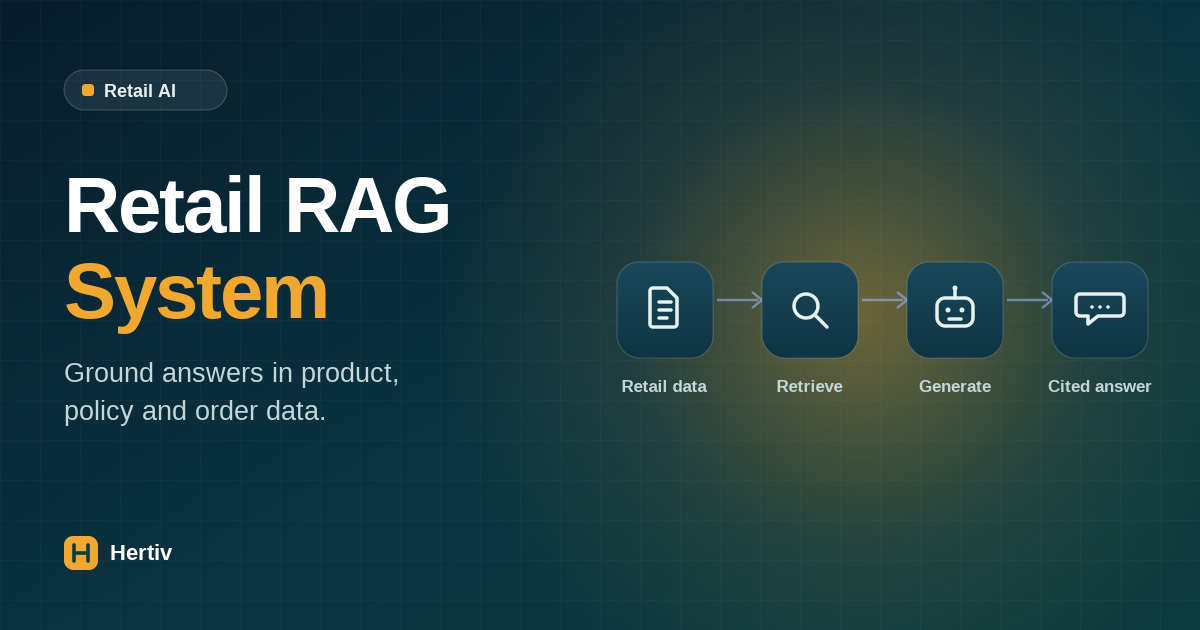
The pattern has three parts. First, a retriever finds the most relevant pieces of your data for the question. Second, those pieces are passed to the model as context. Third, the model writes an answer and, in a good implementation, cites the source it used.
This matters in retail because so much of the information changes weekly: prices, promotions, availability, delivery windows and policies. A model that answers from memory will eventually state something false. A model that answers from retrieved records can be corrected by fixing the record.
Typical first uses are product questions on the storefront, policy questions in support, and internal questions for staff in stores or contact centres. The build is similar in each case; only the data and the audience differ.
Which retail use cases should you start with?
Start with a use case where the answers are short, factual and checked against a source of truth. Those are the easiest to evaluate and the safest to expose. The table below compares common starting points.
| Use case | What it does | Typical data needed | Effort |
|---|---|---|---|
| Product Q&A | Answers size, material and compatibility questions | Product catalogue, attributes, images metadata | Medium |
| Policy answers | Explains returns, delivery and warranty rules | Policy documents, country-specific terms | Low |
| Order status | Answers where is my order questions | Order, shipment and carrier events | Medium |
| Store and stock lookup | Says whether an item is available nearby | Inventory by location, store list | Medium |
| Staff product help | Helps associates answer in-store questions | Catalogue, training material, FAQs | Low |
| Support agent assist | Drafts replies for contact-centre staff | Tickets, macros, knowledge base | Medium |
| Promotions explainer | Explains which offers apply to a basket | Campaign rules, eligibility data | High |
| Returns triage | Decides if an item is eligible and explains why | Order data, policy, product category rules | High |
The lowest-risk start is usually the internal one: staff product help or agent assist. Mistakes are caught by a person before a customer sees them, and you learn how the retrieval performs on your real catalogue.
Customer-facing product Q&A is the next step, because the blast radius of a wrong answer is small and the value is obvious. Order status and returns triage come later, because they need live order data and tighter security controls.
What data do you need, and how should you prepare it?
You need three kinds of data: stable documents, volatile records and permission data. Each is prepared differently, and mixing them up is the most common reason retail RAG projects disappoint.
- Stable documents: policies, size guides, care instructions and manuals. Chunk these by section, keep the heading with the text, and store the document title and version alongside each chunk.
- Volatile records: price, stock, delivery estimates and promotions. Do not copy these into a vector store as fixed text. Fetch them at query time from the source system, or refresh the index on a short schedule.
- Permission data: which customer or staff role may see which record. Store the access rule with each chunk and apply it during retrieval.
Chunking deserves attention. A product description split mid-sentence produces fragments the model cannot use. Split on structure: one chunk per product attribute group, one per policy clause. Keep chunks short enough to be specific and long enough to be understandable on their own.
Quality beats volume. A clean catalogue of a few thousand products with consistent attributes will outperform a messy feed ten times the size. Before indexing, run a simple audit: duplicated products, missing attributes, and outdated policy pages. Fixing those upstream often improves answer quality more than changing the model.
How should the architecture be built?
Build the system as a pipeline with clear stages, so each one can be tested on its own. A workable retail architecture looks like this:
- Ingestion: connectors pull catalogue, policy, order and inventory data from your commerce platform, PIM, ERP or helpdesk.
- Normalisation: map fields to a common schema and attach metadata such as locale, brand, category and access level.
- Indexing: embed document chunks for semantic search, and keep structured records in a database you can query directly.
- Routing: a first step decides whether the question needs documents, live records, both, or a handoff to a human.
- Retrieval: fetch candidate chunks, filter by permissions, and rerank them for relevance.
- Generation: pass the top results to the model with an instruction to answer only from the context and to cite sources.
- Guardrails: check the answer for grounding, block disallowed topics, and log the question, sources and response.
The routing step is what separates a retail RAG system from a generic document chatbot. If a customer asks about today's delivery date, the right move is a live call to the order system, not a semantic search over a policy PDF.
Keep the model behind an interface. Model choices change quickly, and you want to be able to swap one without rewriting the pipeline. Hertiv builds these systems as part of RAG development and generative AI integration work, where the retrieval and data layers are the main effort.
Example: a returns assistant for an online store
Example (hypothetical): an online clothing retailer wants to answer return questions in chat. The data set is a returns policy with 40 clauses, a product catalogue of 5,000 items with category and material attributes, and order records in the commerce platform.
The system routes each question. A question about the general return window retrieves the relevant policy clause. A question about a specific order retrieves the order record and the applicable policy, then answers with both. A question about a final-sale item checks the product category rules before answering.
The team builds a test set of 150 real customer questions, each with an expected answer and the correct source. Before launch, the system must answer at least 90 percent of them correctly, with zero answers that cite a clause that does not say what the answer claims. That second measure matters more than the first.
The first version is limited to customers with an order in the last 90 days and hands off to a human for anything about a damaged item. The scope is deliberately narrow. After four weeks of logged conversations, the team reviews the questions the system refused or got wrong and adds the missing data before widening the scope.
How do you evaluate and monitor answer quality?
Evaluate RAG on two levels: did retrieval find the right material, and did the model use it faithfully? Track them separately, because a wrong answer from good context is a prompt problem, while a right answer from bad context is luck.
Build a fixed evaluation set of real questions with expected answers and expected sources. Run it on every change to chunking, prompts or model. Measure three things:
- Retrieval hit rate: how often the correct source appears in the top results.
- Groundedness: how often every claim in the answer is supported by the retrieved context.
- Refusal quality: how well the system says it does not know, instead of guessing.
In production, log every question with its retrieved sources and the final answer. Review a sample weekly. Watch for questions the system refuses too often: they usually point to missing data, not a model limitation.
Set a policy for stale data. If the index has not refreshed since the last price change, the assistant should say so or defer, rather than answer from an old record.
What are the common mistakes in retail RAG?
Most failures come from data and scope, not from the language model. The list below covers what goes wrong most often.
- Indexing volatile data as static text. Price and stock copied into an index go stale within hours. Fetch them live or refresh aggressively.
- Skipping permissions. A staff assistant that can retrieve any order record is a data leak waiting to happen. Enforce access at retrieval.
- Chunking by character count. Splitting policy text mid-clause produces fragments that mislead the model.
- No evaluation set. Without fixed questions and expected answers, every change is a guess.
- One assistant for everything. A single assistant covering products, orders, HR and finance performs worse than several narrow ones.
- Ignoring locale and language. Retail catalogues and policies differ by country. Index each locale separately and route by language.
- No human handoff. Customers need a clear route to a person when the assistant is unsure.
How do you choose a build approach and sequence the work?
Decide the approach before choosing tools. The sequence below keeps risk low and produces evidence at each stage.
- Pick one use case and one audience. Internal staff help is the lowest-risk start; customer product Q&A is the highest-value next step.
- Audit the data for that use case. List the sources, their owners, how often they change, and who may see them.
- Build a thin end-to-end version. Ingestion, retrieval, generation and citation, on a small slice of the catalogue.
- Create the evaluation set from real questions before you tune anything. This is the step teams skip and later regret.
- Tune retrieval, then prompts, then model. In that order. Retrieval quality sets the ceiling.
- Add guardrails and logging, then run a limited pilot with a human in the loop.
- Widen scope only when the evaluation set holds. Add order data, more locales or new channels one at a time.
On buy versus build: managed RAG platforms speed up the first version but can constrain how you handle volatile data and permissions. A custom build costs more upfront and gives you control over routing, refresh and access rules, which is usually what retail needs. For related patterns, see AI for retail and e-commerce and AI agents for customer support.
Key takeaways
- Start with one narrow use case, usually product Q&A or policy questions, rather than a company-wide assistant.
- Retail RAG quality depends more on data freshness and chunking than on the choice of language model.
- Product, stock, price and order data are volatile, so the index must refresh on a schedule tied to the source system.
- Permissions must be enforced at retrieval time so staff and customers never see each other's data.
- Evaluate answers with a fixed question set and a test for grounding before you expose anything to customers.
Frequently asked questions
How long does a retail RAG implementation take?
A narrow internal pilot on one data source typically takes a few weeks. A customer-facing assistant with live order data, permissions and evaluation usually takes a few months, depending on how clean the catalogue and policy data are.
Do we need to fine-tune a model for retail RAG?
Usually not at first. Grounding in retrieved data solves most accuracy problems. Fine-tuning helps with tone, format or domain vocabulary, but it cannot fix stale or missing data, so fix retrieval first.
How do we keep prices and stock accurate in answers?
Do not store them as static text in the index. Query the commerce or inventory system at request time, or refresh the index on a short schedule, and have the assistant state when a figure was last confirmed.
Can a RAG assistant handle order-specific questions?
Yes, but it needs identity verification and access control. Retrieve order records only for the authenticated customer, and route anything involving refunds or disputes to a human or to a separate workflow with approval steps.
How do we measure whether the assistant is good enough to launch?
Use a fixed set of real questions with expected answers and expected sources. Track retrieval hit rate, groundedness and refusal quality, and set a threshold before launch. Review a sample of live conversations weekly after launch.
What is the biggest risk in retail RAG?
Data leakage through missing permissions, followed by confidently wrong answers from stale data. Both are preventable with retrieval-time access rules, live lookups for volatile records and a grounding check on every response.


