What Does a Payment Orchestration Platform Cost to Build?
A payment orchestration layer that routes payments across several providers costs roughly $40,000 to $150,000 to build. Here is what drives the price.
On this page
Short answer
A payment orchestration platform is software that routes each transaction to the best payment provider for that card, currency and country. A basic orchestration layer costs roughly $40,000 to $150,000 to build, while a full white-label gateway can reach $250,000 to $1 million or more.
What is a payment orchestration platform?
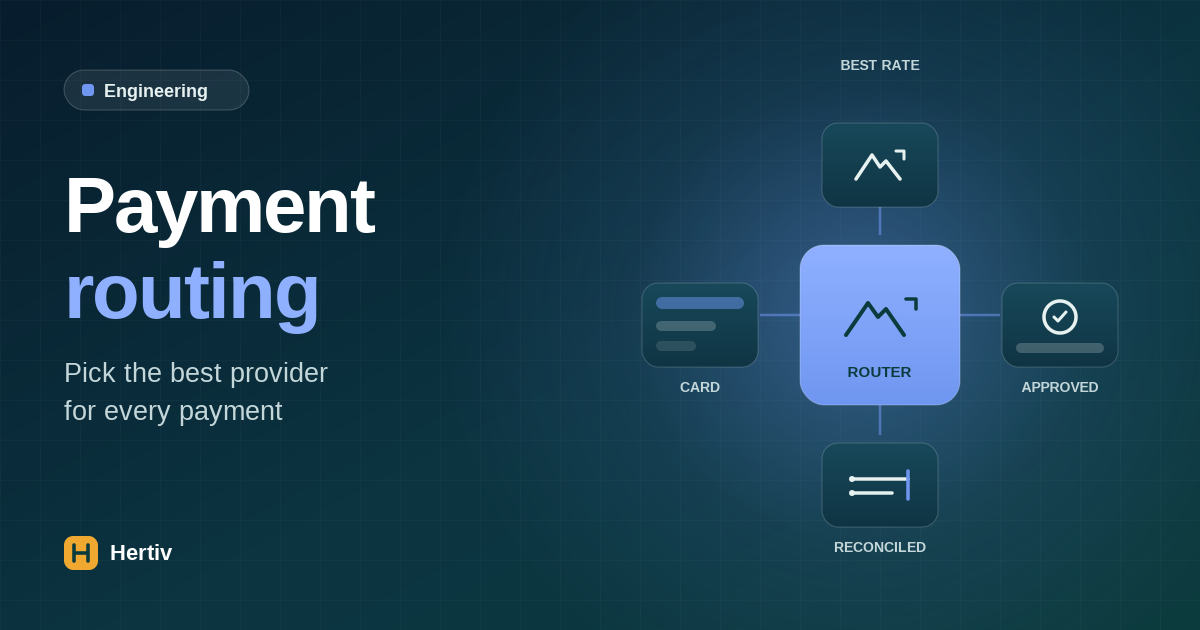
A payment orchestration platform is software that sits between a business and its payment providers and decides, for every transaction, which provider, method and route to use. Instead of connecting to one payment gateway and accepting whatever result it returns, the business routes each payment through the provider most likely to approve it at the lowest cost.
The platform is a layer above the providers. A checkout sends one request to the orchestration layer, which then talks to card acquirers, wallets, bank transfer rails and local payment methods. The business keeps one integration and one set of reports, while the platform handles the differences between providers behind the scenes.
Orchestration grew out of a simple problem: a single provider fails sometimes, declines some cards, and charges different fees in different countries. A business that depends on one provider loses sales when that provider has an outage or declines a good customer. An orchestration layer spreads that risk across several providers and picks the best route for each payment.
What does an orchestration platform do?
An orchestration platform does five jobs that a single gateway cannot do on its own. Smart routing sends each transaction to the provider with the best approval rate or lowest fee for that card, currency and country. Retries resend a declined payment through a second provider instead of showing the customer an error. Failover moves traffic away from a provider that is down or slow.
Tokenization stores card details once and reuses a token across providers, so the customer does not re-enter card details. Reconciliation matches every payment, refund and fee against the providers' reports.
| Job | What it does | Why it matters |
|---|---|---|
| Smart routing | Picks a provider per transaction | More approvals, lower fees |
| Retries | Resends declines to another provider | Recovers sales that would be lost |
| Failover | Shifts traffic when a provider is down | Checkout keeps working |
| Tokenization | One card token works across providers | Fewer abandoned checkouts |
| Reconciliation | Matches payments, refunds and fees | Finance closes the books on time |
| Reporting | One dashboard for all providers | Clear view of approval rates and costs |
Some platforms also add fraud screening, 3D Secure handling and support for subscriptions and payouts. Each extra job adds scope, and scope is the main driver of cost. A platform that only routes card payments is a far smaller build than one that also handles payouts, local methods in ten countries and merchant onboarding. For the crypto side of payments, see crypto payment gateway development.
What does it cost to build a payment orchestration platform?
The cost of building a payment orchestration platform depends on how much of the payment stack you own. Published 2026 agency guides put a basic orchestration layer, routing across several processors with retries and reconciliation, at roughly $40,000 to $150,000 over two to five months. A white-label gateway or payment facilitator build, with full PCI DSS Level 1 scope, reaches $250,000 to $1 million and up over eight to 18 months.
These are planning ranges from published guides, not quotes, and they move with the number of providers and the compliance scope.
| Scope | What it covers | Indicative cost | Typical timeline |
|---|---|---|---|
| Orchestration layer | Routing, retries, failover, reporting | $40,000-$150,000 | 2-5 months |
| Orchestration plus payouts | Layer plus merchant payouts and refunds | $150,000-$400,000 | 5-9 months |
| White-label gateway | Own gateway, PCI DSS Level 1 | $250,000-$1,000,000+ | 8-18 months |
| Enterprise platform | Multi-region, many methods, full compliance | $500,000+ | 12-24 months |
The running costs matter as much as the build. A full platform needs engineers to maintain provider integrations, compliance audits, infrastructure and security updates. Published 2026 guides put annual operating costs for a built platform at $1.5 million to $3 million for a serious operation, which is why most businesses buy a ready-made orchestration service instead of building one. Building only pays when payment routing is core to the product, not just a checkout feature.
What drives the cost up or down?
Four factors drive the cost of a payment orchestration build more than anything else. The number of providers is first: each provider integration takes two to four weeks of specialist work, so supporting 20 providers can mean 40 to 80 weeks of integration effort. The second is payment methods: cards are the baseline, while wallets, bank transfers and local methods in each country each add work and testing.
Compliance scope is third. If the platform touches raw card data, it falls under PCI DSS Level 1, which published guides cost at $200,000 to $500,000 a year for certification alone. Using a tokenization provider and keeping card data out of your own systems shrinks that scope a lot. The fourth factor is geography: every new country adds local methods, settlement rules and tax treatment.
Team location and seniority move the price too, but less than scope does. A smaller scope with a good team beats a large scope with a cheap team, because payment bugs cost real money: a routing error can send transactions to the wrong provider or double-charge a customer. Budget for testing against each provider's sandbox and for a staged rollout where the new layer handles a small share of traffic first.
How do you build a payment orchestration platform?
Building a payment orchestration platform follows a clear sequence, and skipping a step usually shows up later as an outage or a compliance finding.
- Define the routing rules. Decide what "best provider" means for your business: highest approval rate, lowest fee, fastest settlement, or a mix. Write the rules down before any code.
- Pick the first providers. Start with two or three providers that cover most of your volume, not ten at once. Each provider needs a sandbox, test cards and a contract.
- Build the core layer. One API for the checkout, a routing engine, token storage, retry and failover logic, and a ledger that records every transaction state.
- Add reconciliation and reporting. Match every payment, refund and fee to provider reports daily, and give finance a dashboard that shows approval rates by provider, method and country.
- Handle security and compliance. Tokenize card data, encrypt data at rest and in transit, log access, and complete the PCI DSS assessment for your scope.
- Test with real traffic, slowly. Route a small share of live payments through the layer, compare approval rates with the old setup, then raise the share in steps.
- Operate it. Assign an on-call rota, monitor provider latency and approval rates, and review routing rules monthly as fees and performance change.
Most teams underestimate the operating phase. Provider APIs change, certificates expire and acquirers change their rules, so the platform needs a team that watches it every week, not just at launch. If that ongoing team does not exist, buying a hosted orchestration service is usually the better choice.
Example: a marketplace builds an orchestration layer
Example (hypothetical): a marketplace with $2 million in monthly card volume wants to stop losing sales to declines and to a single provider's outages. It decides to build an orchestration layer for six providers instead of a full gateway.
The budget is built from parts. Six provider integrations at $8,000 each come to $48,000. The routing engine and retry logic cost $30,000 to build. Reconciliation and reporting cost $15,000. Tokenization and the PCI DSS assessment for the reduced scope cost $20,000. The parts add up to $113,000. A 20% contingency of $22,600 brings the planned budget to $135,600.
After launch, the marketplace routes 10% of traffic through the new layer for two weeks and compares approval rates with the old single-provider setup. Approval rates rise by 3 points on the routed traffic, which on $200,000 of monthly volume means about $6,000 more in approved sales each month. The team then raises the routed share in steps until all traffic uses the layer, and it reviews the routing rules every month.
What are the common mistakes?
The most common mistakes in payment orchestration builds are underestimating provider work, ignoring reconciliation, and treating compliance as a launch-week task.
- Counting integrations as quick jobs. Each provider has its own error codes, webhook formats and settlement timing. Budget two to four weeks per provider, including sandbox testing.
- Skipping reconciliation. Without daily matching of payments, refunds and fees, small differences grow into finance problems that take weeks to untangle.
- Leaving PCI DSS to the end. Compliance scope shapes the architecture. Decide early whether card data touches your systems, because changing that decision later is expensive.
- Routing on fee alone. The cheapest provider is not the best if it declines more cards. Route on approval rate first, then fee.
- No failover testing. A failover path that has never been tested will fail when it is needed. Simulate provider outages before launch.
- Building when buying fits. If routing is not core to the product, a hosted orchestration service delivers the same result in weeks for a fraction of the build cost.
Key takeaways
- An orchestration layer routes each payment to the best provider instead of relying on one gateway
- Smart routing, retries, failover, tokenization and reconciliation are the five core jobs
- A basic layer costs roughly $40,000 to $150,000; a full gateway build can pass $1 million
- Provider count, payment methods, PCI DSS scope and geography drive the price most
- Daily reconciliation and tested failover matter as much as the routing logic
- Buying a hosted service beats building when routing is not core to the product
Frequently asked questions
What is payment orchestration?
Payment orchestration is the practice of routing each transaction through the best payment provider for that card, currency and country, using one layer above several providers. It adds retries, failover and unified reporting on top of the providers.
How much does a basic orchestration layer cost?
Published 2026 agency guides put a basic orchestration layer at roughly $40,000 to $150,000 over two to five months. That covers routing, retries, failover and reconciliation across a small set of providers.
Why do businesses use more than one payment provider?
One provider can decline cards another would approve, charge more in some countries, or go down entirely. Spreading payments across providers raises approval rates, cuts fees and keeps checkout working during an outage.
What is PCI DSS Level 1 and why does it matter?
PCI DSS Level 1 is the strictest tier of the payment card security standard and applies when a platform handles large volumes of card data. Published guides cost certification at $200,000 to $500,000 a year, so many teams keep card data out of their own systems.
Should a startup build or buy payment orchestration?
Most startups should buy a hosted orchestration service, which delivers routing and retries in weeks. Building only pays when payment routing is core to the product and the team can run the platform every week.
How do you test an orchestration layer before launch?
Test each provider in its sandbox, then route a small share of live traffic through the layer and compare approval rates with the old setup. Raise the share in steps only after the numbers hold up.


