Why Outsource During a Recession? The Honest Case
Outsourcing in a recession keeps software shipping at a variable cost you can scale, but only if you outsource the right work and keep an internal owner.
On this page
Short answer
Outsourcing during a recession means hiring an outside team to build or run software while your budget is under pressure, instead of hiring full-time staff or pausing the work. It trades fixed payroll costs for a variable vendor fee, and it works when the outsourced work is well-defined and measured.
What does outsourcing during a recession mean?
Outsourcing during a recession means hiring an outside team to build or run software while your own budget is under pressure, instead of hiring full-time staff or pausing the work entirely.
The logic is simple: a recession cuts revenue and freezes hiring, but the work does not disappear. Customers still need support, products still need updates, and competitors still ship. Outsourcing lets a company keep that work moving with a variable cost it can scale up or down. For the general picture, see how to outsource software development.
It is not a magic saving. Outsourcing trades one set of costs for another: lower payroll for vendor fees, management time and communication overhead. Whether it helps depends on what you outsource and how you run it.
Why downturns push companies to outsource
Downturns push companies to outsource because fixed costs become the problem. Salaries, offices and benefits continue whether revenue grows or not, while a vendor contract can be sized to the work actually needed.
Three pressures drive the decision:
- Hiring freezes. Roles stay open for months, so teams outsource the work that cannot wait.
- Cost scrutiny. Every budget line is questioned, and a vendor's monthly fee is easier to compare than a fully loaded salary.
- Speed. A vendor with a ready team can start in weeks, while hiring and onboarding takes months.
There is also a defensive reason. Companies that keep shipping during a downturn often come out stronger, because they hold customers and market share while competitors pause. Outsourcing is one way to keep shipping without adding headcount.
A downturn also changes the hiring market. Good engineers who would not have considered contract work in a boom may take vendor roles when permanent jobs are scarce, so the quality of available vendor teams can rise. That is an opportunity, but it cuts both ways: the same engineers may leave for permanent roles as soon as the market recovers, so plan for turnover in any long engagement.
What to outsource first during a recession
Outsource the work that is well-defined, measurable and not your core advantage first. Keep the decisions that define your product in house.
| Work type | Outsource first? | Why |
|---|---|---|
| Maintenance and bug fixes | Yes | Clear scope, easy to measure |
| Support and QA testing | Yes | Volume-based, can scale down |
| Defined feature builds | Yes, with care | Needs a clear spec and owner |
| Product strategy | No | Decides what the product becomes |
| Core algorithms | No | Your main advantage |
| Customer relationships | No | Trust is hard to hand over |
Start with one team and one workstream. A small engagement that works teaches you how to manage a vendor; a large one that fails is expensive to unwind.
Example: a mid-size SaaS company cuts costs without stopping work
Example (hypothetical): a 60-person SaaS company loses a major customer and must cut $20,000 a month from its budget. It keeps its 8-person core product team and outsources maintenance and QA to a vendor team of 3 people at $12,000 a month.
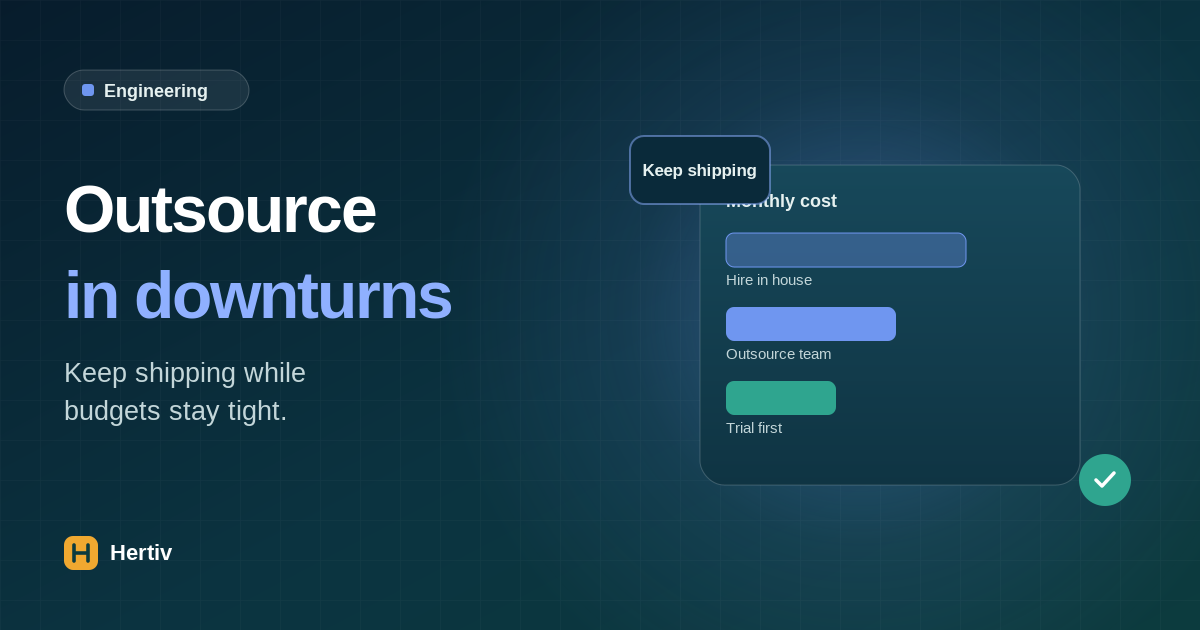
The arithmetic: the company had planned to hire 2 engineers at $8,000 a month each, or $16,000 a month plus hiring costs. The vendor team costs $12,000 a month, so the company saves $4,000 a month against the hiring plan and avoids roughly $10,000 in one-off hiring costs. It also keeps shipping, because the vendor starts in 3 weeks instead of the 10 weeks hiring would take.
The saving is real but narrow. The company still pays its core team, still manages the vendor, and still owns the product decisions. Outsourcing bought time and flexibility, not a free lunch.
The risks of outsourcing in a downturn
Outsourcing in a downturn carries risks that are easy to miss when cost pressure dominates the decision.
- Knowledge loss. If the vendor leaves, the knowledge of how your systems work leaves with them. Keep documentation and an internal owner for every outsourced area.
- Quality drift. A vendor under price pressure may cut corners. Define acceptance criteria and check them every sprint.
- Communication overhead. Managing a vendor takes real time. Budget for it, or the saving disappears into meetings.
- Morale. Staff who see work leaving may worry about their own roles. Be honest about why the decision was made.
- Vendor failure. Vendors also suffer in recessions. Check the vendor's financial health and keep an exit plan.
Mitigate these by starting small, keeping an internal owner for each workstream, and writing the exit terms into the contract before you need them. Dedicated development teams are one model that keeps continuity when the work is long-term.
One more risk is easy to overlook: scope creep from your own side. When internal teams are stretched, they tend to push extra work to the vendor without adjusting the budget or the timeline. That strains the relationship and the quality. Keep a written scope for each sprint and a simple change process, so extra work is agreed and priced instead of silently absorbed.
How to outsource during a recession in 5 steps
Outsource in a recession with a plan that protects quality and keeps an exit open, not with a rushed cost-cutting move.
- List what must keep shipping. Rank work by revenue impact and decide what cannot pause.
- Cost the in-house option honestly. Include hiring time, onboarding and management, not just salary.
- Shortlist vendors on evidence. Ask for references from similar-sized companies and check them.
- Run a 4-week trial. One workstream, clear acceptance criteria, and a review at the end.
- Scale or stop based on the trial. Expand only if quality and communication held up under real work.
Review the arrangement monthly while the downturn lasts. Costs, priorities and vendor performance all change fast in a recession, and a contract that made sense in January may not fit in June.
Common mistakes when outsourcing during a recession
The most common mistakes are choosing the cheapest vendor, outsourcing the wrong work, and cutting management along with the budget.
- Picking on price alone. The cheapest vendor usually costs more once rework and delays are counted.
- Outsourcing the core product. If the vendor builds your main advantage, you lose control of it.
- No internal owner. Every outsourced workstream needs someone inside who owns the result.
- Cutting communication. Fewer meetings feel like a saving until quality drops and nobody notices.
- No exit plan. Contracts end, vendors fail, and priorities change. Plan the handover before signing.
Key takeaways
- A recession freezes hiring but the work continues, which is why outsourcing rises in downturns
- Outsource maintenance, QA and defined builds first; keep product strategy and core technology in house
- A vendor team can start in weeks, but management time and communication are real costs
- Knowledge loss, quality drift and vendor failure are the risks to manage
- Run a 4-week trial with clear acceptance criteria before scaling
Frequently asked questions
Is outsourcing cheaper than hiring?
Usually in the short term, because you avoid hiring costs and pay only for the work you need. Over a long period the gap narrows, since vendor fees, management time and communication add up. Compare the full cost of both options, not just the monthly rate.
What should I never outsource?
Keep product strategy, core technology that gives you an advantage, and direct customer relationships in house. These decide what your product becomes and how customers trust you, and they are hard to hand back once outsourced.
How do I pick a vendor during a recession?
Shortlist on evidence: references from similar companies, code quality, communication and financial health. Run a small paid trial with clear acceptance criteria before signing a larger contract.
What if the vendor fails during the recession?
Vendors can fail too. Keep documentation and an internal owner for every outsourced area, write exit terms into the contract, and keep a second vendor or an in-house fallback in mind for critical work.
How long should an outsourcing contract run?
Short contracts with renewal options suit a recession, because priorities change fast. A 3 to 6 month term with a trial period gives flexibility, while a long lock-in can trap you if the vendor underperforms.
Does outsourcing hurt team morale?
It can, if staff learn about it second hand. Be honest about why the decision was made, which work stays in house, and how the vendor helps the team keep shipping rather than replacing it.


