How Startups Outsource Development: Tools and Steps
Startups outsource development to move fast without hiring a full team. Here are the tools and steps that keep the work on track.
On this page
Short answer
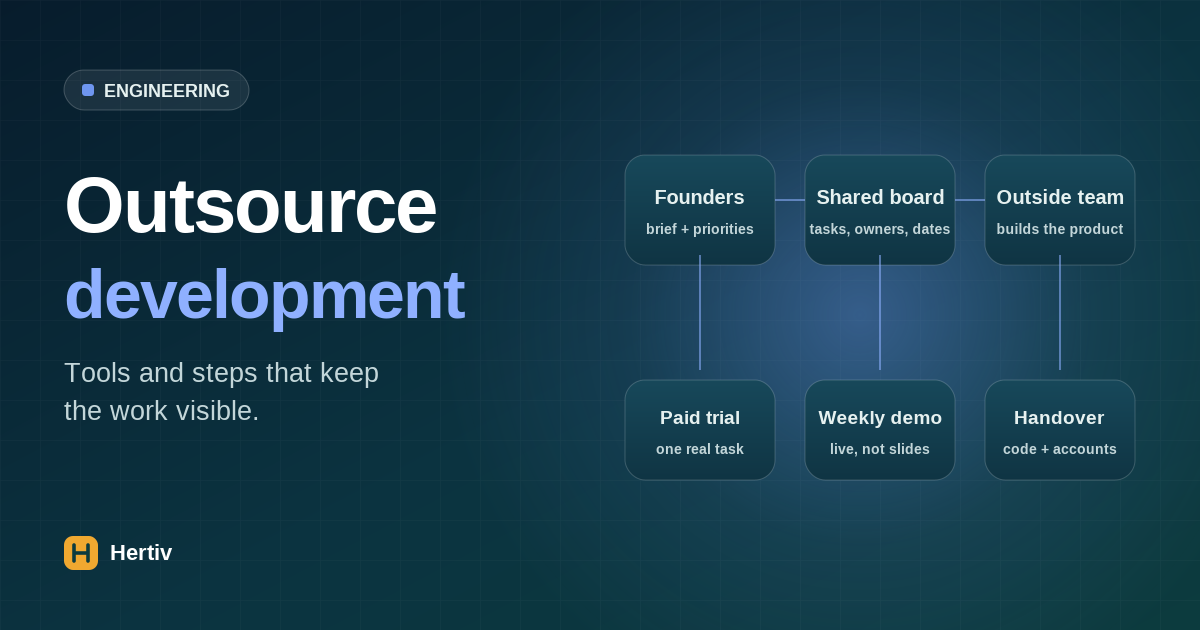
Startups outsource development by hiring an outside team or freelancers to build their product, while the founders keep control of the idea, the priorities and the quality checks. The tools that matter most are the ones that keep the work visible: a shared task board, a code repository, a chat channel and a weekly demo.
What does it mean to outsource development as a startup?
Outsourcing development as a startup means hiring an outside team or freelancers to build your product, while the founders keep control of the idea, the priorities and the quality checks. You are buying build capacity, not giving away the product.
Startups usually outsource for one of three reasons: speed, skills or cost. Speed matters when a launch window is fixed. Skills matter when the product needs experience the founders do not have, such as payments or mobile apps. Cost matters when hiring a full team would burn the budget before the product earns anything.
The model only works if the work stays visible. A shared task board, a code repository the founders can open, and a weekly demo are the minimum. Without them, the founders find out too late that the product drifted from the plan, and fixing it costs more than building it slowly.
Which tools do startups use to manage outsourced development?
Startups manage outsourced development with a small set of tools: one place for tasks, one place for code, one place for conversation, and one place for decisions. Four tools, used every day, beat ten tools used once a month.
| Job | Tool type | What good looks like |
|---|---|---|
| Tasks | Shared task board | Every task has an owner, a size and a due date |
| Code | Version control repository | Founders can see every change and who made it |
| Talk | Chat channel plus one weekly call | Questions answered the same day, not next week |
| Decisions | Short written record | Every choice has a date and a reason |
| Quality | Test checklist and demo | A live demo every week, not a slide deck |
The task board is the most important of the five. If a task is not on the board, it does not exist, and if the board is out of date, the founders cannot tell whether the launch date is real. Ask to see the board before you sign, and check it yourself every week.
The code repository matters just as much. The startup should own the repository from day one, with its own account, so the work is never held hostage by a vendor. Every change should arrive as a small, reviewed update, not as one huge delivery at the end.
How should a startup outsource development, step by step?
A startup should outsource development in small, checked steps: a clear brief, a paid trial, a weekly rhythm, and a handover plan. Each step reduces the risk of the next one.
- Write a one-page brief. State the problem, the user, the first version's features and the launch date.
- Shortlist two or three teams. Ask for similar past work, references and a sample of their code.
- Run a paid trial. Give the best team one small, real task and pay for it, so you see how they work.
- Agree the rhythm. A weekly demo, a daily written update and a shared board, in writing.
- Start small. Build the first version in slices, and check each slice before the next begins.
- Plan the handover. Decide who owns the code, the accounts and the documentation from day one.
The paid trial is the step most founders skip, and the one that saves the most money. A one-week trial shows how the team communicates, how it handles feedback and how clean its code is, which no sales call can show. If a team refuses a paid trial, that is useful information too.
Keep the first version small on purpose. A startup that asks for everything at once gets a long estimate, a late delivery and a product nobody tested. A small first version that real users try will teach you more than a large one that ships late.
How do you pick the right outsourcing partner?
You pick the right outsourcing partner by checking three things: similar past work, clear communication, and a process you can see. Price comes after those three, not before them.
Similar past work is the strongest signal. A team that has built a booking app will build yours faster and with fewer mistakes than a team that has only built marketing sites, even if the second team is cheaper. Ask to see the actual product, not just a logo on a slide.
Communication is the second signal, and you can test it in the first week. Do they answer questions the same day? Do they say when they do not know something? Do they push back when a request is unclear? A team that nods at everything is a team that will build the wrong thing politely.
Finally, check the process. Ask how they handle changes, how they test, and what happens if a key developer leaves. A team with a written answer to those questions is a team that has survived them before, which is exactly what a startup needs.
What does outsourcing cost a startup?
Outsourcing costs a startup the team's time plus the cost of managing them, which founders often forget to count. The management time is real: writing briefs, reviewing demos, answering questions and checking quality takes several hours a week.
The price depends on the team's location, the size of the first version and how much design and testing is included. A small first version with a few screens costs far less than a marketplace with payments, accounts and an admin panel. The cheapest quote is rarely the cheapest outcome, because rework after a bad build costs more than a careful build.
Budget for the handover as well. Documentation, account transfers and a short period where the team answers questions after launch are part of the job, and they should be in the contract. A team that disappears on launch day leaves the startup with code nobody understands.
For a fuller picture of the whole process, read how to outsource software development, which covers the same steps for larger teams and longer projects.
Example (hypothetical): a startup's first outsourced build
Example (hypothetical): a two-founder startup wants a booking app for local clinics. The founders write a one-page brief, shortlist three teams, and pay the best one for a one-week trial: a booking screen and a confirmation email.
The trial goes well, so they agree on a first version of 8 screens, a booking flow and a simple admin panel, at 320 hours of work. At $60 an hour, that is $19,200 for the build, plus $1,000 for design tools and testing accounts, for a total of $20,200. They add a 10% reserve of $2,020, bringing the budget to $22,220.
The team demos every Friday, and the founders test each slice on a real phone. In week three, the demo shows the booking flow takes four taps too many, so the founders cut one screen and the team rebuilds it the same week. The app launches two weeks later, and the founders own the repository, the accounts and the documentation.
What are the common mistakes?
The most common mistakes in outsourcing development are a vague brief, no trial, and no weekly demo. Each one turns a manageable project into a surprise at the end.
- A vague brief. If the brief does not say who the user is and what the first version must do, the team will guess.
- Skipping the paid trial. A trial is the cheapest way to learn how a team really works.
- No weekly demo. Without a demo, problems hide until launch week, when they are expensive.
- Choosing on price alone. The cheapest team often costs the most once rework is counted.
- No handover plan. Code, accounts and documentation must belong to the startup from day one.
Key takeaways
- Outsourcing buys build capacity, not the product; founders keep the idea, priorities and quality checks
- Four tools carry the work: a task board, a code repository, a chat channel and a weekly demo
- A paid trial is the cheapest way to learn how a team really works
- Pick a partner on similar past work, communication and process, not on price alone
- Own the code, accounts and documentation from day one, and plan the handover before launch
Frequently asked questions
Is outsourcing development good for startups?
Yes, when the work stays visible. Outsourcing gives a startup build capacity without hiring a full team, but the founders must keep control of the brief, the priorities and the weekly demo, or the product will drift from the plan.
How much does it cost to outsource development?
It depends on the team's location and the size of the first version. A small first version with a few screens costs far less than a marketplace with payments and an admin panel. Budget for management time and a handover as well as the build.
Should a startup outsource its first product?
Many do, and it can work well if the founders stay involved. Write a short brief, run a paid trial with one team, and check a live demo every week. The risk is not outsourcing itself, it is losing sight of the work.
How do I find a good outsourcing team?
Look for similar past work you can open and try, references you can call, and a written process for changes, testing and handover. A short paid trial tells you more than a sales call or a low quote.
What tools do I need to manage an outsourced team?
Four are enough: a shared task board, a code repository you own, a chat channel, and a weekly demo. Add a short written record of decisions so nothing important lives only in a call.
Who owns the code when development is outsourced?
The startup should own it from day one. The repository, the accounts and the documentation should be in the startup's name, and the contract should say so clearly before any work starts.


