Supabase Alternatives: Open Source Backends Compared
A practical comparison of open source Supabase alternatives for teams that need self-hosting, SQL, auth and realtime. Covers Appwrite, PocketBase, Nhost, Directus and more.
On this page
Short answer
Open source Supabase alternatives include Appwrite, PocketBase, Nhost, Directus and Parse Platform. Each trades some of Supabase's Postgres-first design for different strengths, such as simpler self-hosting, broader built-in services or a headless CMS model, so the right pick depends on your database, auth and deployment constraints.
What are the main open source Supabase alternatives?
Supabase is an open source backend platform built around Postgres, with auth, storage, realtime and edge functions. The alternatives below solve overlapping problems but differ in database, hosting model and scope.
| Alternative | What it does | Database | Best for |
|---|---|---|---|
| Appwrite | Backend-as-a-service with auth, storage, functions, database | Its own document model | Teams wanting one self-hosted platform |
| PocketBase | Single-binary backend with SQLite, auth, realtime | SQLite | Small apps and prototypes |
| Nhost | Postgres backend with GraphQL, auth, storage, functions | Postgres | Teams that want SQL and GraphQL |
| Directus | Headless CMS and data platform over SQL | Postgres, MySQL, SQLite | Content-heavy apps |
| Parse Platform | Object and user backend with SDKs | MongoDB or Postgres | Mobile-first apps |
| Kuzzle | Backend with realtime and search | Elasticsearch-based | Realtime and search-heavy apps |
| Strapi | Headless CMS with auth plugins | SQL databases | Editorial teams |
| Hasura | GraphQL layer over Postgres | Postgres | GraphQL APIs on existing databases |
Each entry below describes where it fits and where it costs you effort. Compare them against your existing schema and deployment model before committing, not against feature checklists.
Appwrite, PocketBase and Nhost compared
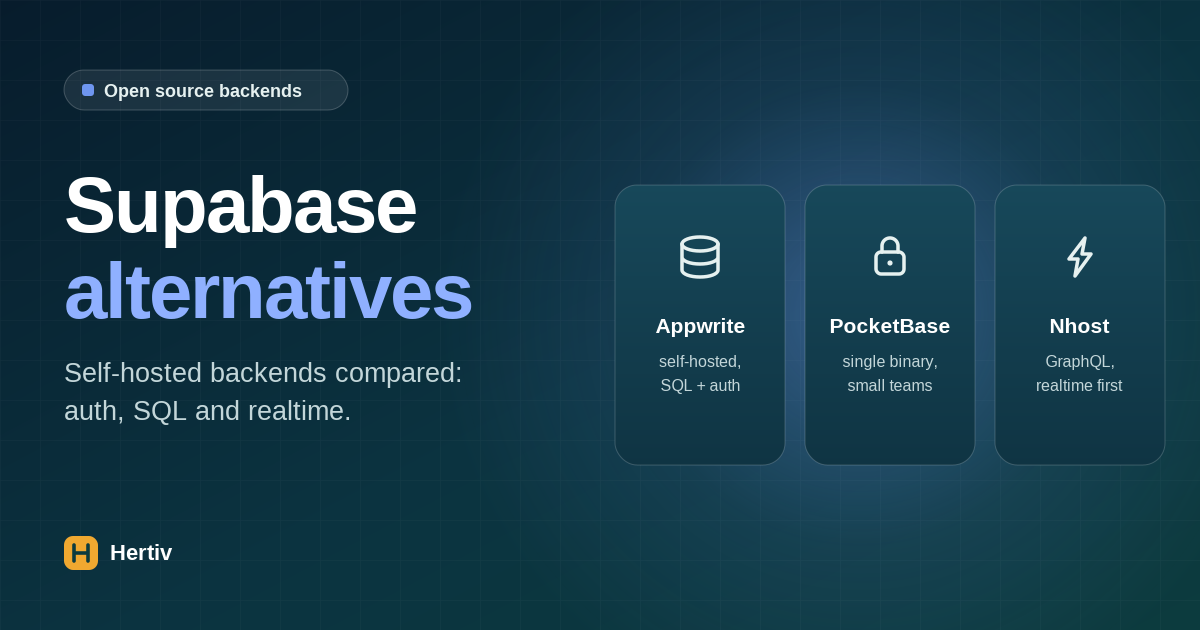
These three cover the most common reasons teams leave Supabase: simpler hosting, lighter footprint or a different query model. Appwrite packages auth, storage, functions and a database into one self-hostable platform. It suits teams that want a single vendor surface and are comfortable with its own query and permission model rather than raw SQL. Pros: broad built-in features, active community, Docker-based deployment. Cons: not Postgres-native, so SQL reporting and existing Postgres extensions need separate handling.
PocketBase ships as a single binary with SQLite, auth, file storage and realtime subscriptions. It is the fastest way to stand up a small backend on one server. Pros: trivial to deploy and back up, small resource footprint. Cons: SQLite limits write concurrency, and horizontal scaling is not its design goal.
Nhost keeps Postgres and adds GraphQL, auth, storage and serverless functions. It is the closest architectural match to Supabase. Pros: plain Postgres, GraphQL API, migrations in SQL. Cons: smaller ecosystem, and you still own the operational work when self-hosting. For teams weighing a Postgres-first path, Hertiv's custom software development team can help scope the migration.
Directus, Parse and Kuzzle: different shapes
Not every alternative is a drop-in backend-as-a-service. Directus puts a headless CMS and admin interface over an existing SQL database. It is strong when editors and operations staff need to manage content or master data, and you want the database to stay yours. Pros: works with Postgres, MySQL and SQLite, granular role permissions, clear admin UI. Cons: auth and realtime are thinner than in Supabase, so mobile and realtime apps need additional services.
Parse Platform provides object storage, users and SDKs, historically popular for mobile apps. Pros: mature SDKs, flexible schemas. Cons: the community has shifted toward other tools, and running it on MongoDB adds a second database to operate.
Kuzzle combines realtime subscriptions with search over an Elasticsearch-based engine. Pros: strong realtime and full-text search. Cons: a narrower ecosystem and a steeper operational learning curve.
How do these compare on self-hosting and lock-in?
Self-hosting is the main reason teams search for open source alternatives, but the effort varies widely. PocketBase is a single binary. Appwrite and Nhost ship Docker Compose setups with several services. Directus runs as a Node service plus your database. Hasura is a GraphQL engine in front of Postgres. Parse and Kuzzle require their own backing stores.
Lock-in has two dimensions: data and code. Data lock-in is lowest when the store is plain Postgres, which favours Nhost, Hasura and Directus. Code lock-in is lowest when the API is standard SQL or GraphQL rather than a vendor SDK. Supabase's client libraries are convenient but couple app code to its API surface; the same is true of Appwrite and Parse SDKs.
How to choose a Supabase alternative
Start from your database and your team's operational capacity, then narrow the list. A short, ordered process avoids comparing tools on features you will never use.
- Write down the non-negotiables: database engine, SQL access, realtime needs, file storage, auth providers and where it must run (cloud, VPC, on-premises).
- Match the database first. If you need Postgres extensions or existing SQL reporting, keep Nhost, Hasura or Directus on the list and drop document-oriented options.
- Estimate operational load. Count the services each option needs and decide whether your team can own upgrades, backups and security patching.
- Prototype the hardest flow. Build the auth and permission path, not the happy-path CRUD, because that is where platforms differ most.
- Check the exit. Confirm you can export data and replace the client SDK without rewriting the app.
If the decision is part of a wider platform rebuild, a structured AI consulting or engineering review can keep the backend choice aligned with the product roadmap.
When should you stay on Supabase?
Staying on Supabase is often the right call when Postgres, SQL and a managed operational model already fit. Switching platforms costs engineering time, and the savings are usually operational rather than feature-based.
Stay when you rely on Postgres-specific features such as row-level security, extensions or plain SQL analytics. Stay when the managed service removes work your team cannot absorb. Stay when your app code is deeply tied to Supabase client libraries and the migration would touch most screens.
Example: a team with a 40-table Postgres schema and 12,000 auth users estimates three engineer-weeks for a migration and a two-week parallel-run period. That is hypothetical, but it shows the shape of the cost: schema work is usually the smaller part, and auth and app code dominate.
Consider an alternative when self-hosting is a hard requirement, when licensing or data residency rules rule out the managed option, or when you need a different database model. For teams moving backend work in-house, our engineering services cover architecture and delivery.
Common mistakes when switching backends
Most failed migrations come from underestimating auth, permissions and operations rather than from the database itself. These are the recurring ones.
- Choosing on feature lists instead of the two or three flows your product depends on.
- Forgetting that row-level security and permission models do not translate one-to-one between platforms.
- Migrating users without a tested password-reset or re-invite path.
- Assuming self-hosting means lower cost without counting on-call, patching and backups.
- Ignoring realtime semantics: delivery guarantees and reconnection behaviour differ.
- Letting client SDK calls spread through the codebase before an abstraction layer exists.
- Skipping a parallel-run period, which turns a reversible migration into a cutover.
Key takeaways
- Supabase is Postgres-first; most alternatives are either document-oriented or wrap a different database, which affects migrations and SQL tooling.
- Appwrite bundles auth, storage, functions and databases but uses its own query model rather than plain SQL.
- PocketBase is a single binary with SQLite, ideal for small self-hosted apps but not for horizontal scale.
- Nhost keeps Postgres and GraphQL, making it the closest architectural match to Supabase.
- Directus is a headless CMS and data platform, not a full backend-as-a-service, so auth and realtime need extra work.
- Self-hosting any of these moves backup, upgrades and security patching onto your team.
Frequently asked questions
Is Supabase itself open source?
Yes, the core Supabase components are open source and can be self-hosted. The managed cloud service is a commercial offering with additional tooling and support. Many teams use the open source parts under the managed platform rather than hosting everything themselves.
Which Supabase alternative is closest to it architecturally?
Nhost is the closest, because it also keeps Postgres as the primary database and adds auth, storage and functions. Hasura is close on the API layer if you mainly need GraphQL over Postgres. Appwrite and PocketBase differ more in database model and query approach.
Can I self-host Appwrite easily?
Appwrite provides Docker-based self-hosting, and many teams run it on a single server. The effort is moderate: you manage several containers, storage and upgrades. Compare that operational load with your team's capacity before committing, especially for production workloads.
Is PocketBase suitable for production apps?
PocketBase works well for small production apps with modest write volume, internal tools and prototypes. SQLite limits concurrent writes, so high-traffic or write-heavy systems should look at Postgres-based options. Backups are simple, which helps small teams.
How hard is it to migrate auth users between platforms?
Auth migration is usually the hardest part. Password hashes, session tokens and identity provider links differ between platforms, so you often need a password reset flow or a staged cutover. Plan for this before migrating tables, and test the full login journey.
Do open source backends reduce costs?
They can reduce licence and managed-service fees, but they add operational cost: servers, monitoring, patching, backups and on-call time. For small teams, the managed option is often cheaper overall. Compare total cost over a realistic horizon, not just subscription fees.


