Open Source API Management Tools: What to Compare
Open source API management tools route, secure and observe your APIs without a licence fee. Compare six tools and learn how to evaluate one on your own traffic.
On this page
Short answer
Open source API management tools are freely licensed gateways and platforms that sit between clients and your services, handling routing, authentication, rate limiting, logging and documentation. Kong, Tyk, Gravitee, Apache APISIX, WSO2 and KrakenD cover most needs; the right one depends on your stack, traffic and who will run it.
What are open source API management tools?
Open source API management tools are freely licensed software that sits between clients and your services, handling routing, authentication, rate limiting, logging and documentation for your APIs. They give you the control plane for an API programme without a proprietary licence.
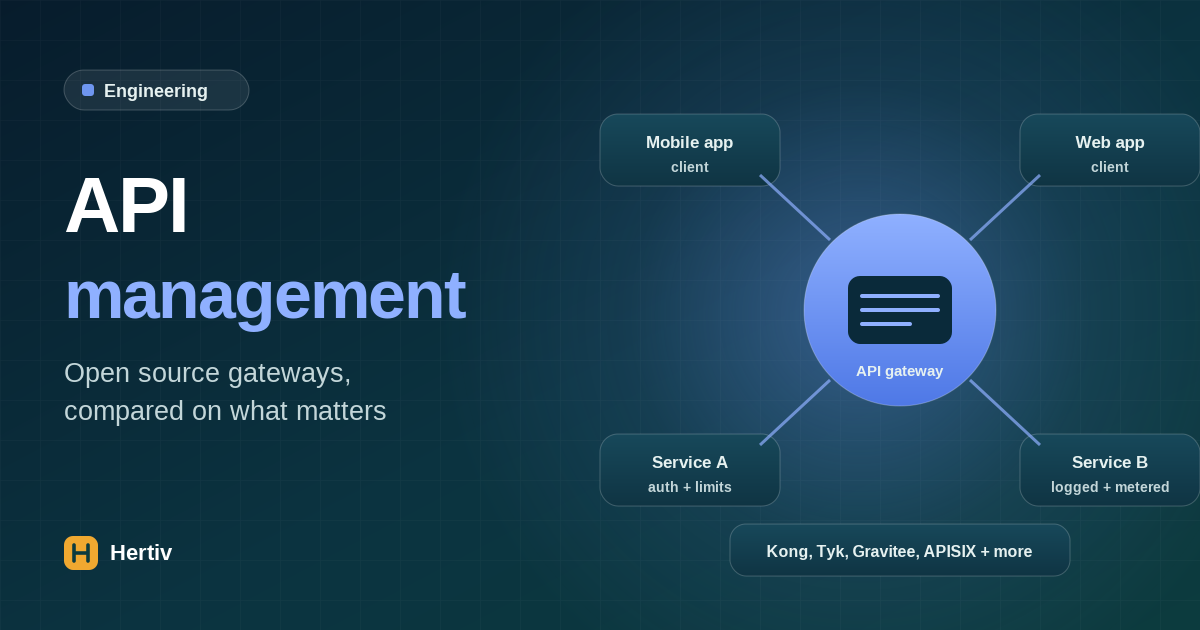
Instead of each service handling auth, quotas and logging on its own, the gateway handles those concerns once, in one place. Your services stay focused on business logic, and the gateway enforces the rules for every request that passes through.
Open source matters here because the gateway sits on a critical path. You can inspect the code, self-host it, change it and move it between clouds, which is hard to do with a closed appliance.
What does API management cover?
API management covers everything between a client calling an API and the service answering. The table below lists the parts a team usually needs, and which of them a gateway handles directly.
| Capability | What it does | Handled by |
|---|---|---|
| Routing | Sends each request to the right service | Gateway |
| Authentication | Checks API keys, tokens or certificates | Gateway |
| Rate limiting | Caps how many requests a client can make | Gateway |
| Request shaping | Validates, transforms and caches requests | Gateway or plugin |
| Logging and metrics | Records calls, errors and latency | Gateway plus observability tools |
| Developer portal | Documents APIs and issues keys | Portal or gateway plugin |
| Monetisation | Tracks usage for billing | Billing system, fed by gateway data |
No single tool covers all of these perfectly. Teams usually pick a gateway for the request path and add a portal, observability and billing around it.
Which open source tools should you compare?
Six open source tools cover most API management needs. They differ in architecture, language and plugin model, so compare them on how they fit your stack rather than on feature lists alone.
| Tool | Style | Strengths | Watch out for |
|---|---|---|---|
| Kong | Gateway with plugins | Large plugin library, wide adoption | Some features sit in the paid edition |
| Tyk | Gateway with dashboard | Clear dashboard, flexible deployment | Smaller community than Kong |
| Gravitee | Full management platform | Portal, policies and analytics included | Heavier to run at small scale |
| Apache APISIX | Cloud-native gateway | Fast, dynamic routing, etcd-backed | Configuration model takes learning |
| WSO2 API Manager | Full management suite | Complete lifecycle and governance | Heaviest footprint of the six |
| KrakenD | Lightweight gateway | Very fast, simple config, low resource use | Fewer built-in policies |
All six are actively maintained and used in production. The right one depends on your traffic, your team's language, and how much of the platform you want in one product.
When does open source API management fit?
Open source fits when you want control over the request path, you have engineers who can run it, and your API programme is large enough to justify the effort. It also fits teams that must keep traffic inside their own network.
- You run many services. A gateway gives one place to enforce auth, quotas and logging.
- Data must stay in your network. Self-hosting keeps request data inside systems you control.
- You need custom behaviour. Plugins and code let you add rules a closed product may not support.
- Budgets are tight. Licence cost is zero, though engineering time is not.
Open source fits less well when you have no one to run it. A gateway on the critical path needs monitoring, updates and incident response, and a managed service may be cheaper once you count that work.
A good test is whether the gateway would save your team time in a month. If each service currently repeats the same auth and logging code, centralising it pays back quickly. If you have one service and one client, the gateway adds a moving part with little return.
How to evaluate an open source API tool
Evaluate on your own traffic and your own APIs, not on a feature matrix. A short pilot with real services will show the gaps that a comparison table hides.
- List your must-haves. Auth methods, rate limiting, logging and the plugins you actually need, not every feature on the list.
- Deploy it on one service. Put the gateway in front of a real, low-risk API and route live traffic through it.
- Test failure modes. Kill the gateway, restart it, and confirm requests fail safely and recover quickly.
- Check the plugin story. Confirm the plugins you need exist, are maintained, and do what the docs claim.
- Count the running cost. Add engineering time, monitoring and upgrades to the zero licence fee.
If you want a comparison focused on gateways alone, API gateway alternatives covers the same tools from the gateway angle.
Example: a team moves three services behind a gateway
Example (hypothetical): a team runs three services with 40 API endpoints and no shared auth. Each service checks API keys on its own, logs are scattered, and one client can flood the busiest service without any limit.
The team deploys Kong in front of the three services over two weeks, spending about 60 engineering hours on setup, plugins and testing. It adds key auth, a rate limit of 100 requests per minute per client, and central logging.
In the first month, the rate limit blocks a runaway client twice, and the team finds a slow endpoint from the central logs in one afternoon instead of a day. The licence cost is zero; the 60 hours of setup and about 4 hours a month of maintenance are the real cost, and the team records both so the next review can compare them with a managed service.
What are the common mistakes?
The most common mistakes are picking a tool before listing requirements, skipping failure testing, and treating the gateway as a one-time setup.
- Choosing on features alone. A long feature list does not tell you whether the tool fits your stack or your traffic.
- No failure testing. A gateway is a single point of failure until you prove it recovers cleanly.
- Skipping the developer portal. APIs without clear docs and key management are hard for other teams to use.
- Ignoring plugin maintenance. A plugin that is unmaintained can block an upgrade for months.
- No owner. If nobody owns updates and monitoring, the gateway quietly falls behind.
If the gateway will sit in front of a product you are building, custom software development covers how the API layer fits into the wider build.
Key takeaways
- A gateway enforces auth, quotas and logging once, for every service
- Kong, Tyk, Gravitee, APISIX, WSO2 and KrakenD cover most needs
- Licence cost is zero; engineering and maintenance time is the real cost
- Pilot on one real service and test failure modes before committing
- A gateway needs an owner for updates, monitoring and incident response
Frequently asked questions
Is open source API management really free?
The licence is free, but running it is not. You pay in engineering time for setup, monitoring, upgrades and incident response. Add those hours to the zero licence fee before comparing with a managed service.
What is the difference between an API gateway and API management?
A gateway routes and secures requests; API management is the wider practice, including the developer portal, lifecycle, analytics and billing. A gateway is one part of a management platform.
Can I use an open source gateway in production?
Yes. Kong, Tyk, Gravitee, APISIX, WSO2 and KrakenD all run in production at many companies. What matters is whether your team can operate the gateway, monitor it and respond when it fails.
Which open source API tool is easiest to start with?
KrakenD and Tyk are usually the quickest to run, while Gravitee and WSO2 cover more of the platform in one product. Start with the one that matches your traffic and your team's experience, and pilot it on one service.
Do open source tools support rate limiting and auth?
Yes. All six tools in this article support API keys, tokens and rate limiting, either built in or through plugins. Check that the specific auth method you need is supported and maintained.
When should we buy a managed API service instead?
When no one on your team can own the gateway, or when uptime and support matter more than control. A managed service costs more in fees but removes the operating work.


