NLP Use Cases in Retail That Hold Up in Production
NLP in retail works best for support triage, search, review analysis, voice ordering and catalog cleanup. Here are 8 use cases with data needs and effort.
On this page
Short answer
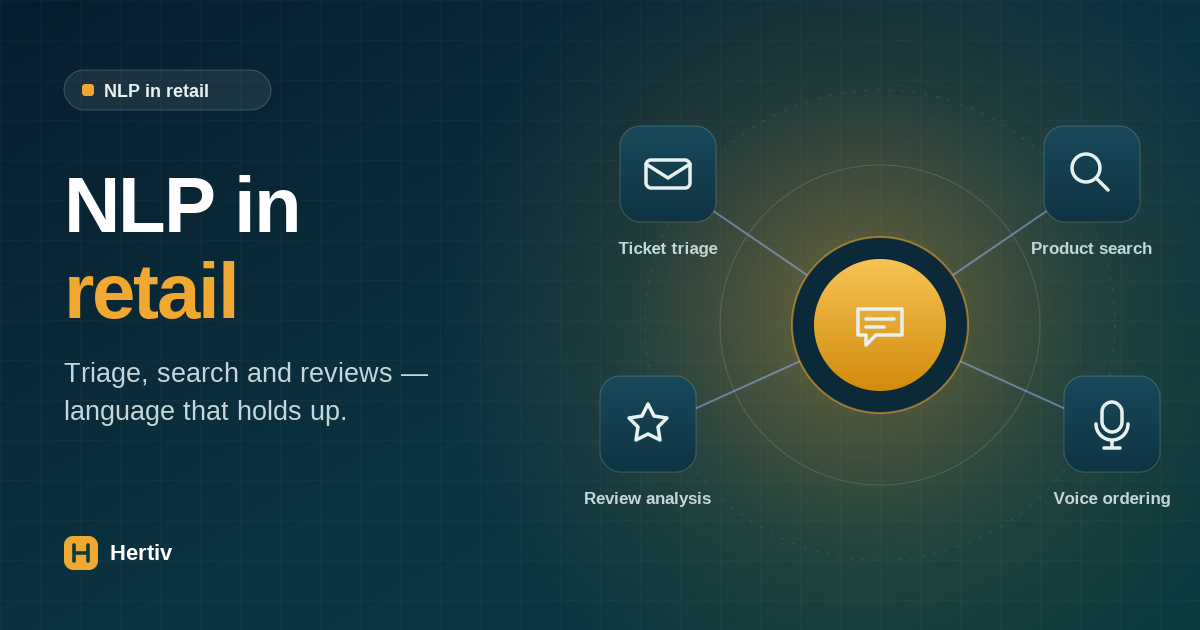
NLP use cases in retail cluster around customer language: support ticket triage, semantic product search, review and feedback analysis, voice and chat ordering, and catalog attribute extraction. The ones that hold up in production are narrow, measurable and tied to a workflow the team already owns.
What are the main NLP use cases in retail?
Most retail NLP work falls into a small number of patterns: helping customers find things, helping staff answer questions, and turning unstructured text into structured data. The table below compares the ones we see most often, with honest notes on what each needs.
| Use case | What it does | Typical data needed | Effort |
|---|---|---|---|
| Support triage | Classifies and routes tickets, drafts replies | Ticket history, macros, order data | Low to medium |
| Semantic product search | Matches queries by meaning, not just keywords | Catalog, search logs, synonyms | Medium |
| Review and feedback analysis | Groups themes, sentiment and product issues | Reviews, surveys, chat logs | Low |
| Catalog attribute extraction | Pulls size, material, colour from text | Product descriptions, images | Medium to high |
| Voice and chat ordering | Takes orders in natural language | Menus, stock, POS integration | High |
| Customer support chatbot | Answers common questions, escalates | Policies, order status, FAQs | Medium |
| Staff knowledge assistant | Answers policy and process questions | Internal docs, SOPs | Medium |
| Demand signal mining | Finds product requests in text | Reviews, social, support notes | Medium |
Effort here means engineering and evaluation time, not licence cost. A narrow triage model can ship in weeks; voice ordering across a full menu is a multi-quarter build with hardware and telephony in scope. For a wider view of where these sit in a retail stack, see AI for retail and e-commerce.
Support triage and reply drafting
Support triage is usually the first NLP use case that pays for itself, because the data and the workflow already exist. A model reads each incoming ticket, assigns a category and priority, and drafts a reply that an agent edits and sends.
The value is in reducing handling time and routing errors, not in removing agents. Keep a human in the loop for refunds, complaints and anything involving money. Measure accuracy on a hand-labelled sample before launch, and keep that sample as a regression set.
What you need:
- Historical tickets with the final category assigned by a human
- Access to order and account context so the draft is specific
- A clear escalation rule for low-confidence cases
Semantic product search and query understanding
Semantic search helps when shoppers describe what they want instead of typing the exact product name. "Warm jacket for a rainy commute" should return sensible results even if no product is titled that way.
This is a retrieval problem more than a language-generation problem. You embed products and queries, retrieve candidates, then re-rank. Query understanding layers on top: spelling correction, intent detection and synonym expansion for terms your catalog does not use.
Start by mining search logs for queries that return no results or end in an immediate exit. Those are your test cases. Then measure whether the new ranking improves click-through and conversion on the same queries, not on a generic benchmark.
Example (hypothetical): if 4% of daily searches return zero results and you recover half of them at your usual conversion rate, the gain is small per query but compounds across a year. Model it with your own numbers before scoping the build.
Review and feedback analysis
Review analysis turns free text into themes you can act on: fit issues, delivery complaints, packaging damage, unclear sizing. The model clusters feedback and tags sentiment, and someone in merchandising or operations reviews the output weekly.
This is one of the cheapest use cases to start because the data is already public or already collected. The risk is producing dashboards nobody reads. Assign an owner before you build anything.
A practical setup:
- Pull reviews and survey responses on a schedule
- Tag by product, theme and severity
- Route severe safety or quality signals to the right team immediately
- Keep a weekly summary short enough to read in two minutes
Be careful with sentiment scores as a single number. They hide the difference between a mild size complaint and a damaged-goods complaint, and those need different responses.
Catalog enrichment and attribute extraction
Many catalogs are thin: a title, a price and a paragraph of marketing copy. NLP can extract structured attributes such as material, fit, colour, compatibility and care instructions from that text, which then powers filters, search and comparison pages.
This is a data quality project with a language model in the middle. Expect a human review step for the first months, especially on regulated categories like food, cosmetics or children's products.
A workable sequence:
- Pick one category with high traffic and poor filters.
- Define the attributes you actually need, not every attribute you could extract.
- Extract, review a sample, and measure precision per attribute.
- Feed approved values back into the product database.
- Expand to the next category only after the first is clean.
Voice and chat ordering
Voice ordering lets customers place or modify orders by phone or in-app chat. It works best where the menu is narrow and the language is repetitive: pizza, coffee, repeat grocery baskets, appointment-based services.
Open-ended conversational ordering across a large catalog is much harder. Customers change their minds, use vague references and expect the system to remember context. Design for the common path and hand off to a human quickly when confidence drops.
You will need telephony or chat infrastructure, integration with stock and POS, and a confirmation step so orders are not placed by mistake. Accuracy matters more than fluency: a slightly robotic system that always confirms the order beats a natural-sounding one that gets it wrong.
The same underlying stack often serves both channels. See AI voice agent development for the phone side.
How to prioritise NLP use cases
Pick the use case with the clearest owner and the shortest path to a measurable result, not the most impressive one. A useful order of work:
- List candidate use cases and write down the metric each one should move, such as first-contact resolution, search exit rate or filter usage.
- Check whether the data exists and is accessible. If the labels are missing, add the labelling effort to the estimate.
- Score each option on effort, data readiness and business value, and choose one to build first.
- Build a small evaluation set from real examples before writing production code.
- Ship narrowly, measure against the baseline, then decide whether to expand.
A short proof of concept is a reasonable way to test data readiness before committing to a build. See AI proof of concept development for how that is usually scoped. For teams that need the workflow to run end to end, agentic AI development covers the orchestration layer.
Common mistakes
Most retail NLP projects fail for organisational reasons rather than model quality. These are the patterns worth avoiding.
- No evaluation set. Without a fixed set of real examples, nobody can tell whether a change helped.
- Choosing a use case with no owner. If no team is accountable for the outcome, the model will not be maintained.
- Skipping the taxonomy work. Overlapping categories and messy product data make every downstream task harder.
- Treating sentiment as a strategy. A single score rarely tells a merchandising team what to do.
- Ignoring escalation. Any customer-facing system needs a fast, obvious route to a human.
- Automating before measuring. Run the process manually on a sample first so you know what good looks like.
For teams deciding where to start, an AI readiness assessment can surface data gaps before they become build problems.
Key takeaways
- Start with a use case that has a clear owner and a measurable outcome, not the most impressive demo
- Semantic product search and support triage are usually the fastest wins because the data already exists
- Catalog attribute extraction needs human review at first; budget for it rather than hiding it
- Review and feedback analysis is only useful if someone downstream acts on the themes
- Voice ordering works best for narrow, repeated menus, not open-ended conversation
- Most failures come from missing data, unclear escalation paths and no evaluation set
Frequently asked questions
What is the easiest NLP use case to start with in retail?
Review and feedback analysis is usually the easiest, because the text already exists and the output does not need to be perfect to be useful. Support triage is a close second if you have clean historical tickets with categories assigned by humans.
Do I need a large language model for retail NLP?
Not always. Classification, tagging and extraction can often be done with smaller models that are cheaper and easier to control. Large language models help most with drafting, summarisation and handling messy, varied language.
How do I measure whether semantic search is working?
Build a test set from real queries, including ones that currently return nothing, and compare click-through and conversion against your existing search on the same queries. Avoid judging results by eye on a handful of examples.
Can NLP handle multiple languages in one store?
Modern models handle multiple languages reasonably well, but quality varies by language and by domain vocabulary. Test each language you support with native examples, and keep a fallback for languages with thin training data.
What data do I need before starting a retail NLP project?
You need examples of the real text the system will process, a way to label a sample by hand, and access to the systems the output must connect to, such as order data or the product catalog. Missing labels are the most common blocker.
Should voice ordering replace the phone line?
Usually not at first. Run it alongside human agents on a narrow menu, measure order accuracy and handoff rate, and expand only where it performs reliably. A fast handoff to a person is part of a good voice system, not a failure.


