Native App Developers: What They Do and When to Hire One
Native app developers build apps for one platform, iOS or Android, using its own tools, which gives the best speed, feel and access to device features.
On this page
Short answer
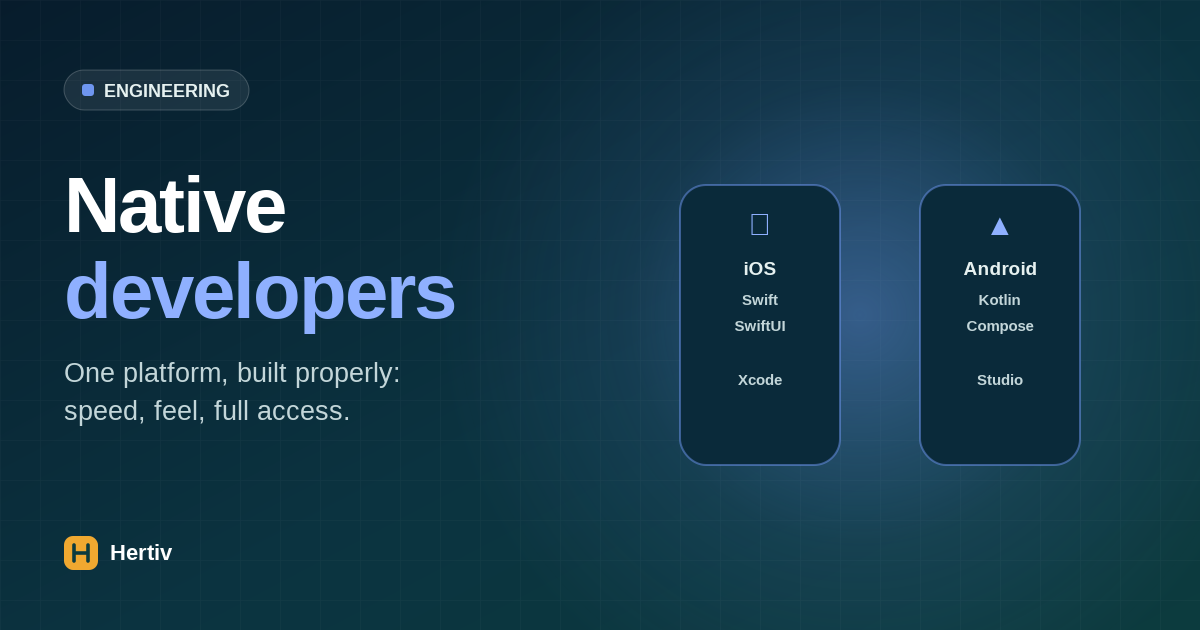
Native app developers build apps for a single platform, iOS or Android, using that platform's language and tools: Swift and SwiftUI for iOS, Kotlin and Jetpack Compose for Android. Because the app is built for one system, it runs fast, feels like the rest of the phone and can use the camera, sensors and payments as the platform intends. The trade-off is that one code base serves one platform only.
What do native app developers do?
Native app developers build apps for one platform using its own tools and language. An iOS developer works in Swift and Xcode, an Android developer works in Kotlin and Android Studio, and each one builds the screens, logic and connections that make the app work on that system. They also handle the platform's rules: store submission, permissions, updates and the design patterns users expect.
Their work is different from cross-platform development, where one code base serves both platforms. Native developers trade the shared code for full access to the device: better performance, smoother animation and every feature the platform offers, from Face ID to background location. That is why apps that need speed or deep device access usually go native.
| Area | Native | Cross-platform |
|---|---|---|
| Code base | One per platform | One for both |
| Performance | Best available | Good, sometimes slower |
| Device features | Full access, day one | Often needs plugins |
| Look and feel | Matches the platform | Close, but not exact |
| Cost to build | Higher, two teams | Lower, one team |
| Time to market | Longer for both platforms | Faster for both platforms |
When should you hire native app developers?
Hire native developers when the app needs the best performance, the smoothest feel or deep access to device features. Games, video editors, navigation apps and anything with heavy animation or real-time data usually justify the extra cost. The same applies when most of your users are on one platform and the other can wait.
Hire cross-platform instead when the app is mostly forms, lists and content, and when reaching both platforms fast matters more than squeezing out the last bit of speed. A simple booking or content app rarely needs native code, and the saved budget can go into design and testing. See React Native vs native apps for a direct comparison.
A middle path exists too. Some teams build the main app cross-platform and write the heavy parts, such as video or scanning, in native code. That keeps one code base for most screens while the demanding parts still get native performance. The split needs discipline, but it can be the best of both worlds for apps with one or two heavy features.
What skills should you check before hiring?
Check the platform first: an iOS developer should know Swift, SwiftUI and Xcode, while an Android developer should know Kotlin, Jetpack Compose and Android Studio. Both should know how to handle the app lifecycle, background work, permissions and the store submission process, because those are where junior developers get stuck.
Check the basics too. A good developer writes tests, handles errors gracefully and can explain a past app they shipped, including what went wrong. Ask for a working app in the store, not just code samples, and check how it behaves on a real phone. Our how to outsource software development guide covers the vetting steps in detail.
Also check how the developer handles the platform's moving parts. Stores change their rules, phones change their sizes, and operating systems add new permission screens each year. A developer who keeps up with those changes will save you from rejected submissions and broken updates, while one who does not will leave you fixing the same problems every release.
How do you hire native app developers in 5 steps?
Hiring native developers follows the same shape as hiring any specialist: define the work, check the skills, test on a small job, then commit. The step that matters most is the small paid test, because it shows how the developer works on your code, not just how they talk about it.
- Write the app's job in one page: users, features and platforms.
- Shortlist developers with a shipped app in the store.
- Check platform skills: Swift and SwiftUI, or Kotlin and Compose.
- Give a small paid task on your real code base.
- Agree the working rhythm: reviews, testing and release plan.
Agree the rhythm before the work starts. Weekly builds, code review and a test plan keep a remote developer in step with the team, and a clear release plan stops the app from drifting. Prices vary by region and experience, so check current rates before you budget.
Example (hypothetical): a delivery app team
A delivery startup needs an Android app with live tracking, offline maps and fast scanning. Two native Android developers estimate 16 weeks: 2 weeks of design, 11 weeks of building and 3 weeks of testing. At 40 hours a week each, that is 2 times 16 times 40, or 1,280 hours of work, plus a part-time designer for the screens.
A cross-platform team quotes 12 weeks for both platforms, but the live tracking and scanning need platform plugins that add 3 weeks of fixes, so the real time is about the same. The startup picks native Android first, because 9 in 10 of its couriers use Android, and plans the iOS version for the next quarter.
The choice also shapes the team. Two native Android developers own the app fully, while a cross-platform team would split attention across two stores and two sets of quirks. For a small startup, one platform done well beats two platforms done halfway, and the iOS version can reuse the designs, the back end and the lessons from the first launch.
Common mistakes
The most common mistake is hiring a native developer for an app that does not need native code, then paying for two code bases when one would have done. Another is hiring on price alone, which usually buys slow work and a rewrite later. A third mistake is skipping the paid test and discovering the skill gap after the contract is signed.
A fourth mistake is forgetting the second platform in the plan. If the app succeeds on one platform, the other will be asked for, so budget for it early or be honest that it comes later. See mobile app development for how native fits into a wider app plan.
A fifth mistake is hiring for one app and forgetting maintenance. An app needs updates for new operating systems, new phones and new store rules, so the developer's job does not end at launch. Agree the maintenance plan, the update rhythm and who fixes urgent bugs before the first release, not after the first crash report.
Key takeaways
- Native developers build for one platform with its own tools, for the best speed and feel.
- Hire native when the app needs performance, smooth animation or deep device access.
- Check Swift and SwiftUI for iOS, or Kotlin and Compose for Android, plus a shipped app.
- Use a small paid test on your real code base before you commit.
- Plan the second platform early, even if you build it later.
Frequently asked questions
What is the difference between native and cross-platform?
Native apps are built for one platform with its own tools, while cross-platform apps share one code base across iOS and Android. Native is faster and closer to the platform; cross-platform is cheaper and faster to launch on both.
Do I need two teams for iOS and Android?
Yes, if you go fully native, because iOS and Android use different languages and tools. Some teams share a designer and a back-end developer, but the app code itself needs a developer for each platform.
How much does it cost to hire a native app developer?
Rates vary widely by region and experience, so check current rates before you budget. A senior developer in a high-cost region can cost several times a junior developer elsewhere, and the cheapest option often costs more once rework is counted.
Can one developer do both iOS and Android natively?
Some developers can, but few are strong on both, because each platform has its own language, tools and design rules. If you need both platforms well, hire one developer per platform or choose a cross-platform approach.
What should I ask a native developer in an interview?
Ask them to walk through an app they shipped, including a bug they fixed and a design decision they made. Then give a small paid task on your code base, because that shows how they work far better than quiz questions.
Is native still worth it in 2026?
Yes, for apps that need speed, smooth animation or deep device access. For simple content or form apps, cross-platform is usually enough, so the answer depends on what your app actually does.


