From MVP to Enterprise: A Scaling Framework That Works
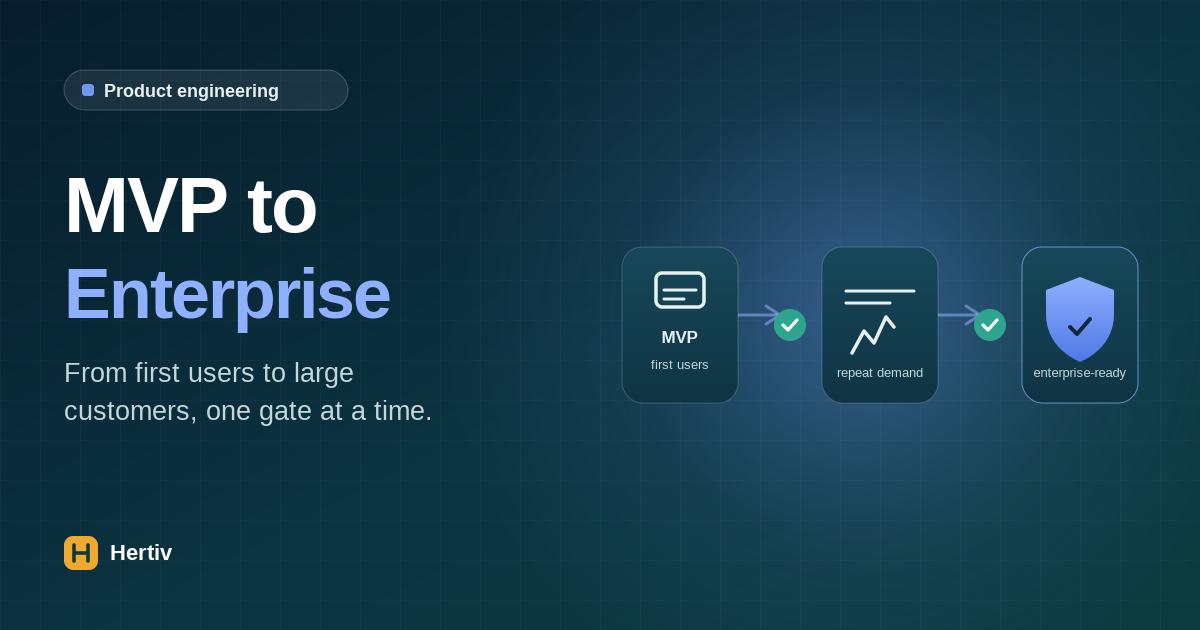
An MVP-to-enterprise scaling framework moves a product through staged gates: prove the idea, prove repeat demand, then prove it is safe and supportable at scale.
On this page
Short answer
An MVP-to-enterprise scaling framework is a staged plan that takes a minimum viable product from its first users to enterprise customers. It sets three gates: a working product people use, repeatable demand from paying customers, and enterprise readiness covering security, reliability, integrations and support. A team passes one gate before investing in the next, so effort goes where the evidence points.
What is an MVP-to-enterprise scaling framework?
An MVP-to-enterprise scaling framework is a staged plan that takes a minimum viable product from its first users to enterprise customers, one gate at a time. A minimum viable product, or MVP, is the smallest version that solves a real problem for real users. Enterprise scale means the product can pass a security review, serve thousands of users, connect to a customer's systems and be supported under a service agreement.
The framework matters because the work at each stage is different. Early on, the job is learning what users want and changing the product fast. Later, the job is proving the product is dependable: it stays up, it keeps data safe, it fits the way a large organisation buys and runs software.
Teams that skip a stage usually pay for it later, either by rebuilding a product that was never tested with users or by losing a large deal because the product fails a security review.
Think of the framework as a sequence of promises. Each stage promises the next one something: the MVP promises a real problem worth solving, the growth stage promises demand that repeats, and the enterprise stage promises a product a large customer can trust. You can read how to build the first version in our guide on how to develop an MVP that scales.
What are the stages of the framework?
The framework has three stages, and each one ends with a test the team must pass before moving on. The stages are deliberately narrow: each one answers one question, and the answer is measured with real users or real buyers, not with opinion inside the team.
| Stage | What it proves | Exit test |
|---|---|---|
| 1. MVP | People use the product to solve a real problem | At least a small group returns weekly without being asked |
| 2. Repeat demand | Paying customers keep coming back | Revenue repeats and churn stays low for three months |
| 3. Enterprise-ready | Large customers can buy and run it safely | Passes a security review and a pilot with one large customer |
Stage 1 is about use, not sales. If nobody returns to the product on their own, the problem is not painful enough or the solution is not good enough, and no amount of marketing fixes that. Stage 2 is about money that repeats: one-off sales do not count, because enterprise buyers want proof the product keeps its customers.
Stage 3 is where most small products fail. A large customer will ask about data handling, access controls, uptime, support hours and how the product connects to its own systems. The team should only start this work once stages 1 and 2 are passed, because enterprise features built for a product nobody uses are wasted effort.
What has to change in the product at each stage?
The product changes at every stage, and the changes are mostly about trust rather than features. In stage 1 the product needs to work for one kind of user and one core task, and it needs to be easy to change, because feedback will force changes every week. Simple code, a single database and a small set of screens are an advantage here, not a weakness.
In stage 2 the product has to handle more users and more data without slowing down or breaking. This is when teams add monitoring, so they know when something fails before users report it, and when they start separating the parts of the system that grow at different speeds. The goal is a product that survives a sudden jump in users, for example after a customer tells its whole team to start using it.
In stage 3 the product has to fit enterprise rules. That means separate workspaces for each customer, roles and permissions so only the right people see the right data, an audit log that records who did what, and single sign-on so a customer's staff can log in with their own accounts.
It also means documented ways to connect to other tools, because a large customer will not accept a product that lives alone. MVP development services often cover the first two stages, while the third stage needs the team itself to own the security and integration work.
What has to change in the team and the way it works?
The team changes as much as the product. In stage 1 a small team can do everything: build, talk to users, fix bugs and answer questions. Decisions are fast because the same people who hear the feedback write the code. The main discipline is writing down what was learned each week, so the team does not repeat the same experiment twice.
In stage 2 the team has to split its time between new work and keeping the product running. Someone has to watch the system, answer support messages and fix problems while others build. This is also when written help pages and a simple way to report a problem start to matter, because the team can no longer talk to every user directly.
In stage 3 the team needs roles it did not need before: someone who answers security questionnaires, someone who runs support during business hours with agreed response times, and someone who manages the relationship with each large customer. Releases also change. In stage 1 the team can ship every day; in stage 3 a large customer needs to know what is changing and when, so releases become planned and announced in advance.
How do you pass each stage gate?
Passing a gate means showing evidence, not making a claim. The team should write down the test for each gate before it starts the stage, so nobody moves the goalposts when the work gets hard.
- Define the test in numbers. For stage 1, pick a return rate and a user count. For stage 2, pick a revenue figure and a churn limit. For stage 3, pick the security checks and pilot results it must pass.
- Collect the evidence weekly. Track the numbers in one place the whole team can see, and review them together. If the numbers stall for three weeks, change the plan instead of changing the test.
- Fix the weakest link first. If users return but do not pay, the problem is pricing or value, not more features. If buyers like the product but the security review fails, stop building features and fix the review findings.
- Run a real pilot for stage 3. One large customer using the product with real data and real users is worth more than ten slide decks. Agree in advance what success looks like for that pilot.
- Record the decision. When a gate is passed, write down what was proved and what is still unknown. That record stops the team from reopening settled questions later.
For a related view, see our guide on scaling AI products, which covers what changes when usage grows quickly.
Example (hypothetical): a scheduling tool grows from MVP to enterprise
Example (hypothetical): a small team builds a scheduling tool for clinics. The MVP lets one clinic book appointments online. After six weeks, 12 of the first 15 clinics use it every week without reminders, so stage 1 passes. The team then charges a monthly fee. After three months, 40 clinics pay, 3 cancel, and monthly revenue repeats, so stage 2 passes.
Stage 3 starts when a hospital group with 30 clinics asks for a pilot. The group asks for separate workspaces per clinic, staff roles, an audit log and a written security review. The team spends eight weeks adding those, then runs a four-week pilot with 3 of the group's clinics. The pilot handles 1,200 bookings a week with no outage longer than 10 minutes, and support answers every message within 4 working hours.
The numbers tell the story. The MVP served 15 clinics; the pilot alone served 3 clinics with 1,200 bookings a week, or 400 per clinic. If all 30 clinics joined at the same rate, that would be 12,000 bookings a week, 10 times the pilot load.
The team uses that figure to plan capacity before signing the contract, instead of finding out after. The hospital group signs, and the framework has done its job: each stage was proved before the next one began.
What are the common mistakes?
The most common mistakes in scaling from MVP to enterprise all come from skipping a gate. Teams add enterprise features before anyone uses the product, or they chase a large customer before the product keeps its small customers. Both mistakes burn months on work that nobody asked for.
- Rebuilding too early. Rewriting the product for scale before it has users is guesswork. Keep the simple version until the numbers show it is too slow or too fragile.
- Promising enterprise features in sales calls. If sales promises single sign-on or an audit log that does not exist yet, the team inherits a deadline it did not choose.
- Treating the security review as paperwork. A review that finds real gaps is useful; a review the team rushes through will fail again at the next customer.
- Hiring support too late. When the first large customer arrives, support is already needed. Plan support hours and response times before the pilot, not after the first complaint.
- Changing the gate test mid-stage. If the test is too hard, the right answer is to change the product or the plan, not to lower the bar quietly.
Key takeaways
- The framework has three stages: prove use, prove repeat demand, then prove enterprise readiness
- Each stage ends with a measured exit test, not a date on a calendar
- Stage 3 work — security, roles, audit logs, integrations — only starts after stages 1 and 2 pass
- The team changes with the product: support, security and release discipline arrive at stage 3
- A real pilot with one large customer is the strongest proof a product is enterprise-ready
Frequently asked questions
How long does it take to go from MVP to enterprise-ready?
There is no fixed timeline. A simple product with strong demand can pass all three stages in under a year, while a product in a regulated field can take much longer. The stages, not the calendar, decide when the product is ready.
What is the difference between an MVP and a prototype?
A prototype is a mock-up used to test an idea, often with no real users and no real data. An MVP is a working product that real users rely on. The framework starts at the MVP, because only real use produces the evidence the later stages need.
Do small teams need an enterprise stage at all?
Only if they want large customers. Many products stay healthy at stage 2, serving small and mid-size customers who pay every month. The enterprise stage is a choice, and it costs real effort, so it should follow demand rather than ambition.
What does an enterprise security review usually ask for?
Typical questions cover how data is stored and encrypted, who can access it, how staff are vetted, how incidents are handled and how the product is tested. A team that keeps these answers written down passes reviews faster than one that starts from scratch each time.
Can a product skip stage 2 and go straight to enterprise customers?
It can try, but the risk is high. Without repeat paying customers, the team has no proof the product holds its value, and a large customer that leaves after a pilot costs far more than a small one. Stage 2 is the cheapest place to learn whether the product lasts.
Who should own the framework inside the team?
One person should own the numbers and the gate tests, usually the product lead or founder. The work itself is shared, but a single owner keeps the tests honest and stops the team from moving on before a stage is truly passed.


