Multi-Agent Procurement in Manufacturing: How It Works
Multi-agent procurement platforms split factory buying across AI agents that source parts, compare quotes and track orders. Learn how they work and where to start.
On this page
Short answer
A multi-agent procurement platform for manufacturing is software where several AI agents split the buying job: one finds suppliers, one compares quotes, one places orders and one tracks deliveries, while a supervisor agent checks each step against budget and policy. The agents share one view of stock, orders and supplier history, so a factory can move from request to purchase order faster, with fewer errors than a manual process allows.
What is a multi-agent procurement platform?
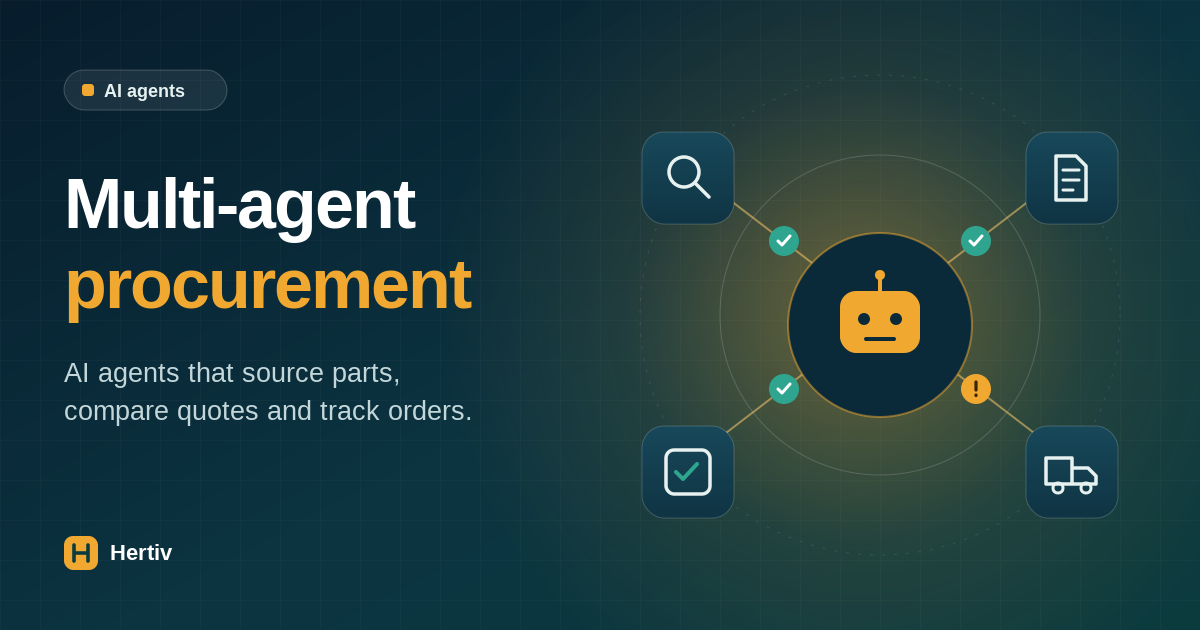
A multi-agent procurement platform is software where several AI agents split the buying job for a factory: one finds suppliers, one compares quotes, one places orders and one tracks deliveries, while a supervisor agent checks each step against budget and policy. The agents share one view of stock, orders and supplier history, so a request can move from a shop-floor need to a purchase order without waiting on a chain of emails.
It differs from a single procurement assistant in one way: each agent owns a narrow job and hands its result to the next agent, instead of one model doing everything. A sourcing agent that only ranks suppliers can be tested on its own, and a quoting agent can be replaced without rebuilding the whole system.
For a manufacturer, the platform sits between the production plan and the suppliers. It reads the bill of materials, checks what is in stock, raises requests for the missing parts, and keeps the order history that auditors and planners need. Humans stay in charge of approvals above a spending limit and of any supplier change. For the wider factory picture, see multi-agent systems in manufacturing.
Which agents do the buying work?
The agents in a procurement platform each handle one stage of the buying cycle, and they pass structured results to each other rather than free-form chat. That keeps the work auditable: you can see which agent chose a supplier and why.
| Agent | Job | What it checks |
|---|---|---|
| Sourcing agent | Finds and ranks suppliers | Certifications, lead time, past quality |
| Quote agent | Requests and compares quotes | Price, delivery date, payment terms |
| Order agent | Creates purchase orders | Budget, stock levels, approval rules |
| Delivery agent | Tracks shipments and receipts | Delivery dates, quantities, damage |
| Invoice agent | Matches invoices to orders | Price, quantity, tax, payment due |
A supervisor agent watches the whole flow. It checks that the quote agent compared at least two suppliers, that the order agent stayed inside budget, and that no step skipped an approval. When a rule is broken, the supervisor stops the flow and routes it to a buyer instead of letting the order through. The pattern is the same one used by multi-agent systems in other departments.
What data does the platform need to work?
A multi-agent procurement platform needs four sets of data before it can buy anything safely: the bill of materials, live stock levels, a supplier register, and the buying rules. Without them, the agents guess, and guesses in procurement become wrong orders.
The bill of materials says which parts each product needs and in what quantity. Stock data says what is already on hand. The supplier register holds contact details, certifications, lead times and past delivery performance. The buying rules hold spending limits, approved suppliers and the approvals each amount needs.
Start with clean data, not more agents. If part numbers differ between the stock system and the supplier catalogue, the sourcing agent will match the wrong parts. A short data-cleaning pass — one part number, one supplier name, one unit of measure — pays for itself before the first agent runs. See AI agents for procurement for the buying workflow these agents slot into.
How do you roll it out in a factory?
You roll out a multi-agent procurement platform one buying category at a time, starting with the parts that are bought often and rarely cause disputes. A narrow start keeps the risk low and gives the team real results to judge.
- Pick one category, such as fasteners or packaging, and map its current buying steps.
- Connect the stock system and the supplier register so the agents read live data.
- Turn on the sourcing and quote agents first, with a buyer reviewing every recommendation.
- Add the order agent once quotes are reliable, with a spending limit that needs human approval above it.
- Add delivery and invoice agents, then measure time saved and error rate for a month.
Keep a buyer in the loop for the first quarter. The agents learn from corrections, and the team learns where the agents are weak. Only widen the spending limit once the error rate is lower than the manual process it replaced.
Example (hypothetical): a parts maker automates RFQs
Example (hypothetical): a parts maker with 120 purchase orders a month asks its platform to handle requests for quotation (RFQs) for standard fasteners. A buyer used to spend about 2 hours per RFQ — finding suppliers, emailing specs, chasing replies and comparing prices in a spreadsheet.
With the platform, the sourcing agent finds three approved suppliers, the quote agent sends the spec and collects replies, and the buyer reviews a one-page comparison. Each RFQ takes about 10 minutes of buyer time. Across 40 RFQs a month, that saves 40 times 110 minutes, or 4,400 minutes — about 73 hours a month.
The maker keeps a $5,000 approval limit: orders below it go through automatically, orders above it wait for a buyer. In the first quarter, two quotes were flagged because a supplier's lead time had doubled, and the supervisor agent routed both to a buyer instead of ordering late parts.
What are the common mistakes?
The most common mistakes with multi-agent procurement platforms are connecting agents to dirty data, giving them spending power too early, and skipping the audit trail.
- Dirty master data. Mismatched part numbers and supplier names produce wrong orders that look correct.
- No spending limit. Agents should not place large orders without a human approval above a clear threshold.
- One agent doing everything. A single agent with every tool is harder to test and harder to trust than five narrow ones.
- No audit trail. If you cannot see which agent chose a supplier and why, you cannot fix a bad choice.
- Ignoring supplier relationships. A platform that always picks the cheapest quote can damage the suppliers you rely on in a shortage.
- Measuring speed only. Faster orders that arrive wrong cost more than slow orders that arrive right.
When does multi-agent procurement fit, and when does it not?
Multi-agent procurement fits factories that buy the same parts often, from a known set of suppliers, with clear rules for price and delivery. Repeatable buying is where agents earn their keep, because the same steps run dozens of times a month.
It fits less well for one-off purchases, custom tooling and new supplier relationships, where judgement and negotiation matter more than speed. A first order from a new supplier, a part with no history, or a contract worth a large share of annual spend should stay with a human buyer.
A useful test is volume against variety. If most of your orders are repeat buys of standard parts, the platform will pay back quickly. If most orders are unique, start with a single quoting agent and keep the rest manual until the pattern is clear. Compare the tools first in top AI agents for procurement.
Key takeaways
- Each agent owns one buying stage, from sourcing to invoice matching
- A supervisor agent checks budgets, approvals and rules before orders go through
- Clean part numbers and supplier data matter more than the number of agents
- Start with one buying category and a spending limit that needs human approval
- Measure time per order and error rate before widening the scope
Frequently asked questions
What is the difference between a multi-agent platform and a procurement assistant?
A procurement assistant is one model that answers questions and drafts documents. A multi-agent platform splits the buying job across several agents, each with a narrow role and its own checks, so sourcing, quoting, ordering and delivery are separate steps that can be tested and audited on their own.
Do the agents replace buyers?
No. The agents handle repeatable steps such as finding suppliers, comparing quotes and tracking deliveries. Buyers keep the judgement calls: approving large orders, choosing a new supplier, negotiating terms and handling disputes. The platform changes what buyers spend time on, not whether they are needed.
How much data does a platform need to start?
It needs a clean bill of materials, live stock levels, a supplier register with lead times and past performance, and written buying rules. Start with one buying category so the data cleaning stays small, then add categories once the first one runs reliably.
Can the agents negotiate with suppliers?
They can compare quotes and flag the best terms, and some can send counter-offers within limits you set. Real negotiation — a long-term contract, a volume discount or a quality dispute — still needs a human, because it depends on the relationship and on trade-offs no rule covers.
What does a multi-agent procurement platform cost?
Costs vary with the number of agents, the systems it connects to and the supplier count, so ask vendors for a quote based on your order volume. See vendor sites for current pricing, and weigh the price against the hours saved and the errors avoided rather than the licence fee alone.
How do you measure whether it works?
Track time per order, the share of orders that needed a correction, on-time delivery rate and the share of spend with approved suppliers. Compare the first month against the manual process it replaced, and widen the scope only when the error rate is lower than before.


