Mobile App Development in Iraq: A Practical Guide
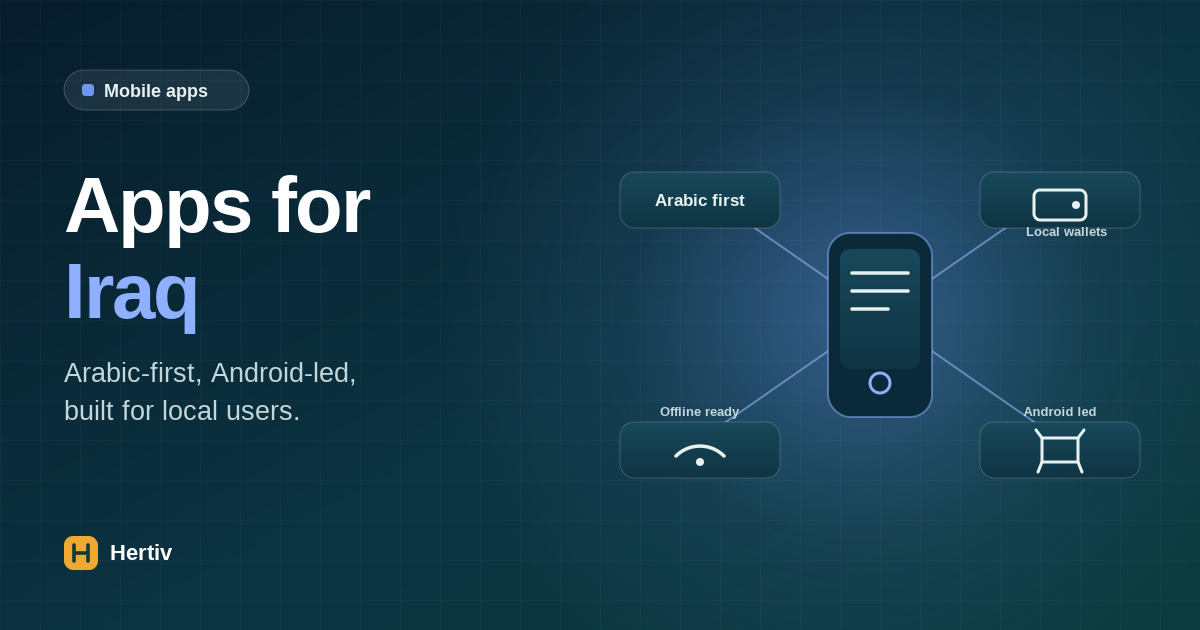
Building an app for Iraq means Arabic-first design, Android-led devices, local payment habits and light, offline-friendly screens. Here is what to plan for.
On this page
Short answer
Mobile app development in Iraq means building apps for Arabic-speaking users on mostly Android phones, with local payment habits and variable connectivity in mind. The winning apps are light, work offline where possible, and let users pay the way they already pay.
What does mobile app development in Iraq involve?
Mobile app development in Iraq is the process of designing, building and launching apps for users in Iraq, with Arabic-first content, Android-led devices, local payment habits and variable connectivity built into the plan from day one. An app that works well in Europe can fail in Iraq if it assumes fast broadband, card payments and English-speaking users.
| Area | What to plan for |
|---|---|
| Language | Arabic first, Kurdish in the Kurdistan Region, English for business users |
| Devices | Android-led, many mid-range and older phones |
| Payments | Cash on delivery and local mobile wallets before cards |
| Connectivity | Variable speeds; offline modes and light data use matter |
| App stores | Google Play and Apple App Store, with store listing in Arabic |
| Support | Phone and chat support in Arabic, not email-only |
The pattern is familiar from other markets with similar conditions: the winning apps are light, work offline where possible, and let users pay the way they already pay. Mobile app development covers the general build process; this article covers what changes for Iraq.
Who uses apps in Iraq, and on what devices?
App users in Iraq are mostly on Android phones, often mid-range or older models, and they use apps for messaging, shopping, food delivery, banking, education and government services. Many users keep several apps for the same job and switch quickly if one is slow or confusing.
That has direct design consequences. Screens should stay light, images should be compressed, and the app should stay usable on a slow connection rather than failing with a blank screen. Test on real mid-range devices, not only on a fast office phone, and test on mobile data rather than office Wi-Fi.
Offline behaviour matters more than in markets with reliable broadband. A food delivery or booking app should show cached content, queue actions when the connection drops, and sync when it returns. Users notice when an app loses their work to a dropped connection, and they rarely give it a second chance.
Language, layout and content for Iraqi users
Arabic is the main language for most users, and the interface should be built right-to-left from the start, not flipped at the end. Kurdish is widely used in the Kurdistan Region, so apps targeting the whole country should plan for both languages, and English is useful for business and professional users.
Right-to-left layout affects more than text direction. Navigation, icons, progress indicators and swipe gestures should mirror correctly, and numbers, dates and phone numbers need consistent formatting. Arabic text is often longer than English for the same meaning, so buttons and cards need room to grow without clipping.
Content should reflect local life: Iraqi place names, local holidays, prayer times where relevant, and prices in Iraqi dinar. Stock photos and illustrations that look generic or foreign make an app feel imported; local imagery and familiar references make it feel made for the user.
Payments, pricing and monetisation in Iraq
Payments are the part most foreign teams get wrong. Cash on delivery remains common for ecommerce, and many users prefer to pay in person or through a local mobile wallet rather than by card. An app that only accepts international cards will lose orders at checkout, whatever its design quality.
Plan the payment flow around what users already trust. Offer cash on delivery where it fits, add local mobile wallets as they become available, and treat card payments as one option among several rather than the default. Prices should be shown in Iraqi dinar with the total, including delivery, visible before the user commits.
Monetisation follows the same logic. Subscriptions work best when they can be paid in local ways and cancelled easily, and in-app purchases should be priced for local purchasing power rather than copied from another market. A pricing page that only shows dollars will confuse users and suppress conversion.
How to build an app for the Iraqi market
You build an app for the Iraqi market by starting with local research, then designing for Arabic, Android and slow connections, and only then choosing the technical stack.
- Talk to users in Iraq first. Interview a small group about the apps they use, what frustrates them, and how they pay.
- Define the core journey in Arabic. Map the one flow that matters, such as booking or ordering, in Arabic before designing screens.
- Design right-to-left and light. Build the interface for Arabic layout, compress images, and plan offline behaviour.
- Choose the payment mix. Decide which payment methods to launch with and which to add later, based on user interviews.
- Build a small pilot and test on real devices. Test on mid-range Android phones over mobile data with Iraqi users.
- Launch in one city, then expand. Start in Baghdad or Erbil, fix the issues real users report, and then roll out wider.
A pilot in one city teaches you more than a national launch plan written from abroad. MVP development covers how to scope a pilot that is small enough to ship fast and real enough to learn from.
Example: a Baghdad clinic booking app
Example (hypothetical): a clinic in Baghdad wants patients to book appointments through an app instead of by phone. The clinic sees 120 patients a day, and the team estimates half of them, 60 patients, would book through the app if it is simple and in Arabic.
Each phone booking takes a receptionist about 5 minutes. If 60 patients book through the app, that saves 60 times 5 minutes, which is 300 minutes, or 5 hours of receptionist time per day. The clinic uses that time for walk-in patients and follow-up calls instead of hiring another receptionist.
The app is built Arabic-first with right-to-left layout, works on older Android phones, and lets patients pay in cash at the clinic. Reminders go out by SMS and chat rather than email, because patients check those more often. After a pilot with 20 patients, the clinic fixes two issues: the booking form asked for information patients did not have, and the reminder arrived too early. The pilot catches both before launch.
What are the common mistakes?
The most common mistakes are translating an English app at the end, assuming card payments, and testing only on fast devices. Each of these is cheap to avoid early and expensive to fix after launch.
- Translating instead of designing in Arabic. A translated interface usually has clipped text, broken layouts and awkward phrasing.
- Card-only checkout. Users who cannot pay the way they trust will abandon the order at the last step.
- Heavy screens and no offline mode. Large images and constant network calls make the app feel broken on slow connections.
- Testing on flagship phones only. Performance on a new phone says nothing about performance on the phones most users own.
- Ignoring the Kurdistan Region. An app for the whole country needs Kurdish content and local context, not only Baghdad.
- Email-only support. Users in Iraq expect phone and chat support in Arabic, and will leave if they cannot reach a human.
Local research before the build is what separates apps that get used from apps that get deleted. Custom software development can help run that research and turn it into a build plan.
Key takeaways
- Arabic-first, right-to-left design is a starting point, not a translation step
- Android-led, mid-range devices and slow connections set the performance bar
- Cash on delivery and local mobile wallets come before card-only checkout
- Prices in Iraqi dinar, with the full total visible before the user commits
- Pilot in one city on real devices, then fix what users report before expanding
Frequently asked questions
Do I need an Arabic version of my app for Iraq?
Yes, for most users. Arabic is the main language, and an Arabic-first interface with right-to-left layout is expected. Kurdish is also important in the Kurdistan Region, and English helps for business users, but Arabic is the default.
Is Android or iOS more important in Iraq?
Android is the larger platform, with many mid-range and older phones in use. iOS matters for some professional and higher-income users, but an Android-first build with iOS following is the usual order for the Iraqi market.
How do users in Iraq prefer to pay in apps?
Cash on delivery is still common for ecommerce, and local mobile wallets are growing. Card payments are one option among several rather than the default, so an app should offer the payment methods users already trust.
Should my app work offline in Iraq?
At least partly, yes. Connections vary, so cached content, queued actions and graceful handling of dropped connections make a real difference. Users notice when an app loses their work to a dropped connection.
How much does it cost to build an app for Iraq?
It depends on scope, platforms and payment integrations, as in any market. A small pilot with one core journey and Arabic-first design is the cheapest way to learn what users want before committing to a full build. See vendor sites for current rates.
Can I launch in Iraq from outside the country?
Yes, but local research is essential. Interviews with users in Iraq, testing on real devices over mobile data, and local payment and language expertise are what separate apps that get used from apps that get deleted.


