Manufacturing Cost Estimation: How to Price a Product
Manufacturing cost estimation adds up materials, labour, overhead and packaging for one unit, then checks the total against real quotes. Here is the method.
On this page
Short answer
Manufacturing cost estimation is the process of working out what it costs to make one unit of a product, by adding up materials, direct labour, factory overhead and packaging, then checking the total against supplier quotes and past jobs. A good estimate lets a business set a price that covers costs and leaves a margin.
What is manufacturing cost estimation?
Manufacturing cost estimation is the process of working out what it costs to make one unit of a product, by adding up materials, direct labour, factory overhead and packaging, then checking the total against supplier quotes and past jobs.
It sits between design and pricing. A designer sketches a part, the estimator prices the materials and the machine time, and the sales team uses that figure to set a price. Without an estimate, pricing is guesswork, and a product can sell well while losing money on every unit.
The estimate is a planning figure, not a promise. Material prices move, machines break down and yields vary. A good estimate states its assumptions, so the team knows which numbers to recheck when reality changes.
What costs go into a manufactured product?
Four cost groups make up most manufactured products: direct materials, direct labour, factory overhead and packaging. Each one is priced differently, and each one has its own common error.
| Cost group | What it covers | Common error |
|---|---|---|
| Direct materials | Raw materials and bought parts | Forgetting scrap and offcuts |
| Direct labour | Hands-on making and assembly | Using wage only, not loaded cost |
| Factory overhead | Rent, power, machines, supervision | Spreading it by guesswork |
| Packaging and freight | Boxes, pallets, delivery | Leaving out the last mile |
Labour is the easiest group to underprice. The wage is only part of it: add payroll taxes, leave, training and supervision to get the loaded cost, which is often a quarter to a third higher than the wage alone. Overhead is the hardest group, because it must be shared across products by a fair rule, such as machine hours or labour hours.
Which estimation method fits your stage?
The right estimation method depends on how much detail you have. Early on, a rough analogy is enough; once the design is fixed, a bottom-up build of every part and minute is the honest approach.
| Method | How it works | Best stage |
|---|---|---|
| Analogy | Price from a similar past product | Early concept |
| Parametric | Cost per kilo, per hour, per unit | Budget and quotes |
| Top-down | Split a known total across units | Programme planning |
| Bottom-up | Price every part and minute | Final design, before quoting |
Use analogy and parametric methods to screen ideas, and bottom-up costing to set the price. A parametric rate such as cost per machine hour is useful for quick quotes, but it hides the detail that decides whether a job makes money. When a quote is on the line, build it bottom-up.
How do you build a unit cost estimate, step by step?
You build a unit cost estimate by listing every part and every minute of work, pricing each one from a quote or a known rate, then adding overhead and a scrap allowance before checking the total against past jobs.
- List the bill of materials. Write down every part, its quantity and its supplier price.
- Add a scrap allowance. If 5% of parts are rejected, buy 5% more and price it in.
- Time the labour. Measure the hands-on minutes per unit, then multiply by the loaded labour rate.
- Share the overhead. Divide factory overhead by machine hours or labour hours and apply the rate per unit.
- Add packaging and freight. Price the box, the pallet and the delivery to the customer.
- Check against history. Compare the total with a similar past product and explain any large gap.
- Set the price from the cost. Add the margin you need, then check the market will pay it.
Keep the estimate in a sheet the whole team can see, with each assumption written next to its number. When a supplier raises a price, the sheet shows exactly which products are affected. AI for manufacturing can help automate the data capture behind these sheets.
Example (hypothetical): costing a small metal bracket
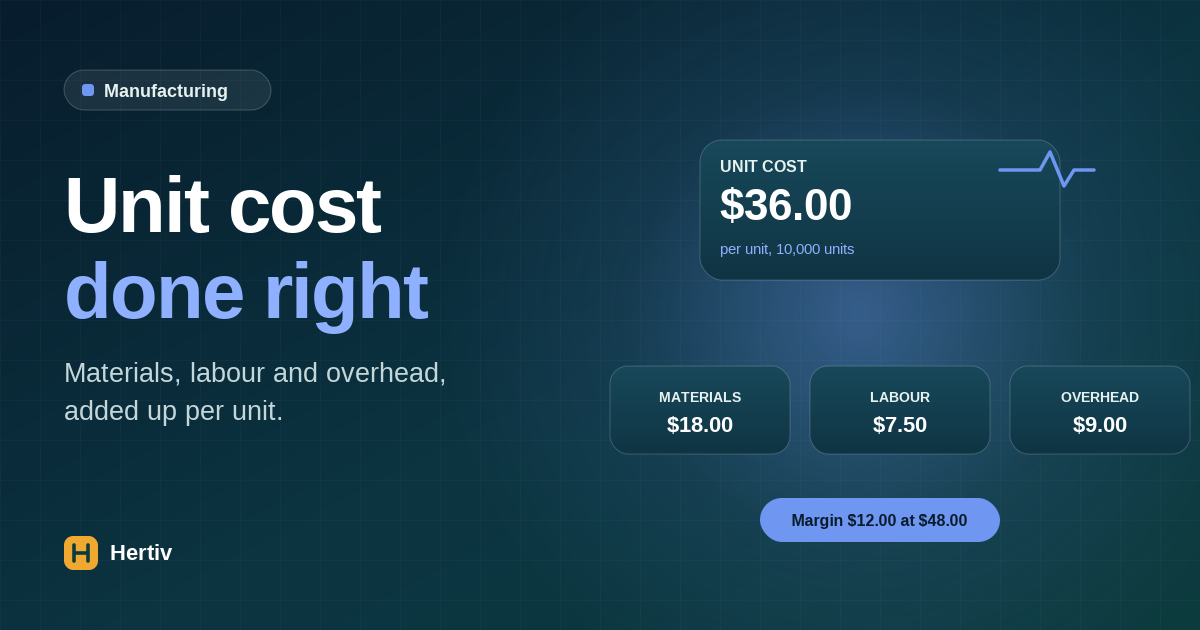
Example (hypothetical): a workshop costs a small metal bracket. Materials are $18.00 per unit, direct labour is $7.50, factory overhead is $9.00 and packaging is $1.50. Adding them gives $18.00 plus $7.50 plus $9.00 plus $1.50, which is $36.00 per unit.
For an order of 10,000 units, the total cost is $36.00 times 10,000, which is $360,000. The workshop sells the bracket at $48.00, so the margin is $48.00 minus $36.00, which is $12.00 per unit, or $120,000 on the order.
Then a supplier raises the steel price by $2.00 a unit. The new unit cost is $38.00 and the margin falls to $10.00, or $100,000 on the order. Because the estimate lists every input, the workshop sees the effect at once and can raise the price or find a cheaper supplier before quoting the next order.
How do you keep estimates accurate over time?
You keep estimates accurate by tracking actual costs against estimated costs on every job, then updating the rates that were wrong. An estimate that is never checked is a guess that gets repeated.
After each job, record what materials, labour and machine time were actually used, and compare them with the estimate. If labour runs 10% over on three jobs in a row, the labour rate or the time allowance is wrong, and the next estimate should use the real figure.
Review supplier prices every quarter and machine rates every year. A rate set two years ago will quietly underprice every job, and the gap only shows up when the accounts are done. Teams that track this well often use software to link quotes, jobs and costs; see the ROI of AI in manufacturing for where automation pays for itself.
What are the common mistakes?
The most common estimation mistakes are forgetting scrap, pricing labour at the wage only, and spreading overhead by guesswork. Each one makes the product look cheaper than it is, and the loss only appears at the end of the month.
- Forgetting scrap and rework. Rejected parts and rework time are real costs; add an allowance based on past rates.
- Wage-only labour. Use the loaded cost with taxes, leave and supervision, not the headline wage.
- Guessed overhead. Share overhead by machine hours or labour hours, and review the rate yearly.
- Stale supplier prices. A quote from last year is not a price; recheck before committing.
- No margin check. A cost is not a price. Add the margin you need and test whether the market will pay it.
If your costing still lives in scattered sheets, a partner for custom software development can build one system that links quotes, jobs and actuals.
Key takeaways
- A unit cost is materials plus labour plus overhead plus packaging, checked against quotes
- Price labour at its loaded cost, not the wage, and add a scrap allowance
- Use analogy early, parametric for budgets, and bottom-up costing before quoting a price
- Track actuals against estimates on every job and update the rates that were wrong
- A cost is not a price: add the margin you need and test whether the market pays it
- Review supplier prices quarterly and machine rates yearly
Frequently asked questions
What is the difference between direct and indirect costs?
Direct costs, such as materials and hands-on labour, can be traced to one product. Indirect costs, such as rent, power and supervision, support the whole factory and must be shared across products by a fair rule, such as machine hours.
How much scrap should an estimate allow?
Use your past rejection and rework rates. If 5% of parts are rejected, buy 5% more and price it in. A new product with no history should start with a higher allowance and revise it once real data exists.
What is the loaded cost of labour?
The loaded cost is the wage plus payroll taxes, leave, training, equipment and supervision. It is often a quarter to a third higher than the wage alone, and using the wage only is one of the most common estimation mistakes.
How do you share factory overhead across products?
Divide total overhead by a base such as machine hours or direct labour hours, then apply that rate to each product. Pick the base that tracks the real use of the factory, and review the rate at least once a year.
When should you re-estimate a product?
Re-estimate when a supplier price changes, when the design changes, or at least once a year. Material and labour rates move, and an estimate built on old rates will quietly underprice every order.
Does software help with cost estimation?
Yes. Software that links bills of materials, quotes, jobs and actual costs keeps every estimate current and shows which inputs changed. It also builds a history that makes the next estimate more accurate than the last.


