Machine Vision in Business: How Cameras Check Work
Machine vision uses cameras, lighting and software to inspect products on a production line. It catches faults a person would miss and keeps a record of every check.
On this page
Short answer
Machine vision is a factory system that uses cameras, lighting and software to inspect products as they move along a line. It checks size, shape, colour, labels and defects, and it rejects or flags anything that fails. Businesses use it to cut defects, prove quality to customers and reduce the cost of manual inspection.
What is machine vision?
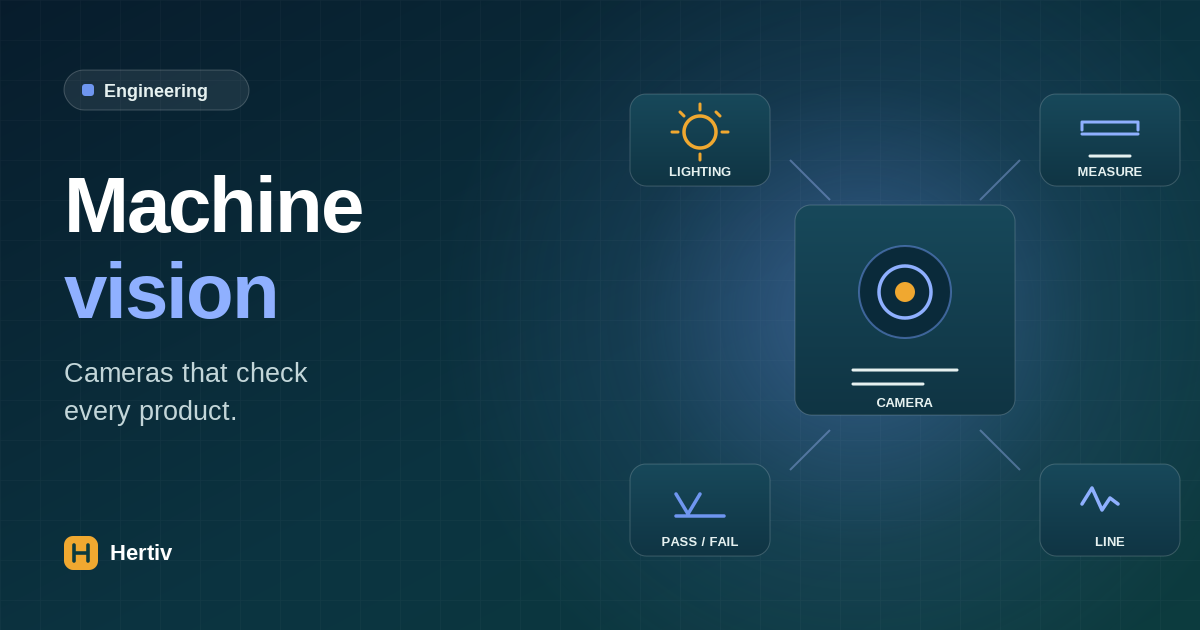
Machine vision is a system that lets a machine see and judge. A camera takes a picture of a product, software compares that picture with a good example, and the system decides whether the product passes or fails. The parts are simple: a camera, a lens, a light, a computer and a way to act on the result, such as a reject arm or a signal to the line controller.
Machine vision is the industrial cousin of computer vision. Computer vision is the wider field: software that reads images and video, as what computer vision is and how it works explains.
Machine vision is that technology put to work in a factory, with fixed cameras, fixed lighting and a fixed job, such as checking every bottle cap on a line. The fixed setup is the point: it makes the result repeatable, which is what quality checks need.
Businesses use machine vision where the check is visual, repetitive and fast. Reading a code, checking a label, measuring a part, finding a crack or counting items are all jobs a camera can do thousands of times without getting tired. The business case is usually simple: fewer defects reach the customer, and fewer people are needed to stand at the end of a line checking by eye.
Where do businesses use machine vision?
Machine vision shows up in most industries that make or move physical goods. In food and drink it checks fill levels, caps, labels and expiry dates. In electronics it checks solder joints, screens and connectors. In car parts it measures dimensions and finds surface faults. In logistics it reads barcodes and sorts parcels.
| Industry | What the camera checks | Why it matters |
|---|---|---|
| Food and drink | Fill level, caps, labels, dates | Wrong labels and underfilled packs reach shops |
| Electronics | Solder joints, screens, connectors | Faults are too small to see by eye |
| Car parts | Dimensions, surface faults, assembly | A bad part can stop a whole vehicle line |
| Pharma | Tablets, vials, packaging, codes | Regulations demand a record of every check |
| Logistics | Barcodes, labels, parcel shape | Wrong labels send parcels to the wrong place |
| Printing | Colour, registration, missing print | Print errors are costly to reprint |
The same system can serve several jobs on one line. A camera that reads a barcode can also check the label position and the print quality in the same picture. That is why teams often start with one check and add more once the camera is in place and the line is running.
How does a machine vision system work?
A machine vision system works in five steps. First, a sensor or trigger tells the camera when a product is in place. Second, the light fires and the camera takes a picture. Third, software finds the part in the picture and measures what it needs to measure. Fourth, the software compares the result with the limits for a good part.
Fifth, the system sends a pass or fail signal, and a reject device removes the bad part or a screen shows the fault.
Lighting matters more than the camera. A bright, even light makes the picture clear, and a bad light makes even the best camera useless. Teams spend real time on lighting: a ring light for flat parts, a backlight for outlines, or a low-angle light that makes scratches stand out. The camera and software come after the light is right.
Most systems use rules, not learning, for the first version: measure this edge, count these pixels, read this code. Learning-based checks, where a model is trained on good and bad examples, are used when the fault is hard to describe as a rule, such as a scratch on a shiny surface. Rules are easier to explain and to audit, which matters when a customer asks why a part was rejected.
What does a machine vision system cost?
A machine vision system costs from a few thousand dollars for a simple sensor to well over $100,000 for a line with several cameras, custom lighting and integration with the line controller. The camera itself is often the smallest part of the bill. The bigger costs are the lens, the light, the mount, the software and the time to set it up and test it on real products.
| Setup | Indicative cost | Typical use |
|---|---|---|
| Single smart camera | $3,000 - $15,000 | One check, such as reading a code or checking a label |
| Multi-camera station | $20,000 - $60,000 | Several checks on one product at one station |
| Full line system | $80,000 - $250,000 | Several stations, reject handling, line integration |
These are indicative ranges for planning, not quotes. The price moves with the speed of the line, the size of the smallest fault to catch, and how much of the line must change to fit the camera.
A slow line with a simple check is cheap. A fast line with tiny faults needs a better camera, a faster computer and more setup time, as big data in manufacturing shows for the data side of the same factories.
How do you start a machine vision project?
Start with one check on one line. Pick the fault that costs the most: the defect customers complain about, the check that slows the line, or the inspection that needs the most people. A single, costly fault is easier to justify than a vague plan to add cameras everywhere.
Next, collect examples. Gather good parts and bad parts, and take pictures of both under the light you plan to use. The examples decide whether the check is possible. If a human cannot see the fault in a clear photo, the software will struggle too, and the project needs a different approach, such as a different light or a different sensor.
Then run a trial on the real line. A trial shows whether the system keeps up with line speed, whether vibration or dust spoils the picture, and whether the reject device works. Most trials find at least one surprise, such as a reflection that appears only at certain times of day. Fix those in the trial, not after the system is bought and installed.
After the trial, plan the rollout in steps: install, train operators, set the limits for pass and fail, and watch the first week closely. Keep a log of every reject and check a sample of them by hand. If the system rejects good parts, the limits are too tight. If bad parts get through, the limits are too loose or the check is wrong.
Example (hypothetical): a bottling line inspection
Example (hypothetical): a bottling plant runs one line at 120 bottles a minute and checks caps by hand. Two people watch the line, and about 1 in 500 bottles leaves with a loose or missing cap. The plant installs one smart camera above the capper, with a ring light and a reject arm. The camera checks every cap for height and tilt, and the arm pushes bad bottles off the line.
The system costs $18,000 to buy and install, plus $4,000 a year for support and spares. Before the camera, the plant shipped about 400 bad bottles a week, and each returned case cost $25 in refunds, postage and handling. That is $10,000 a week in returns, or $520,000 a year. After the camera, bad bottles fall to about 20 a week, so returns fall to $500 a week, or $26,000 a year.
The saving is $494,000 a year against a first-year cost of $22,000. The numbers in this example are made up to show the arithmetic, and a real plant would check its own return rate before buying. But the shape is common: a single expensive fault pays for a simple camera system many times over, which is why inspection is usually the first machine vision job a factory buys.
What are the common mistakes?
The most common mistake is buying the camera before fixing the light. A poor light gives the software a poor picture, and no amount of tuning fixes that. Spend the time on lighting first, and test it with real products on the real line.
The second mistake is setting the limits too tight. A system that rejects good parts wastes product and teaches operators to ignore it. Start with limits that catch the clear faults, watch the rejects for a week, and tighten them slowly. A system operators trust is worth more than a system that catches one extra fault a day.
The third mistake is treating machine vision as a one-off purchase. Lenses get dirty, lights dim, and products change. Plan for cleaning, spare lights and a review each time a product changes. The IoT data analytics view of the same lines shows why the record matters: a system that logs every check gives the team the data to prove quality and to find the next fault worth fixing.
Key takeaways
- Machine vision is a factory system: camera, light, software and a way to reject bad parts.
- Lighting matters more than the camera for a clear, repeatable check.
- Start with the single fault that costs the most, not with cameras everywhere.
- Trial on the real line before buying, and watch rejects for the first week.
- Plan for cleaning and spares: lenses get dirty and lights dim.
Frequently asked questions
How is machine vision different from computer vision?
Computer vision is the wider field of software that reads images and video. Machine vision is that technology set up in a factory, with fixed cameras, fixed lighting and a fixed job, such as checking every cap on a bottling line.
Can machine vision replace manual inspection?
It can replace the repetitive part of inspection, such as checking every item on a fast line. People are still needed for new faults, for judgement calls and for checking the system itself. Most lines end up with cameras doing the routine checks and people handling the exceptions.
Do I need AI for machine vision?
Not for the first version. Most checks use rules: measure an edge, read a code, count pixels. Learning-based checks help when the fault is hard to describe as a rule, such as a scratch on a shiny surface, but rules are easier to explain and audit.
How fast can a machine vision system check products?
A simple check takes a few milliseconds, so a system can keep up with lines running hundreds of items a minute. The limit is usually the camera and the light, not the software, so check the line speed before choosing hardware.
What happens when a product changes?
The system needs new limits, and sometimes a new light or lens. Keep samples of the new product, retake reference pictures and test the check again. A system that is not retested after a product change will reject good parts or miss new faults.
Is machine vision only for big factories?
No. A single smart camera costs a few thousand dollars and suits a small line with one check. Small teams often start with a code reader or a label check, then add more cameras once the first one proves its value.


