Machine Learning in Cars: Where It Helps in Automotive
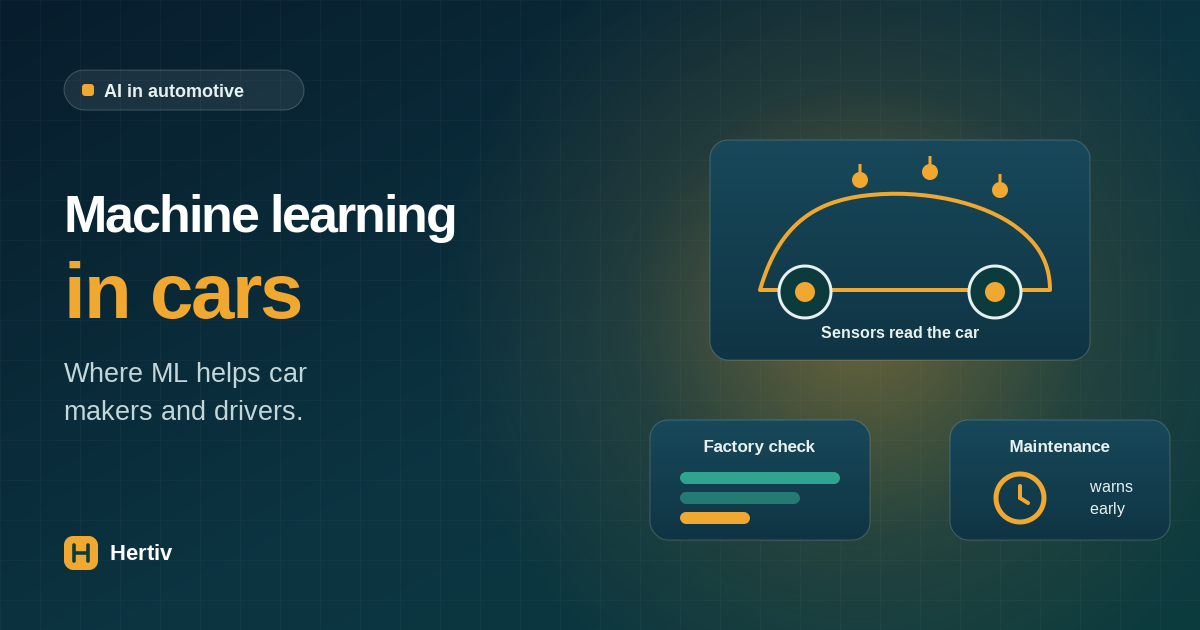
Machine learning helps car makers inspect parts, predict failures, assist drivers and plan production. Here is where it works in the automotive sector.
On this page
Short answer
Machine learning in the automotive sector means using models trained on vehicle, factory and road data to predict failures, inspect parts, assist drivers and plan production. It works where the data is plentiful and the cost of a missed problem is high.
What is machine learning in the automotive sector?
Machine learning in the automotive sector is the use of models trained on vehicle, factory and road data to make predictions and decisions that used to need human judgement. It covers factory quality checks, maintenance, driver assistance and supply planning.
The idea is simple: a model learns patterns from past examples, then applies them to new data. A camera on a production line learns what a good weld looks like. A sensor stream learns the vibration pattern that appears before a bearing fails. The model does not replace engineers, it gives them a faster way to spot problems and act on them.
What makes the sector a good fit is the volume of data. Modern cars carry dozens of sensors, factories log every step of assembly, and fleets report location and condition in real time. Machine learning turns that stream into warnings, rankings and forecasts that people can act on.
Where does machine learning help on the factory floor?
Machine learning helps most on the factory floor where inspection is repetitive and the cost of a missed defect is high. Cameras and sensors check parts faster than a person can, and they do not get tired at the end of a shift.
| Use case | What the model does | What it replaces |
|---|---|---|
| Visual inspection | Flags scratches, dents and bad welds | Manual spot checks |
| Predictive maintenance | Warns before a machine fails | Fixed service schedules |
| Process tuning | Adjusts settings for fewer defects | Trial and error by hand |
| Parts sorting | Sorts and routes parts by type | Manual sorting lines |
| Energy use | Forecasts demand and trims waste | Flat monthly budgets |
Visual inspection is usually the first win. A camera above a conveyor checks every part against examples of good and bad ones, and flags the doubtful cases for a human to review. The team still decides, but it reviews ten parts instead of ten thousand.
Predictive maintenance is the second common use. Vibration, temperature and current draw from a machine feed a model that has seen past failures, and it raises a warning days before a breakdown. That turns an emergency stop into a planned repair during a scheduled break.
How does predictive maintenance work in cars?
Predictive maintenance in cars works by watching sensor data from the vehicle and comparing it with patterns learned from vehicles that later failed. When the live data starts to look like the pre-failure pattern, the system raises a warning.
A typical setup collects data from the engine, brakes, battery and tyres, sends it to a central system, and scores each vehicle for risk. The score is not a diagnosis on its own. A mechanic still checks the car, but the warning tells them which cars to check first and what to look for.
Fleets benefit most, because one model serves hundreds of vehicles at once. A delivery company can plan workshop visits around the warnings instead of waiting for a breakdown on the road. For private cars, the same idea appears as a dashboard alert that suggests a service visit before a part fails.
The data needs to be clean for this to work. A model trained on one model of car will not transfer directly to another, and a sensor that drifts out of calibration will produce false warnings. Teams that succeed keep the data pipeline and the model under the same owner, so both get fixed together.
What does machine learning do for drivers?
Machine learning helps drivers through assistance systems that read the road and warn or act when a hazard appears. Lane keeping, adaptive cruise control, automatic emergency braking and parking assistance all rely on models that interpret camera, radar and lidar data.
The model takes in a stream of sensor readings and classifies what is around the car: lane markings, other vehicles, pedestrians, traffic signs and road edges. The car then decides whether to warn the driver, brake, or steer. The decision must happen in a fraction of a second, so these models run on hardware inside the car, not in a distant data centre.
Driver monitoring is a quieter use case. A cabin camera watches for signs of drowsiness or distraction and alerts the driver. This is a safety feature, not surveillance for its own sake, and it raises questions about privacy that car makers must answer clearly before they ship it.
Full self-driving is a different scale of problem from assistance. Assistance handles a narrow task with a human ready to take over. A self-driving system must handle the whole task, including the rare events no one predicted. That gap is why assistance features are common today while full autonomy is still limited to controlled trials.
How do car makers use machine learning in design and planning?
Car makers use machine learning in design and planning to test ideas before building physical prototypes. A model trained on crash test data, wind tunnel results and material tests can predict how a new shape will behave, which cuts the number of physical prototypes a team needs.
In planning, models forecast demand for parts and vehicles, which helps factories order the right quantities at the right time. A forecast that is wrong by a few percent can mean either a warehouse full of unsold parts or a line stopped for a missing one, so even a small improvement in accuracy is worth money.
Supply chain planning is a third area. A model can spot a supplier at risk from late deliveries, price moves or regional disruption, and suggest alternatives before the line stops. It works best when the data covers the whole chain, not just the first tier of suppliers.
These uses share a pattern: the model does the repetitive prediction work, and people make the decisions. A design team still chooses the shape, and a planner still signs the order. The model makes both jobs faster and better informed.
Example (hypothetical): cutting unplanned downtime at a parts plant
Example (hypothetical): a parts plant runs 20 stamping machines. Each machine breaks down 3 times a year on average, and each breakdown stops the line for 8 hours. That is 20 times 3 times 8, which is 480 hours of unplanned downtime a year.
The plant installs sensors and a model that warns two days before a bearing is likely to fail. The model catches 2 out of every 3 failures in time to fix them during a planned break. Failures fall from 60 a year to 20, and downtime falls from 480 hours to 160 hours, saving 320 hours a year.
The plant spends 120 hours a year on planned repairs triggered by warnings, plus the time to review false alarms. Even after that cost, the net saving is about 200 hours of line time a year. The numbers are invented to show the arithmetic, not a real result, but the shape is typical: the saving comes from planned work replacing emergency work, not from the model being perfect.
For teams planning a first project, machine learning development work usually starts with one machine and one failure type, then expands only after the first warnings prove useful.
What are the common mistakes?
The most common mistakes with machine learning in automotive are starting with the model instead of the data, trusting a demo on clean data, and ignoring the safety case.
- Starting with the model. Teams that pick a model before they know what data they have end up with a system that cannot be trained. Check the data first.
- Trusting a clean demo. A model that works on curated test images often fails on a real line, where lighting, dust and vibration change the picture. Test on real conditions.
- Ignoring the safety case. A driver assistance feature needs a clear answer to what happens when the model is wrong. If there is no answer, it is not ready to ship.
- Treating the model as finished. Roads, parts and drivers change, so a model that is never retrained drifts. Plan for retraining from the start.
- Skipping the human review step. A model that flags defects still needs a person to confirm the borderline cases. Removing the review step too early causes good parts to be scrapped.
How do you start with machine learning in automotive?
You start with machine learning in automotive by picking one costly, well-defined problem, gathering the data around it, and running a small pilot that a mechanic or inspector can check.
- Name the problem. Write down the defect, failure or delay in one sentence, with the cost attached. A vague goal produces a vague model.
- Check the data. Confirm you have labelled examples of both good and bad cases, and that the data is stored where a model can reach it.
- Run a pilot on one line. Train a model on one machine or one inspection point, and compare its calls with a human inspector for a month.
- Measure the saving. Count defects caught, downtime avoided and false alarms, and work out whether the pilot pays for itself.
- Plan the rollout. Only after the pilot works, extend to more lines, add retraining, and put someone in charge of the model.
A pilot that fails is still useful, because it shows where the data is weak. A pilot that succeeds gives the team evidence to fund the next step. For a wider view of how models fit a business, an AI readiness assessment can rank use cases against the data a team actually has.
Key takeaways
- Factory inspection and predictive maintenance are the most proven automotive ML uses
- Driver assistance relies on models that read camera, radar and lidar data in real time
- A model warns; a person still decides, inspects and signs off
- Clean, labelled data matters more than the choice of model
- Start with one costly problem and a small pilot on one line
Frequently asked questions
What is machine learning used for in cars?
It is used for driver assistance, predictive maintenance, quality inspection and planning. Assistance systems read the road and warn or act on hazards, while factories use models to spot defects and warn before machines fail.
Can machine learning predict car breakdowns?
It can warn when a breakdown is likely, by comparing live sensor data with patterns from past failures. The warning tells a mechanic which car to check first, but it is not a diagnosis on its own.
Is machine learning used in car factories today?
Yes. Visual inspection of parts and predictive maintenance of machines are in use now. A camera checks every part against examples of good and bad ones, and flags doubtful cases for a human to review.
What data does automotive machine learning need?
It needs labelled examples of both good and bad cases, plus sensor streams from vehicles or machines. Without enough labelled examples, a model cannot learn the difference between normal and faulty.
Does machine learning replace mechanics and inspectors?
No. It ranks and flags cases so people spend time on the ones that matter. A model that flags defects still needs a person to confirm borderline cases and decide what to fix.
How much does an automotive ML pilot cost?
It depends on the data, the hardware and the scope. A pilot on one inspection point with existing cameras costs far less than a plant-wide rollout, so teams usually start small and fund the next step from the result.


