Loyalty Program Tracking for Travel and Hospitality
Loyalty program tracking shows hotels and airlines which guests come back and what they spend. Here is how the tracking works and what to measure.
On this page
Short answer
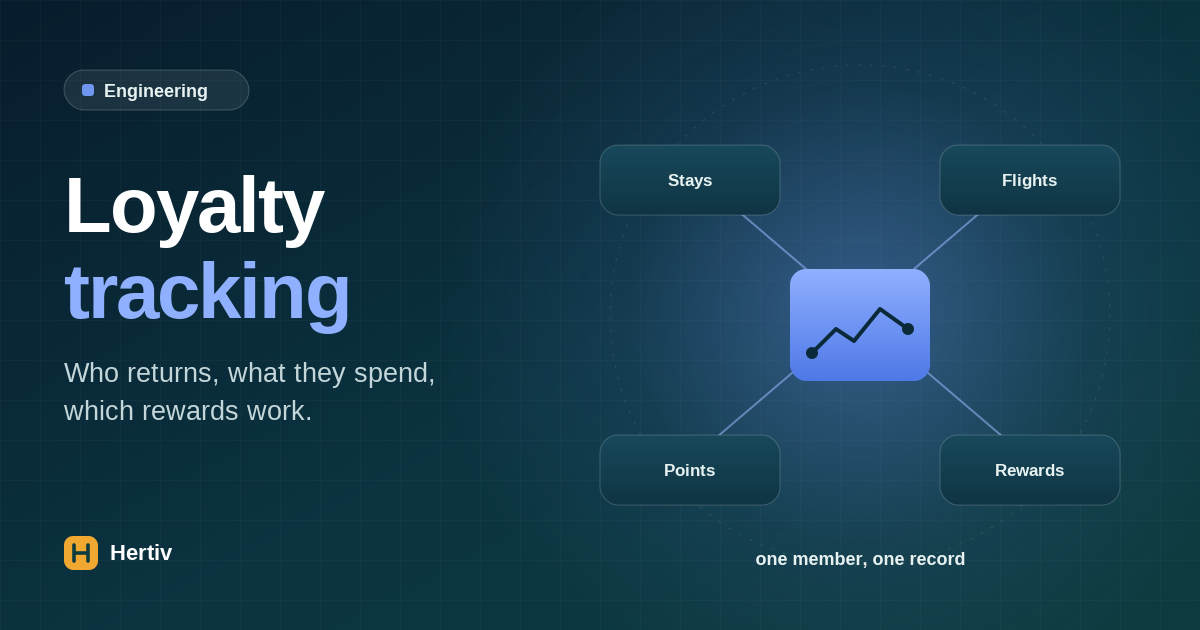
Loyalty program tracking is the system a hotel or airline uses to record each member's stays, flights, spending and rewards, so it can see who returns, what they value and which offers bring them back. It joins booking data, on-property spending and reward redemptions into one member record, and the measures that matter most are repeat rate, spend per member and the share of rewards that are actually used.
What is loyalty program tracking?
Loyalty program tracking is the way a travel or hospitality business records what each member does, from the first booking to the latest stay, and turns that record into decisions about rewards and offers. A member earns points or nights for each stay or flight, and the system tracks the balance, the tier and what the member redeems.
The tracking covers three things: earning, redemption and behaviour. Earning is points or nights added after each booking. Redemption is what members spend points on, such as free nights, upgrades or lounge access. Behaviour is the pattern underneath, such as how often a member books, how far ahead they book, and whether they book direct or through a third party.
Without tracking, a loyalty program is guesswork. With it, a hotel can see that members who book direct return twice as often as those who book through an agent, and an airline can see which routes fill with members who redeem miles rather than pay cash.
How does the tracking system work?
The tracking system joins data from the booking engine, the property management system, the payment system and the loyalty app into one member record. Each booking carries a member number, and each stay or flight adds points, nights or miles to that record automatically.
The flow has five steps. First, the member joins and gets a number and a tier. Second, each booking is tagged with that number at the time of booking or check-in. Third, points are calculated from the spend or the distance, using the program rules. Fourth, redemptions are recorded when the member spends points. Fifth, the data is cleaned and matched, so a member who books under two email addresses is still one person.
Matching is the hard part. Guests use different emails, book through agents, and share a family account. A good system matches on several signals, such as name, phone and payment card, and asks staff to confirm the member number at check-in. A hotel that wants this joined up with its own app can read more in the guide to mobile app development for guest-facing booking and loyalty features.
Which measures matter most?
The measures that matter most are repeat rate, spend per member, redemption rate and the cost of the program per member. Repeat rate shows whether members come back. Spend per member shows whether they spend more over time. Redemption rate shows whether rewards are attractive enough to use. Cost per member shows whether the program pays for itself.
| Measure | What it shows | Healthy sign |
|---|---|---|
| Repeat rate | Share of members who book again | Rising year on year |
| Spend per member | Average yearly spend by members | Above non-member spend |
| Redemption rate | Share of points actually used | Steady, not near zero |
| Direct booking share | Bookings made direct, not via agents | Growing over time |
| Cost per member | Rewards and running cost per member | Below extra revenue per member |
Watch these monthly, not yearly. A sudden fall in redemption rate usually means rewards have become too hard to use, and a fall in direct booking share usually means the program is not giving members a reason to book direct.
How do hotels and airlines use the data?
Hotels and airlines use the data to send offers that fit each member, to set tier benefits, and to decide which rewards to keep. A member who always books weekend city breaks gets weekend offers, not long-haul flight deals. A member who is one stay from the next tier gets a nudge to book that stay before the tier year ends.
Tiers are the main tool. A basic tier gets points and free Wi-Fi. A mid tier gets late check-out and room upgrades. A top tier gets lounge access and guaranteed availability. The tracking system decides who qualifies, when tiers change, and which benefits each member has used, so staff can see it at check-in without asking.
The data also shapes the program itself. If few members redeem a particular reward, it is dropped. If a reward is so popular that it costs too much, its price in points goes up. The program is reviewed every year against the same measures, and the rules change in small steps rather than all at once.
Example: a 200-room hotel tracks its loyalty members
Example (hypothetical): a 200-room city hotel has 12,000 loyalty members. In a year, 4,000 of them stay at least once, and the average member spends $600 a year, against $420 for a non-member. Members book direct 65% of the time, against 30% for non-members.
The hotel spends $18 per member per year on rewards and running the program. That is $216,000 for all 12,000 members. The extra spend from members is $180 per member per year, which is $2,160,000 across the 12,000 members. Even after the program cost, the members bring in far more than they cost.
The tracking also shows a problem: only 22% of points are ever redeemed. The hotel adds a simple reward, a free breakfast for 5,000 points, and redemption rises to 34% in six months. Members who redeem stay more often, so the repeat rate rises from 33% to 38% in the same period.
What are the common mistakes?
The most common mistakes are making points too hard to earn or use, tracking too little data, and treating all members the same. Each one weakens the program, and each is fixable with simpler rules and better data.
- Rewards that are too hard to reach. If a free night needs ten stays, most members give up; a small reward early keeps them engaged.
- Points that expire silently. Members who lose points without warning stop trusting the program; warn them first.
- Data in separate systems. If booking, payment and loyalty data never join, the hotel cannot see a member's full history.
- One offer for everyone. A business traveller and a family on holiday want different rewards; segment the offers.
- No review of the program cost. A program that costs more per member than it earns needs its rules changed, not more members.
How to set up loyalty tracking in five steps
You set up loyalty tracking by joining your booking, payment and stay data into one member record, then measuring the same few numbers every month. Start simple and add detail as the program grows.
- Give every member one number. Use a single member ID across booking, check-in and the app, and match duplicates by phone and payment card.
- Define the earning rules. Decide how many points a dollar or a night earns, and write the rules down so staff can explain them.
- Track redemptions the same way. Record every reward used, so you can see which rewards members actually want.
- Pick five measures and review monthly. Repeat rate, spend per member, redemption rate, direct booking share and cost per member are enough to start.
- Act on what you see. Change one rule at a time, such as adding a small early reward, and watch the measures for three months.
For a sense of what a guest-facing loyalty app costs to build, the guide to loyalty app costs shows the bands for a first version and a full app.
Key takeaways
- Loyalty tracking joins bookings, spending and redemptions into one member record
- Repeat rate, spend per member and redemption rate are the measures to watch monthly
- Members who redeem rewards return more often than members who never redeem
- One member number across booking, check-in and the app is the foundation
- Review the program yearly and change one rule at a time
Frequently asked questions
What is a good repeat rate for a hotel loyalty program?
There is no single good number, since it depends on the hotel type and the market. A city business hotel may see a third of members return in a year, while a resort may see far fewer. The useful test is whether the rate is rising over time and whether members return more often than non-members.
How do airlines track loyalty differently from hotels?
Airlines track miles by distance flown and fare paid, while hotels track nights and spend. Airlines also have more partners, such as credit cards and car hire, whose miles feed the same account. Both use tiers, and both need the same joined member record.
Why do so many loyalty points never get used?
Points go unused when rewards are too hard to reach, when they expire without warning, or when members do not know their balance. A small reward that is easy to reach, plus a reminder before expiry, usually lifts redemption without raising the program cost much.
Is a loyalty program worth it for a small hotel?
It can be, if the rules are simple and the tracking is cheap. A small hotel does not need a complex tier system; a stamp-style program with one or two rewards, tracked in the booking system, is enough to start. The test is whether members return more often than before.
What data should never be used for loyalty offers?
Avoid using data a guest would not expect you to use, such as health or location history outside the booking. Use booking, spend and stay history, which guests understand, and tell members what you track and why. Clear rules build trust.
How often should loyalty rules change?
Review the program once a year and change one or two rules at a time. Frequent changes confuse members and staff. When a rule does change, tell members in advance and explain what improves for them.


