Loan Application Processing Software: What It Actually Does
Loan application processing software collects applications, extracts document data, runs rules and risk checks, and routes decisions with an audit trail. Here is how it fits together.
On this page
Short answer
Loan application processing software is a system that takes a borrower's application and documents, extracts and validates the data, runs policy and risk checks, and moves the case to a decision, offer or manual review with a full audit trail.
What is loan application processing software?
Loan application processing software is a system that moves a credit application from submission to a decision, capturing borrower data, reading supporting documents, applying policy rules and recording every step. It replaces a mix of inboxes, spreadsheets and manual rekeying with one workflow.
The scope is wider than a web form. A working system usually covers six things:
- Intake: forms, uploads, email and partner channels, with validation at entry
- Document processing: extraction of income, identity and collateral data from PDFs and scans
- Decisioning: rules, scorecards and risk checks applied to the applicant
- Workflow: routing to analysts, underwriters or fraud review with SLAs
- Outputs: offer letters, adverse action reasons, disbursement instructions
- Audit: an immutable record of who saw what, when, and which rules fired
For many lenders the intake is easy and the last three are hard. Regulators and internal risk teams care about the audit trail as much as the decision itself. A system that cannot explain why a borrower was declined is not finished, even if it processes applications quickly.
Keep this definition in mind: the software is a decision pipeline with documents attached, not a document store with a form in front of it.
How the processing pipeline fits together
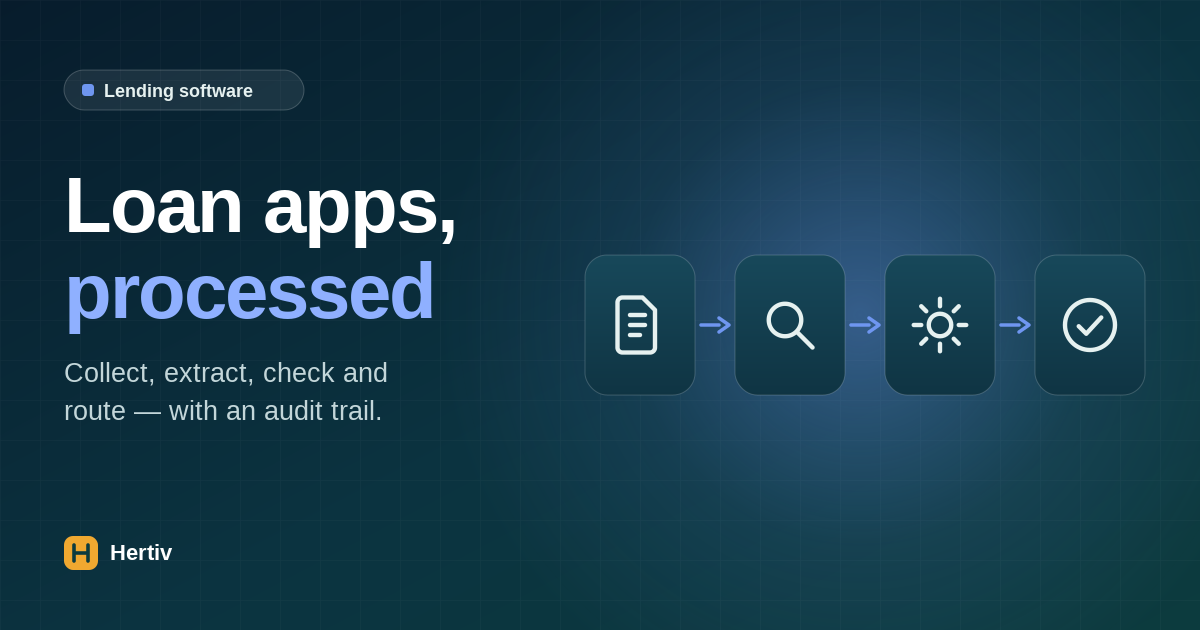
A reliable pipeline separates four stages so that each can be tested and replaced. Mixing them into one monolith is the most common cause of slow change later.
- Capture: the applicant submits data and files through a web or mobile channel. Validate field formats and required documents immediately, and store uploads with checksums so you can prove the file did not change.
- Extract and normalise: parse documents into structured fields. Payslips, bank statements and IDs have different layouts, so treat extraction as a model-driven step with confidence scores, not a regex script.
- Decide: apply policy rules, affordability calculations and risk checks. Keep rules in a readable, versioned format so credit and compliance teams can review them without a code deploy.
- Route and record: send clean cases to auto-decision, and exceptions to a queue with a reason code. Write an audit event for every state change.
A practical design point: make every stage idempotent. Applications get resubmitted, webhooks fire twice, and analysts click buttons twice. If a stage can be re-run safely, recovery from errors is a retry rather than a manual repair.
This is standard custom software work, but with higher audit requirements than most products.
Where document AI changes the economics
Document AI is the part of loan processing that has improved most in recent years. Instead of typing numbers from a payslip, the system extracts them, shows the source region to the analyst and flags low-confidence fields for review.
Useful patterns in production:
- Field-level confidence: route only uncertain fields to humans rather than the whole document
- Source highlighting: show the bounding box in the original scan next to the extracted value
- Cross-document checks: compare stated income on the application with the payslip and bank statement
- Structured output contracts: have the extraction step return a fixed schema so downstream rules are stable
The goal is not full automation. In lending, a small number of wrong extractions can be expensive, so the honest target is a review queue that is short and well ordered. Analysts should see the 20% of cases that genuinely need judgement.
You can read more about document AI and intelligent document processing if extraction is the weak point in your current flow.
Build or buy: how to decide
The decision usually depends on how unusual your credit policy is, not on your engineering headcount. Standard consumer products fit bought software well. Bespoke commercial or asset-backed lending often does not.
Consider buying when:
- Your products and policies resemble the vendor's existing customers
- You need to be live in months and can accept their data model
- Your team has no appetite to run document pipelines in production
Consider building or extending when:
- Underwriting depends on niche data or unusual affordability rules
- You need deep integration with internal risk and servicing systems
- Document types are non-standard and extraction quality is the main lever
- You want to own the decision model as a differentiator
A middle path works well in practice: buy the intake and case management layer, build the decisioning and extraction services, and keep the rules and model in your own repository. That keeps vendor lock-in limited to the parts that are genuinely commodity.
Whichever route you take, insist on export of raw documents, extracted data and audit events. It is the exit plan you will need later. Teams often pair this with custom software development for the glue and decision layer.
Example: a mid-market lender's flow
Example (hypothetical, for illustration): a lender receives 1,000 applications a month. About 600 arrive with complete documents, of which roughly 450 pass automated policy checks and are auto-decided.
The remaining 550 need some human attention:
- 400 have missing or unreadable documents and go back to the applicant automatically with a specific request
- 100 have low-confidence extracted fields and go to a short review queue
- 50 are genuine exceptions that reach an underwriter
The arithmetic: 450 + 400 + 100 + 50 = 1,000. The underwriter's queue is 50 cases, not the full book. That shift, not raw speed, is what makes the economics work.
The numbers are illustrative. The pattern matters: most volume should be resolved by validation, extraction confidence and clear rules, leaving humans for judgement calls.
Risk, compliance and audit requirements
Lending is a regulated activity, so the audit trail is a first-class feature. In most jurisdictions you must be able to show what data was used, which rules applied and who approved a decision.
Practical requirements to design in from day one:
- Immutable event log: append-only records of state changes, sign-offs and rule versions
- PII handling: encryption at rest, field-level access control, and retention rules that match policy
- Explainable decline reasons: map internal rules to reasons a reviewer and the customer can understand
- Model accountability: record the version of any scoring or extraction model used at decision time
- Segregation of duties: the person who configures a rule should not silently approve cases it affects
A useful rule of thumb: any decision should be reconstructable from stored events alone, without asking an engineer. If it is not, the audit process will be painful.
Security work here is not optional. See cybersecurity services for product and engineering teams for the controls that typically apply.
Common mistakes
Most failures in loan processing systems are predictable. These come up repeatedly.
- Treating extraction as perfect: no confidence handling, so every wrong field reaches decisioning
- Rules hidden in code: credit policy changes require a release cycle, and nobody can explain a decline
- No idempotency: retries create duplicate applications or double disbursements
- Vague document requests: applicants resubmit the same unreadable file
- Building the full product before testing the pipeline: months spent on UI while extraction quality is unknown
- Ignoring the review queue design: analysts get a flat list with no priority or context
- Skipping the audit log until compliance asks: retrofitting it costs far more than building it in
A short, honest prototype on real documents from your portfolio usually reveals which of these will bite you. Run that before committing to an architecture, and validate any AI component against a fixed test set rather than spot checks.
Key takeaways
- The core job is document intake plus decisioning, not form filling
- Separate extraction, decisioning and audit so each can change independently
- Most failures come from poor document quality and unclear policy rules
- Human review is a product feature, not a fallback
- Build vs buy usually depends on how unusual your credit policy is
Frequently asked questions
What should loan application processing software include at minimum?
At minimum: intake with validation, document upload and extraction, a versioned rules engine, routing to human review, and an audit log of every state change and decision. Without the audit log it will not pass most compliance reviews.
How accurate is document AI on payslips and bank statements?
Accuracy depends heavily on document quality, layout variety and the model used. Rather than quoting a figure, test on a sample of your own documents and measure field-level accuracy. Then set thresholds so low-confidence fields go to human review.
Can we start with a small build instead of a full platform?
Yes, and this is usually the right approach. Build the pipeline for one product and one document set, measure extraction quality and review rates, then expand. A narrow build exposes integration and policy problems early at much lower cost.
How do we handle declined applications fairly?
Store the exact rules and model versions that fired, and map them to plain-language decline reasons. Give applicants a clear path to appeal. Review decline reasons periodically to check for unintended patterns across applicant groups.
Where does AI fit beyond document extraction?
Common places are affordability summaries, fraud signal triage, and analyst copilots that draft case notes from documents. Keep a human decision point for anything that changes credit outcomes, and log which model version was used.
What data do we need before starting a build?
A representative sample of applications and documents, your current credit policy in written form, and a few real workflows including review and escalation. Missing policy documentation is the most common blocker in early design.


