8 LLM Development Companies for Startups Worth Shortlisting
Eight LLM development companies building production products for startups, from fine-tuning and RAG to agents. Compare what each one focuses on.
On this page
Short answer
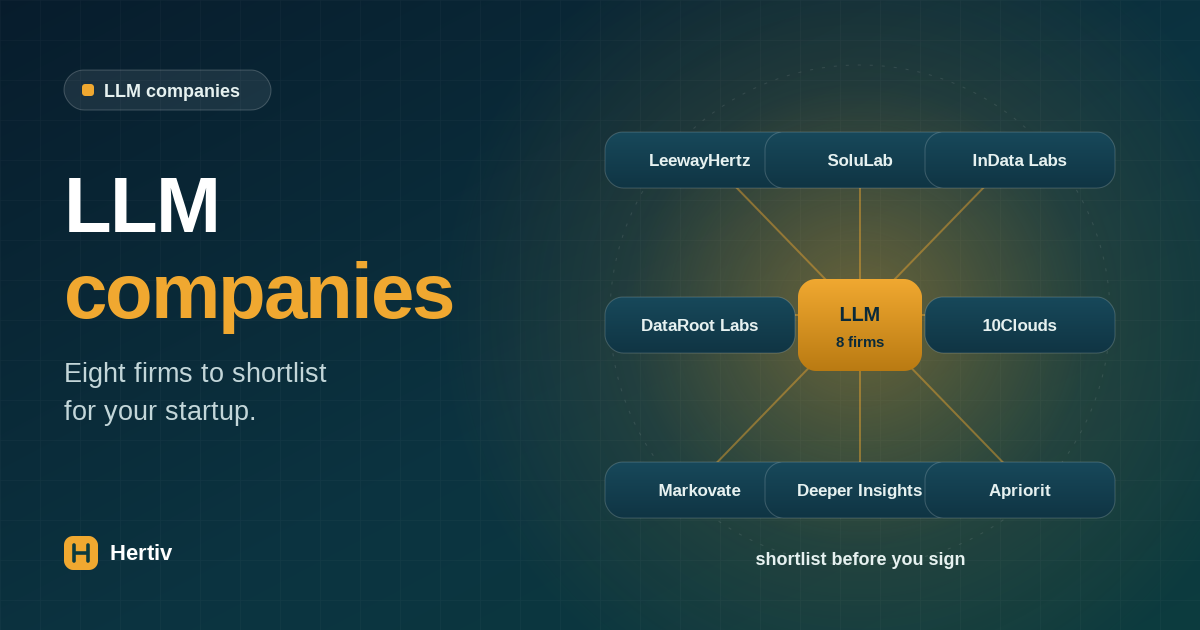
LLM development companies build language-model products for startups: fine-tuning, retrieval-augmented generation, chatbots, copilots and agents. The eight below are established AI development firms with public LLM service offerings. Compare their focus, the industries they serve and how they work with small teams before you shortlist two or three for a call.
Which LLM development companies should startups shortlist?
The companies worth shortlisting are established AI development firms that build LLM products for small teams, not just model vendors. Look for a team that has shipped a production LLM feature, can show how it evaluates answers, and works in weekly sprints with a fixed scope.
| Company | LLM focus | Best for startups that need |
|---|---|---|
| LeewayHertz | LLM apps, agents, RAG | A full product team from idea to launch |
| SoluLab | LLM apps, chatbots, fine-tuning | Fast delivery of a first LLM feature |
| InData Labs | LLM apps, data platforms, RAG | Data-heavy products with retrieval |
| Markovate | LLM apps, agents, copilots | An AI feature inside an existing product |
| Deeper Insights | LLM apps, document AI, RAG | Document work and regulated data |
| Apriorit | LLM integration, AI security | Secure integration into existing systems |
| DataRoot Labs | LLM apps, RAG, data science | A data science team for one product |
| 10Clouds | LLM apps, product design, AI | Design-led product with an AI core |
None of these firms sells a model. They build the product around a model: the retrieval layer, the prompts, the evaluation set, the user interface and the monitoring. That is the work that decides whether an LLM feature survives its first month in production.
<h3>1. LeewayHertz: best for a full product team from idea to launch</h3>
LeewayHertz is an AI development company that builds LLM applications, agents and RAG systems for startups and enterprises. Its public work covers chatbots grounded in company data, document processing, copilots and multi-agent workflows. The team takes products from discovery through launch and ongoing support.
The firm suits a startup that wants one partner for the whole build rather than separate vendors for design, data and engineering. Ask how it evaluates answer quality before launch, and how it handles model updates after launch.
Pros:
- Full product team: discovery, build, launch and support
- Public LLM work across chatbots, RAG and agents
- Experience with enterprise and startup clients
Cons:
- Full-service scope can cost more than a narrow team
- Best for funded teams with a defined product
2. SoluLab: best for fast delivery of a first LLM feature
SoluLab is a software and AI development company that builds LLM applications, chatbots and fine-tuned models for startups. Its public work covers customer support agents, content tools and RAG systems built on a client's own documents. The firm works in short engagements aimed at shipping a first working feature.
The firm suits a startup that wants a working LLM feature in weeks rather than a long discovery phase. Ask what the first release covers, what the evaluation set looks like, and what happens when the model gives a wrong answer.
Pros:
- Short engagements aimed at a first working feature
- Public LLM work in chatbots and RAG
- Works with early-stage teams
Cons:
- Less suited to long, open-ended research work
- Ask how handover and documentation are handled
<h3>3. InData Labs: best for data-heavy products with retrieval</h3>
InData Labs is a data science and AI development company that builds LLM applications, RAG systems and data platforms. Its public work covers retrieval over large document sets, predictive models and analytics products. The team is strongest where the product depends on data pipelines as much as on the model.
The firm suits a startup whose LLM feature needs clean data, a retrieval layer and ongoing data work, not just a prompt. Ask how it structures the data pipeline and how it measures retrieval quality.
Pros:
- Strong data engineering behind the LLM layer
- Public RAG and analytics work
- Good fit for document-heavy products
Cons:
- Data work adds setup time before the first demo
- Best when the data problem is real, not assumed
4. Markovate: best for an AI feature inside an existing product
Markovate is an AI development company that builds LLM applications, agents and copilots for startups. Its public work covers AI features added to existing products, such as chat assistants, content generation and workflow automation. The team works in product sprints with a defined scope.
The firm suits a startup that already has users and wants to add an AI feature without rebuilding the product. Ask how the feature is scoped, how it is tested with real users, and how it degrades when the model is unavailable.
Pros:
- Focus on adding AI to existing products
- Sprint-based work with defined scope
- Public work in copilots and agents
Cons:
- Less suited to building a whole product from zero
- Ask about post-launch support terms
<h3>5. Deeper Insights: best for document work and regulated data</h3>
Deeper Insights is an AI development company that builds LLM applications, document AI and RAG systems. Its public work covers document extraction, question answering over internal records, and analytics for regulated industries. The team works with data that needs careful handling and audit trails.
The firm suits a startup in a regulated field, such as finance, health or legal work, where the LLM must cite sources and keep an audit trail. Ask how it handles data privacy, how answers are cited, and how the system is tested before launch.
Pros:
- Experience with regulated data and audit trails
- Document AI and RAG as core services
- Citation-first answers for compliance
Cons:
- Compliance work adds time to the build
- Best when the regulatory need is genuine
6. Apriorit: best for secure integration into existing systems
Apriorit is a software development company with AI and security practices that builds LLM integrations for startups and enterprises. Its public work covers AI features added to existing systems, with attention to data protection, access control and secure deployment. The team is strongest where the LLM must fit inside a system that already exists.
The firm suits a startup that needs an LLM feature inside a product with existing users, data and security rules. Ask how the integration is secured, how user data flows to the model, and how access is controlled.
Pros:
- Security practice alongside AI development
- Experience integrating into existing systems
- Clear process for access and data control
Cons:
- Security review adds steps to the schedule
- Less suited to greenfield product design
<h3>7. DataRoot Labs: best for a data science team for one product</h3>
DataRoot Labs is a data science and AI development company that builds LLM applications, RAG systems and custom models for startups. Its public work covers data science teams dedicated to one product, from data preparation through model deployment and monitoring. The team works in longer engagements than a typical agency sprint.
The firm suits a startup that needs a data science team for months, not a single feature. Ask how the team is staffed, how knowledge is handed over, and how the model is monitored after deployment.
Pros:
- Dedicated data science team for one product
- Data preparation through deployment and monitoring
- Public RAG and custom model work
Cons:
- Longer engagements than a sprint-based firm
- Needs a clear product scope to stay on track
8. 10Clouds: best for a design-led product with an AI core
10Clouds is a software development company that builds LLM applications with a strong product design practice. Its public work covers AI-powered products where the user experience matters as much as the model: onboarding, chat interfaces, dashboards and mobile apps. The team combines design, engineering and AI in one engagement.
The firm suits a startup whose LLM product must feel polished from day one, such as a consumer app or a tool sold to non-technical users. Ask how design and AI work are sequenced, and how the interface handles wrong or uncertain answers.
Pros:
- Design and engineering in one team
- Strong product and interface work
- Public AI product work for startups
Cons:
- Design-led process adds time before coding
- Best when the user experience is a priority
How to choose an LLM development company
You choose an LLM development company by testing how it works, not by reading its service list. Run these five steps before you sign anything.
- Ask for a shipped product, not a demo. A company that has put an LLM feature in front of real users can show how it handled wrong answers and model updates.
- Ask how it evaluates answers. A serious team has a test set of real questions with known answers, and a process for re-testing after every change.
- Check the data plan. Ask how your documents are prepared, how retrieval is measured, and where your data goes when it reaches the model.
- Compare the first release, not the roadmap. Ask what ships in the first four weeks, what it costs, and what happens if the first release misses.
- Agree on handover. Ask what documentation, prompts and evaluation sets you receive, and who supports the product after launch.
Shortlist two or three firms and give each the same brief: your data, your users, your first feature and your deadline. The quality of the questions they ask back tells you more than any service page.
For help scoping the brief, see LLM development services.
Also read how to evaluate an LLM application before launch.
Key takeaways
- Shortlist firms that have shipped an LLM feature to real users, not just demos
- Ask how the firm evaluates answers and what test set it uses
- Check the data plan: preparation, retrieval quality and where data flows
- Compare the first four-week release, not the roadmap
- Agree on handover: prompts, evaluation sets and post-launch support
Frequently asked questions
How much does it cost to hire an LLM development company?
Costs vary widely with scope, data work and team size, so no single figure is useful. Ask each shortlisted firm for a fixed-scope quote on the same brief: the first feature, the data it needs and the deadline. Compare the first release each firm offers, not the hourly rate alone.
Should a startup fine-tune a model or use RAG?
Most startups start with RAG, because it grounds answers in their own documents without training a model. Fine-tuning fits when the model needs a consistent tone, format or behaviour that prompting cannot hold. A good firm will test RAG first and only recommend fine-tuning when the test set shows a gap.
How long does it take to build an LLM feature?
A first working feature usually takes four to eight weeks when the data is ready and the scope is narrow. Data preparation, evaluation and security review add time. Firms that promise a production feature in days are usually skipping the evaluation step.
Do I need my own data to work with an LLM company?
Yes, for anything beyond a generic chatbot. The value of an LLM product comes from your documents, your data and your users. A firm will ask for sample documents and a list of real questions early, because the quality of the data decides the quality of the answers.
What should I ask in the first call with an LLM company?
Ask for a shipped product, how it evaluates answers, how your data is handled, what ships in the first four weeks, and what handover you receive. The quality of the answers, and the questions the firm asks back, tell you more than any service page.
Can a small startup afford an LLM development company?
Yes, if the scope is narrow. A single feature, such as a support agent over your help centre, is a common first engagement. Start with a fixed-scope pilot of four to eight weeks, measure it against a test set, and decide whether to continue from the results.


