What Is Lightchain AI and How Does It Work?
Lightchain AI is a layer-1 blockchain that runs open AI models on a network of independent workers paid in LCAI. Here is how it works and what to check first.
On this page
Short answer
Lightchain AI is a layer-1 blockchain built to run AI models on a network of independent operators, called workers, who stake LCAI and serve open models such as Llama and Qwen from their own GPUs. The chain assigns each job, holds the fee in escrow and keeps a public record of every job, so answers are traceable.
What is Lightchain AI?
Lightchain AI is a layer-1 blockchain built to run artificial intelligence models on a network of independent computers instead of on servers owned by one company. It combines a blockchain ledger with AI computation, so model answers can be requested, paid for and recorded on-chain.
The project has two core ideas. Proof of Intelligence (PoI) is its consensus mechanism: network participants are rewarded for useful AI work such as model training, inference and optimisation, rather than for raw hashing. The Artificial Intelligence Virtual Machine (AIVM) is the execution layer that runs AI-specific tasks on the blockchain.
The network's token is LCAI. It pays for AI jobs, covers transaction fees and gives holders a vote in the Lightchain DAO, which controls the network's Treasury. The project's legal entity is the LCAI DUNA, an association registered in Wyoming. If the blockchain part is new to you, start with what a blockchain is before going further.
How does Lightchain AI work?
A job on Lightchain AI starts when someone asks a model a question through one of the network's apps, such as Lightchain Chat or Lightchain Desktop. Each question is one job on the blockchain, paid in LCAI at a fixed price shown beside the model, not by the length of the answer.
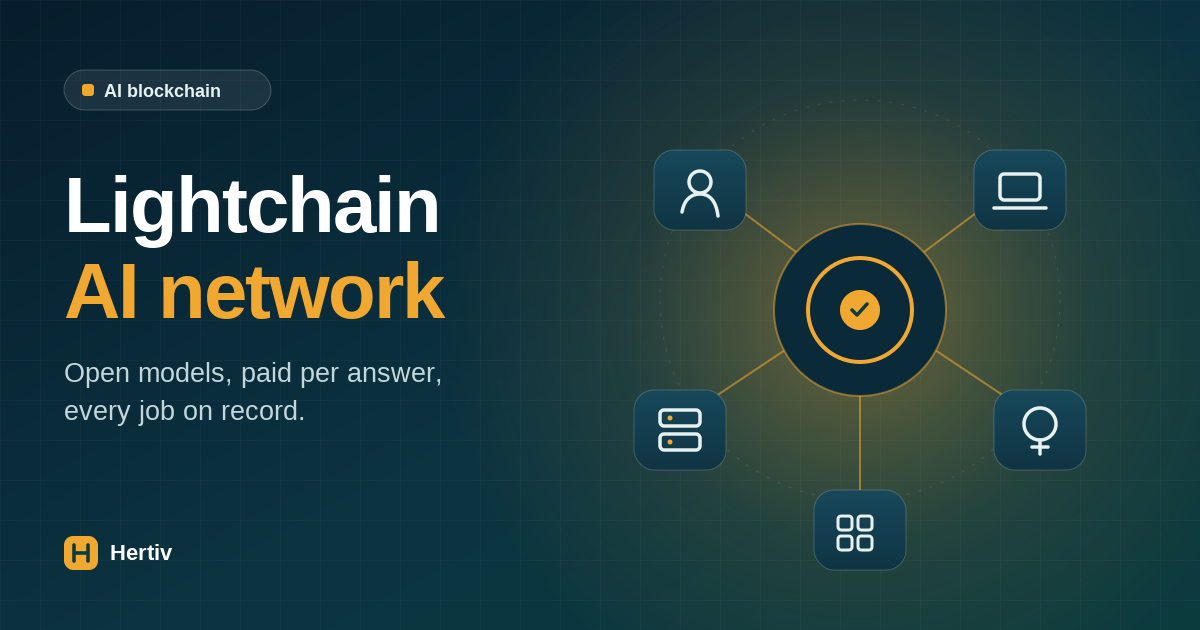
Independent operators, called workers, serve the models from their own GPUs. To serve jobs, a worker stakes 50,000 LCAI. The chain picks the worker for each new session by a weighted random draw, so no single company assigns the work.
The chain holds the fee in escrow while the job runs. When the answer is served, every job leaves an onchain record with its job ID, its transaction and the worker that served it, so anyone can look up what happened.
The network serves open models such as Llama, Qwen, GPT-OSS and DeepSeek-R1. Fees differ by model: on the network's list of October 21, 2026, each model had one fixed fee per answer, from 0.02 to 0.20 LCAI.
What is Proof of Intelligence?
Proof of Intelligence is the mechanism Lightchain AI uses to agree on the state of the network and to reward participants. Instead of rewarding raw computing power, it rewards nodes for performing AI computations that are useful, such as training a model, running inference or optimising a result.
The idea is that the work securing the chain is the same work users want done. A node that serves model answers contributes to the network and earns LCAI for it. That ties the token to real AI work rather than to guessing hashes.
For users, the practical effect is verifiable inference: each answer comes with a public record of which worker served it. If an answer looks wrong, the record shows where it came from, which makes problems easier to trace than in a closed API.
What is the Artificial Intelligence Virtual Machine?
The Artificial Intelligence Virtual Machine, or AIVM, is the execution layer that runs AI tasks on the Lightchain blockchain. It is designed for AI-specific work, such as running a model, scoring a result or coordinating a multi-step AI job, rather than for general smart-contract logic.
Developers build on the AIVM when they want AI features inside a decentralised app: an agent that answers questions, a tool that scores documents, or a service that other apps can call and pay for per use.
The AIVM works with the chain's record-keeping, so AI jobs can be paid for, logged and checked in the same place. That is the part of the design that supports the project's later plans for onchain AI agents: services with their own onchain names that apps and other AIs can find, call and pay for. Teams planning this kind of build usually start with LLM development for production to scope the model side first.
What can you use Lightchain AI for today?
The network's live products cover asking models questions, running a worker, building apps and moving tokens. The table below lists what is available now.
| Product | What it does | Who it is for |
|---|---|---|
| Lightchain Chat | Ask open models, pay per answer | Anyone with a question |
| Lightchain Desktop (beta) | Chat, wallet and worker tools in one app | Desktop users |
| Lightchain Studio | Build AI apps on the network | Developers |
| Lightchain Bridge | Move tokens between chains | Token holders |
| Lightscan | Look up jobs and transactions | Anyone checking a record |
The public roadmap targets a mainnet launch in early 2027, after a go or no-go decision and its own approval. Until then, the network runs with the products above, and the team is adding an agents layer with a waitlist open now.
Example (hypothetical): a small team checks its AI costs
Example (hypothetical): a five-person support team answers product questions with an open model through Lightchain Chat. The team sends 200 questions a month, and the model they use charges a fixed 0.10 LCAI per answer.
The arithmetic is simple: 200 questions × 0.10 LCAI = 20 LCAI for the month. Because the fee is fixed per answer, the team knows the cost before it sends a question, and longer answers do not cost more.
Each answer also leaves an onchain record. When a customer disputes an answer, the team can look up the job ID and see which worker served it, instead of arguing from memory. That record is the part the team values most: cost is predictable, and answers are traceable.
What are the common mistakes?
The most common mistakes are treating the token as the product, assuming mainnet is already live, and expecting closed-model quality from open models.
- Buying the token before understanding the network. LCAI pays for jobs and votes in the DAO, but the product is the AI network, not the token.
- Planning around a launch date. Mainnet is targeted for early 2027, and launch timelines for this project have moved before, so treat dates as plans, not promises.
- Ignoring the worker stake. Running a worker needs 50,000 LCAI staked plus a GPU that can serve the models, so it is not a casual side setup.
- Skipping the onchain record. The record is the main advantage over a closed API; if you never check it, you lose the benefit.
- Comparing open models with closed ones on the wrong tasks. Open models suit general questions and drafting, not every specialist job.
Key takeaways
- Lightchain AI is a layer-1 blockchain that runs open AI models on independent workers' GPUs
- Workers stake 50,000 LCAI and are picked by a weighted random draw for each session
- Each answer has a fixed fee per model and leaves an onchain record anyone can look up
- Proof of Intelligence rewards useful AI work; the AIVM runs AI tasks on-chain
- Mainnet is targeted for early 2027, so check the live status before planning around it
Frequently asked questions
What is Lightchain AI in simple terms?
Lightchain AI is a blockchain network where independent operators run open AI models on their own computers. You ask a model a question, pay a fixed fee in LCAI, and every job is recorded on the blockchain so the answer can be traced.
What is the LCAI token used for?
LCAI pays for AI jobs on the network, covers transaction fees, and gives holders a vote in the Lightchain DAO. Workers must also stake 50,000 LCAI before they can serve model answers.
How much does one answer cost?
Each model has one fixed fee per answer, shown beside the model. On the network's list of October 21, 2026, fees ranged from 0.02 to 0.20 LCAI per answer, and the fee does not depend on the length of the answer.
What is Proof of Intelligence?
Proof of Intelligence is Lightchain AI's consensus mechanism. It rewards network participants for useful AI computations such as model training, inference and optimisation, instead of rewarding raw hashing power. The work that secures the chain is the same work users want done.
Is Lightchain AI mainnet live yet?
The public roadmap targets a mainnet launch in early 2027, after a go or no-go decision and its own approval. Until then the network runs with its current products, including Lightchain Chat, Desktop in beta, Studio, Bridge and Lightscan.
How is Lightchain AI different from a normal AI API?
A normal AI API runs on one company's servers and keeps its records private. Lightchain AI assigns jobs across independent workers, holds the fee in escrow and records every job on-chain, so who served an answer and what it cost can be checked by anyone.


