Latest Meditation App Statistics: What the Numbers Say
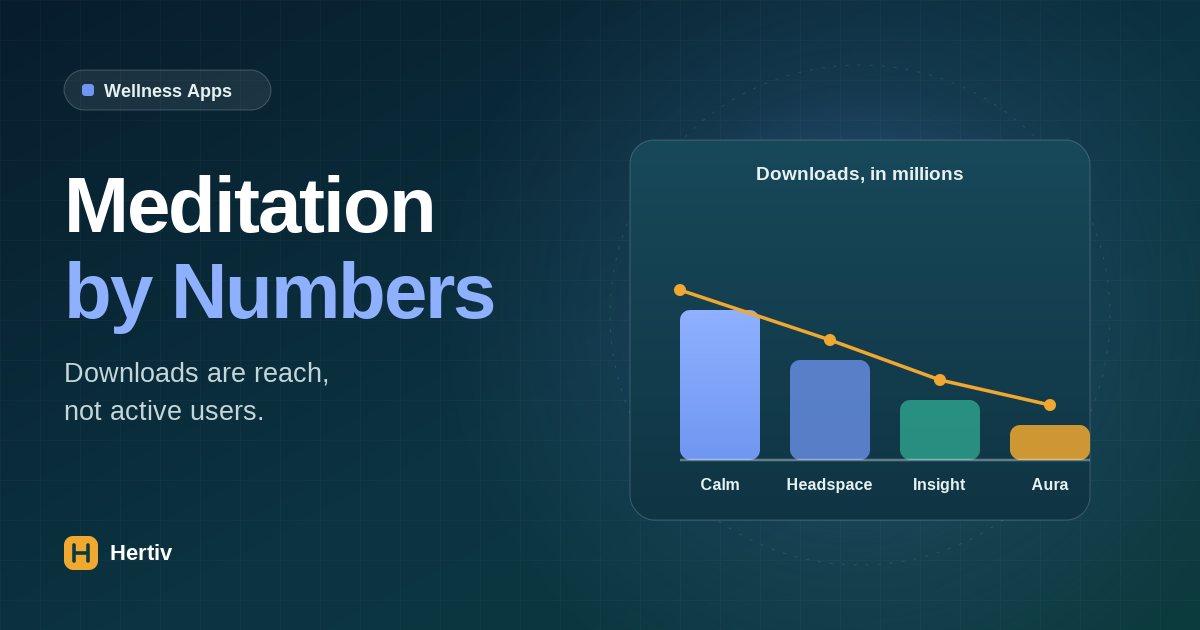
Calm reports more than 180 million downloads and Headspace more than 105 million, but downloads are not users. Here is what the latest numbers actually say.
On this page
Short answer
The latest meditation app statistics come from the companies themselves: Calm reports more than 180 million downloads, Headspace more than 105 million downloads in 200 countries, and Insight Timer 30 million people practising on its app. Smaller apps report user counts instead, from Breethe at more than 18 million to Medito at 4.1 million. Read downloads as reach, not as active users.
What do the latest meditation app statistics show?
Meditation app statistics are the published download, user and review counts that meditation apps report about themselves. The latest figures show a market led by two large apps, Calm and Headspace, with a long tail of smaller apps that report users rather than downloads.
The headline numbers are simple. Calm says its app has been downloaded more than 180 million times. Headspace says its app has been downloaded more than 105 million times and is used in 200 countries and regions. Insight Timer says 30 million people practise on its app. These are the figures the companies publish on their own pages, and they are the most reliable numbers available, because no independent body audits app downloads.
| App | Figure the company publishes | What it counts |
|---|---|---|
| Calm | More than 180 million | Downloads, worldwide |
| Headspace | More than 105 million | Downloads, in 200 countries and regions |
| Insight Timer | 30 million | People practising on the app |
| Breethe | More than 18 million | Users |
| Aura | More than 8 million | Users |
| Medito | 4.1 million | Users |
Two things stand out. First, the gap between the leaders and the rest is wide: Calm reports more downloads than the next three apps put together report as users. Second, the figures do not all count the same thing, which is why the next section explains what each number means.
How big are the leading meditation apps?
Calm is the largest meditation app by the numbers its maker publishes, with more than 180 million downloads and 3 million five-star reviews. Those two figures describe different things: downloads count how many times the app was installed, while reviews count how many people left a five-star rating. Both point the same way, that Calm reaches more people than any rival.
Headspace is the second largest, with more than 105 million downloads across 200 countries and regions. Its reach is broader in one sense: the company stresses how many countries it operates in, which matters for an app sold in many languages. A download in a new country is worth more to Headspace than a second download in a market it already serves.
Insight Timer takes a different approach and reports people rather than downloads: 30 million people practise on its app. That number is smaller than the leaders' download totals, but it is arguably more honest, because it describes people who use the app rather than people who once installed it. The smaller apps follow the same pattern: Breethe reports more than 18 million users, Aura more than 8 million, and Medito 4.1 million.
What do downloads, users and subscribers each mean?
Downloads count installations. One person who installs an app, deletes it and installs it again can count twice, and a download says nothing about whether the app was ever opened. That is why downloads are a measure of reach, not of use.
Users usually count accounts, or people the company can see using the app. A user figure is closer to real use than a download figure, but it still says little about frequency: a person who opens the app once a year is a user on paper. Some companies report monthly active users instead, which is a stricter test, but none of the meditation apps in this article publishes a current monthly active user count.
Subscribers count people who pay. This is the number that matters most to the business, because it drives revenue, and it is the number companies publish least often. No major meditation app publishes a current paid subscriber count, so any article that quotes one is guessing. Treat a subscriber figure with no named source as an estimate, not a fact.
The practical rule is simple: compare downloads with downloads, users with users, and never mix the two. Calm at 180 million downloads and Insight Timer at 30 million people are not directly comparable, because they count different things. Mobile app development teams track the same three numbers for their own apps, for the same reason.
How should you read a meditation app statistic?
Read any meditation app statistic by asking three questions: who published it, what does it count, and when was it last updated. A figure from the company's own page is the most reliable, because the company can be held to it. A figure from a data firm is an estimate, and a figure from a roundup article may be years old.
Check the date first. Download totals only grow, so an old figure is always lower than the current one, and an app that looks small on a 2023 figure may have doubled since. If an article does not give a date for its numbers, treat them as background, not as current fact.
Check what is being counted next. A headline that says "30 million users" sounds impressive, but it means little without knowing whether those users are monthly, yearly or lifetime. The same applies to reviews: Calm's 3 million five-star reviews describe ratings left over many years, not satisfaction today.
Finally, check what the number leaves out. A download total says nothing about retention: most people who install an app stop using it within weeks. A user total says nothing about payment. The honest reading of a meditation app statistic is always narrower than the headline suggests.
Example (hypothetical): comparing two apps by the numbers
Example (hypothetical): a team building a wellness app compares the two leaders. Calm reports more than 180 million downloads and Headspace more than 105 million, so the difference is 75 million downloads, and Calm's total is about 1.7 times Headspace's, since 180 divided by 105 is about 1.71.
The team then asks what those downloads are worth. Suppose one in ten downloads becomes a regular user. That gives Calm about 18 million regular users, since 180 million times 10 percent is 18 million, and Headspace about 10.5 million, since 105 million times 10 percent is 10.5 million. The gap narrows in absolute terms but stays the same in proportion: Calm still leads by roughly 7.5 million regular users.
The team does not stop there. It checks Insight Timer's 30 million people practising, which is already larger than either leader's hypothetical regular-user count, and realises that a smaller download total can hide a more engaged audience. The lesson is that the biggest number is not always the most useful one: engagement, not reach, decides whether an app keeps its users.
Which statistic matters most when you choose an app?
Which statistic matters depends on what you want the app to do. If you are choosing an app for yourself, the download total matters least: a popular app is not necessarily the one that fits your routine. What matters is the size of the free library, the length of the sessions, and whether the app covers sleep, stress or focus, whichever you need most.
If you are building an app, the user and retention numbers matter most. A rival with 30 million people practising has an audience that returns, which is harder to build than a large download total. Look for what the rival publishes about its users, not its downloads, and ask what keeps those users coming back.
If you are investing or partnering, the subscriber number matters most, and it is the one you will have to ask for, because it is rarely published. A company that will not share its subscriber count is not necessarily hiding bad news, but you should not fill the gap with a guess.
Ask for the number, or value the business on what is published and nothing else. SaaS development teams face the same choice when they judge a rival's health.
What are the common mistakes?
The most common mistakes are comparing numbers that count different things, trusting undated figures, and treating downloads as users.
- Comparing downloads with users. Calm's 180 million downloads and Insight Timer's 30 million people are different measures. Compare like with like, or say clearly that you cannot.
- Quoting a figure with no date. Download totals only grow, so an old number understates the present, and an old market claim may no longer be true.
- Treating downloads as users. Most people who install an app stop using it quickly. A download is a try, not a habit.
- Trusting a subscriber figure with no source. No major meditation app publishes a current paid subscriber count. If you see one quoted without a source, it is an estimate.
- Ignoring the free library. The size of what is free matters more to a new user than any download total. Product discovery work starts with what users actually get, not with how many installed the app.
A useful check is to read the company's own page before you quote a number. If the figure is not there, say so, and say what the company does publish instead. That keeps the article honest and the reader informed.
Key takeaways
- Calm reports more than 180 million downloads; Headspace more than 105 million
- Insight Timer reports 30 million people practising, not downloads
- Downloads measure reach, users measure accounts, subscribers measure payment
- No major meditation app publishes a current paid subscriber count
- Always check who published a figure, what it counts, and when
Frequently asked questions
What is the most downloaded meditation app?
Calm, by the figures the companies publish themselves. Calm reports more than 180 million downloads worldwide. Headspace is second, with more than 105 million downloads in 200 countries and regions. No other meditation app publishes a larger download total.
How many people use Insight Timer?
Insight Timer says 30 million people practise on its app. That figure counts people who use the app, rather than downloads, which makes it different from the totals Calm and Headspace publish. It is the largest user count published by a free-first meditation app.
Are meditation app download numbers reliable?
Download totals from the companies themselves are the most reliable figures available, because the companies publish them on their own pages. They are still limited: a download counts an installation, not a regular user, and the same person can count more than once.
Why do some apps report users instead of downloads?
Smaller apps often report users because it describes their audience better. A download total can be inflated by people who install and never open the app, while a user count describes people the company can see using it. Both figures are honest if the company says what it counts.
Do meditation apps publish subscriber numbers?
No major meditation app publishes a current paid subscriber count. Subscriber numbers drive revenue, so companies keep them private. Any article that quotes a subscriber figure without naming its source is passing on an estimate, not a fact.
How often do meditation app statistics change?
Download totals change every day, because every new installation adds to the total. The published figures change only when a company updates its own page, which happens rarely. Treat any figure as current only if you have checked the company's page recently.


