Kotlin vs Java: Which Language Should Your Team Pick?
Kotlin and Java both run on the JVM, but Kotlin is shorter and safer by design while Java is older and wider. Here is how to choose between them for your project.
On this page
Short answer
Kotlin and Java are both languages for the Java Virtual Machine, and they can be used together in one project. Kotlin is the newer language: it is shorter to write, guards against null errors by design, and is the preferred language for Android. Java is older, has a larger body of existing code and libraries, and remains the default for many server systems.
What is Kotlin, and what is Java?
Kotlin is a programming language that runs on the Java Virtual Machine and works with Java code in the same project. It was designed to fix common Java pain points: long boilerplate code, null pointer errors and slow iteration. Google made it the preferred language for Android development.
Java is the older language behind the same virtual machine. It has been used for decades in banks, governments and large companies, and it has one of the largest libraries of existing code, tools and trained developers in the world.
The key fact is that the two are not rivals in the way two separate platforms are. A Kotlin file can call Java code and a Java file can call Kotlin code, so a team can adopt Kotlin gradually instead of rewriting a whole system at once.
How do Kotlin and Java differ?
Kotlin and Java differ mainly in how much code they need and how they handle missing values. Kotlin needs fewer lines for the same job: data classes, property access and string templates remove much of the boilerplate that Java requires.
Null safety is the clearest difference. In Kotlin, a value that can be missing must be marked as such, and the compiler forces the developer to handle it. In Java, a null can appear anywhere, and a missing check causes a crash at run time.
Java answers with maturity. Its tooling, libraries and hiring pool are larger, and its long-term support releases are well understood by operations teams. Kotlin answers with speed of writing and fewer common errors, which suits new code more than old code.
| Area | Kotlin | Java |
|---|---|---|
| Code length | Shorter, less boilerplate | Longer, more explicit |
| Null safety | Built into the type system | Checked by hand or tools |
| Android | Preferred by Google | Supported, less common now |
| Existing code | Growing, smaller base | Huge base in enterprises |
| Learning | Quick for Java developers | Well known, widely taught |
When should you choose Kotlin?
Choose Kotlin for new Android apps, for new services in a Java shop, and for teams that want fewer null errors without changing platform. Android is the clearest case: Google's tools, samples and new APIs are written for Kotlin first.
Kotlin also fits teams that write a lot of new code and want it reviewed quickly. Shorter code means shorter reviews, and the compiler catches a class of errors that would otherwise reach testing or production.
For server work, Kotlin fits when the team already runs the JVM and wants modern language features without moving to a new runtime. The deployment, monitoring and libraries stay the same, which keeps the change small. Mobile app development teams often start with Kotlin on one new feature and expand from there.
When should you stick with Java?
Stick with Java when the system is large, stable and already written in Java, and the team knows it well. Rewriting working code in Kotlin adds risk and cost without changing what users see.
Java also fits when hiring matters most. More developers know Java, more training material exists, and more contractors can be found quickly. For a team that must grow fast, that is a real advantage.
Regulated and long-lived systems are another case. Java's long-term support releases, proven libraries and conservative change history suit systems that must run for years with few surprises. Custom software development for such systems often stays with Java for exactly that reason.
Can you use both in one project?
Yes, and most teams that adopt Kotlin do exactly that. The two languages share the same virtual machine, the same libraries and the same build tools, so a project can hold both kinds of files.
A common path is to write new code in Kotlin and leave old Java code alone until it needs a change. That keeps the migration gradual and lets the team learn Kotlin on real work instead of in a training course.
- Pick one new feature. Write it in Kotlin and review it as a team.
- Agree on style rules. Decide how nulls, data classes and coroutines are used.
- Convert small files first. Start with data classes and utilities, not core logic.
- Keep the build the same. Do not change deployment while changing language.
The risk to watch is a split codebase where nobody knows which language a file should use. A short written rule — new code in Kotlin, old code converted only when touched — prevents that drift.
Example (hypothetical): the same feature in both languages
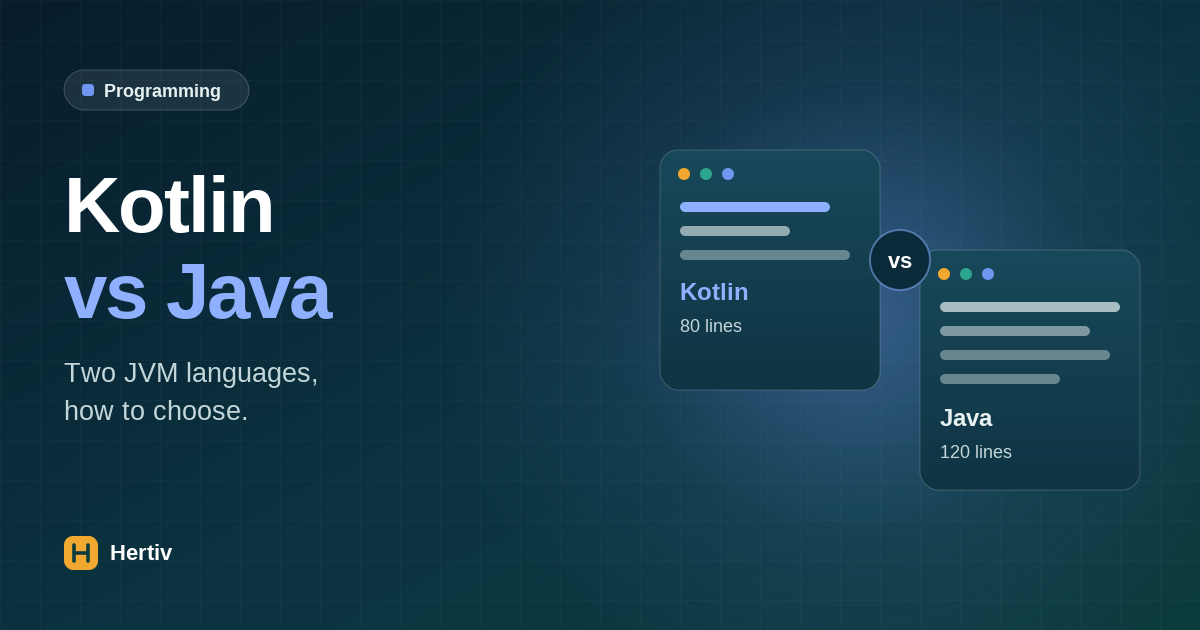
Example (hypothetical): a team writes a user profile feature. In Java it takes 120 lines, mostly getters, setters and null checks. In Kotlin the same feature takes 80 lines, because data classes and null-safe types remove the boilerplate.
That is 40 fewer lines, and 40 divided by 120 is one third, so the Kotlin version is about a third shorter in this invented example. Shorter code is easier to review, but it is not automatically better code: a short file can still be wrong.
The lesson is that Kotlin saves writing time on new code, while Java keeps its advantage on existing code and hiring. The choice should follow the work the team actually has, not the language that looks newer.
What are the common mistakes?
The common mistakes start with rewriting a working Java system in Kotlin for no user benefit. A rewrite takes months, introduces new bugs, and delays features that users asked for.
Another mistake is mixing languages without rules. When some files are Kotlin and some are Java with no pattern, new developers waste time working out which to use, and reviews slow down.
A third mistake is assuming Kotlin removes the need for tests. Null safety catches one kind of error, but logic errors, wrong data and bad API design still need tests. Software engineering teams keep the same test discipline in either language.
How do you decide?
Decide by the work, not by the trend. If the work is new Android code, pick Kotlin. If the work is maintaining a large Java system, stay with Java. If the work is new server code in a Java shop, try Kotlin on one service and judge the result.
Ask the team three questions: what code will we write most, who will we hire, and what must keep running without change? The answers point to the language that fits, and they also show when a mix of both is the honest answer.
Whatever you pick, write the decision down with its reasons. A team that can explain why it chose Kotlin or Java can revisit the choice later, instead of arguing about it every time a new file is created.
Key takeaways
- Kotlin and Java share the JVM and can be mixed in one project.
- Kotlin is shorter and guards against null errors by design.
- Java has the larger codebase, libraries and hiring pool.
- New Android code points to Kotlin; stable Java systems stay in Java.
- Adopt Kotlin gradually, one feature at a time, with written rules.
Frequently asked questions
Is Kotlin better than Java?
Neither is better in general. Kotlin is better for new code where shorter code and null safety help, and Java is better where a large existing codebase and hiring matter most. Many teams use both, with Kotlin for new features and Java for the code that already works.
Is Kotlin hard to learn for Java developers?
No, most Java developers can read Kotlin within days and write it within weeks, because the two share the same platform and libraries. The main learning is Kotlin's null types and its shorter syntax, which a short team guide can cover.
Does Kotlin run on the same platform as Java?
Yes. Kotlin compiles to the same bytecode and runs on the Java Virtual Machine, so it uses the same libraries, tools and deployment as Java. That is why the two languages can be mixed in one project.
Should I learn Kotlin or Java first?
Learn Java first if you want the widest base of jobs and existing systems, and learn Kotlin first if you want to build Android apps now. Either way, learning the second language later is much easier than learning the first.
Is Java still used for Android?
Yes, Java is still supported for Android, and many existing apps are written in it. New Android development, however, is mostly done in Kotlin, because Google's tools and samples are written for Kotlin first.
Can Kotlin be used for server applications?
Yes. Kotlin is used for server applications on the JVM, often with the same frameworks Java uses. Teams choose it for new services where shorter code and null safety help, while keeping Java for the systems that already run well.


