IT Strategy for Business: How to Build One That Works
An IT strategy links technology spending to business goals, with clear priorities, owners and measures. Here is how to build one that survives the budget.
On this page
Short answer
An IT strategy is a written plan that connects technology spending to business goals: which systems to keep, which to replace, what to build, and in what order. A good one names an owner for each priority, sets a budget, and defines how success will be measured. Without it, technology spending follows the loudest request instead of the biggest need.
What is an IT strategy?
An IT strategy is a written plan that sets out how technology supports the goals of a business over the next one to three years. It covers systems, data, security, people and spending, and it says what comes first when the budget cannot cover everything.
It is not a list of tools to buy. It is a set of decisions: which processes matter most, which systems carry them, what risks the business will not accept, and how much change the team can absorb in a year. Those decisions then shape every project and purchase.
A strategy also gives the rest of the business a way to ask for technology. Instead of a queue of unrelated requests, each request is judged against the same priorities. That is the difference between an IT plan and a shopping list.
| Part of the strategy | What it answers |
|---|---|
| Business goals | What the business must achieve in one to three years |
| Current systems | What you run today, what it costs, what is at risk |
| Priorities | Which three to five changes matter most |
| Budget | How spending splits between run, fix and build |
| People and skills | Who owns each priority and what skills are missing |
| Risks | What could break, and what you will do about it |
| Measures | How you will know each priority is working |
Why do most IT strategies fail?
Most IT strategies fail because they are written once and never used. A 60-page document that nobody opens after the board meeting cannot guide decisions, and teams go back to judging requests by who shouts loudest.
Other common causes are goals too vague to test, no owner for each priority, and a budget that was never agreed. A strategy that says improve security without a measure or an owner is a wish, not a plan.
Watch for these warning signs:
- No one can name the top three priorities without opening the document.
- Every new request is approved, because there is no agreed way to say no.
- The budget is a single number with no split between keeping systems running and building new ones.
- Security and backups are unfunded until an incident forces emergency spending.
- The plan is over a year old and nobody has reviewed it since it was written.
If three or more of these apply, the strategy is not guiding decisions, whatever the document says. A short plan that is reviewed every quarter beats a long one that is filed and forgotten.
How to build an IT strategy in 6 steps
You build an IT strategy in six steps: agree the business goals, audit what you run today, find the gaps and risks, set three to five priorities, cost and sequence them, and write the plan down with owners and measures.
- Agree the business goals. Ask the leaders what the business must achieve in the next one to three years: grow revenue, cut cost, enter a new market, or reduce risk. Write them down in plain words.
- Audit current systems. List every system, what it costs, who uses it, and what breaks if it stops. Include spreadsheets and tools bought on a company card.
- Find the gaps and risks. Compare the goals with what you run. Mark the systems with no backup, no owner, or no support, and the processes that still run on paper or email.
- Set three to five priorities. Pick the changes that close the biggest gaps or remove the largest risks. Fewer priorities mean each one actually gets done.
- Cost and sequence them. Price each priority, put them in order, and check the total against the budget. If the total is too high, cut a priority, not the testing.
- Write it down and review quarterly. One page per priority, with an owner, a budget and a measure. Review progress every quarter and rewrite when goals change.
The audit step usually surprises people. Most businesses find systems nobody owns, subscriptions nobody uses, and data in places nobody expected. That list alone often pays for the exercise.
How to set technology priorities
Priorities come from business pain, not from technology fashion. Rank each candidate by the cost of doing nothing, the risk it removes, and the effort it takes. A system that holds customer data and has no backup beats a new dashboard every time.
| Priority test | Question to ask |
|---|---|
| Business value | Which goal does this serve, and how will we know it worked? |
| Risk | What happens if we do nothing for a year? |
| Effort | How many people, for how long, and what else stops? |
| Timing | Does this depend on another change finishing first? |
| Fit | Does it work with the systems we already run? |
Score each candidate on these five tests and sort the list. The top three to five become the plan. Everything else waits, and saying so in writing is part of the job: a strategy that promises everything promises nothing.
How to budget and measure an IT strategy
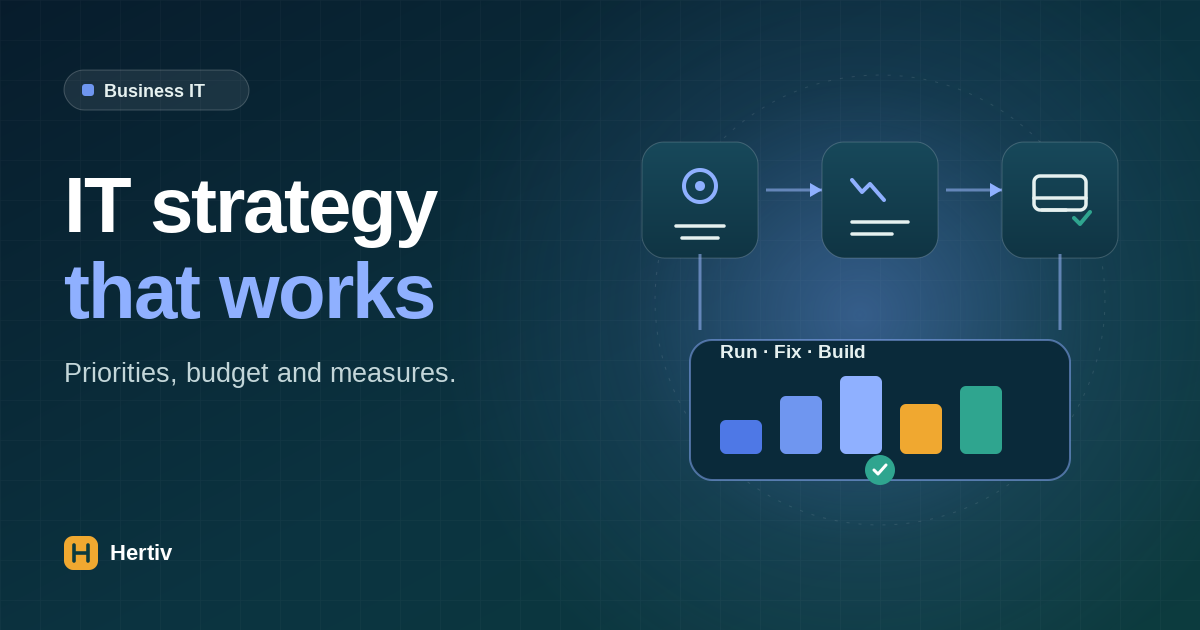
Budget in three buckets: keep the lights on, fix what is broken, and build what is new. Most businesses spend most of the budget on the first bucket, and the strategy should say so openly instead of pretending every project is new.
| Budget bucket | Share | What it covers |
|---|---|---|
| Run | Largest share | Licences, hosting, support, keeping systems working |
| Fix | Steady share | Backups, security patches, upgrades, replacing old systems |
| Build | Smallest share | New systems, new features, new markets |
Measure each priority with one number you can check monthly: backup success rate, time to restore, share of systems patched, or hours saved by an automated process. If a priority has no measure, it will drift, and nobody will notice until the next incident.
Report the measures to the same people who approved the budget. A virtual CTO can run that review for teams without a full-time technology leader, keeping the plan honest without adding a hire.
Example: a 60-person firm rebuilds its IT plan
Example (hypothetical): a 60-person professional services firm spends $18,000 a month on technology, or $216,000 a year, but nobody can say what the money buys. Backups run by hand, the CRM is seven years old, and each department buys its own tools.
The new plan splits the $216,000 into three buckets: $120,000 to run the systems the firm already has, $48,000 to fix backups, patching and security, and $48,000 to build a new CRM. The fix bucket pays for automated backups and a patching schedule, and the first restore test cuts recovery time from two days to four hours.
Each bucket has an owner and one measure: uptime for run, backup success rate for fix, and sales team adoption for build. The plan is reviewed every quarter, and the second year shifts money from fix to build as the old risks close. The arithmetic is simple; the value is that the firm finally knows where its $216,000 goes.
What are the common mistakes?
The most common IT strategy mistakes are writing a long document nobody reads, funding new projects while security and backups go unfunded, and never reviewing the plan after it is written.
- Writing for the board, not for the team. A strategy full of jargon cannot guide daily decisions. Write it so a new hire can follow it.
- Too many priorities. Twelve priorities mean none of them gets done. Pick three to five and finish them.
- Funding build before fix. A new system on top of broken backups and unpatched servers just adds risk.
- No owner per priority. A priority owned by a committee is owned by nobody.
- No review rhythm. A plan reviewed once a year is out of date for eleven months.
- Copying another company's strategy. Your goals, systems and risks are different, so the priorities must be too.
Key takeaways
- An IT strategy connects technology spending to business goals, in writing, with owners
- Three to five priorities beat twelve: fewer priorities mean each one actually gets done
- Budget in three buckets: run, fix and build, and say the split openly
- Every priority needs one owner and one measure you can check monthly
- Review the plan every quarter; a strategy that is never reviewed is not a strategy
Frequently asked questions
How long should an IT strategy cover?
One to three years is the usual range. Shorter than a year and it becomes a project list; longer than three and the technology assumptions go stale. Review it every quarter and rewrite it when the business goals change.
Who should write the IT strategy?
The person who owns technology decisions, working with the leaders who own revenue, operations and risk. In a small business that may be the owner and an outside adviser. The key is that the people who must fund it and live with it help write it.
Do small businesses need an IT strategy?
Yes, in a shorter form. A five-page plan that names the systems, the risks and the next three projects is enough for a small team. The point is to decide priorities in advance, not to produce a thick document.
How is an IT strategy different from an IT roadmap?
The strategy sets the goals and priorities; the roadmap sets the order and dates. A roadmap without a strategy is a list of projects with no reason behind them. Write the strategy first, then turn its priorities into dated steps.
What should an IT strategy cost?
The plan itself costs staff time or adviser fees; see vendor site for advisory pricing. The real cost is the spending it commits to, so the budget section matters more than the document. Start with the three buckets: run, fix and build.
How often should an IT strategy be reviewed?
At least once a quarter, with a short check on measures and priorities. A full rewrite is due when business goals change, a major system is replaced, or a serious incident shows a gap the plan missed.


