Is Outsourcing the Right Call for Your Business?
Outsourcing is a good decision when the work sits outside your core skills and a partner can do it better or cheaper. Here is how to judge the call.
On this page
Short answer
Outsourcing is a good decision for a business when the work is not core to what it sells, a partner can do that work better or at a lower cost, and the business can manage the relationship with clear expectations. It is a poor decision when the work defines the product, when quality cannot be checked, or when the cost of managing the partner exceeds the saving.
Is outsourcing a good decision for your business?
Outsourcing is a good decision for a business when the work is not core to what it sells, a partner can do that work better or at a lower cost, and the business can manage the relationship with clear expectations. It is a decision about focus, not just price.
Most businesses outsource work that is needed but does not set them apart: payroll, support, testing, or maintenance. The work still matters, but doing it in-house adds headcount, tools and management time without improving the product itself.
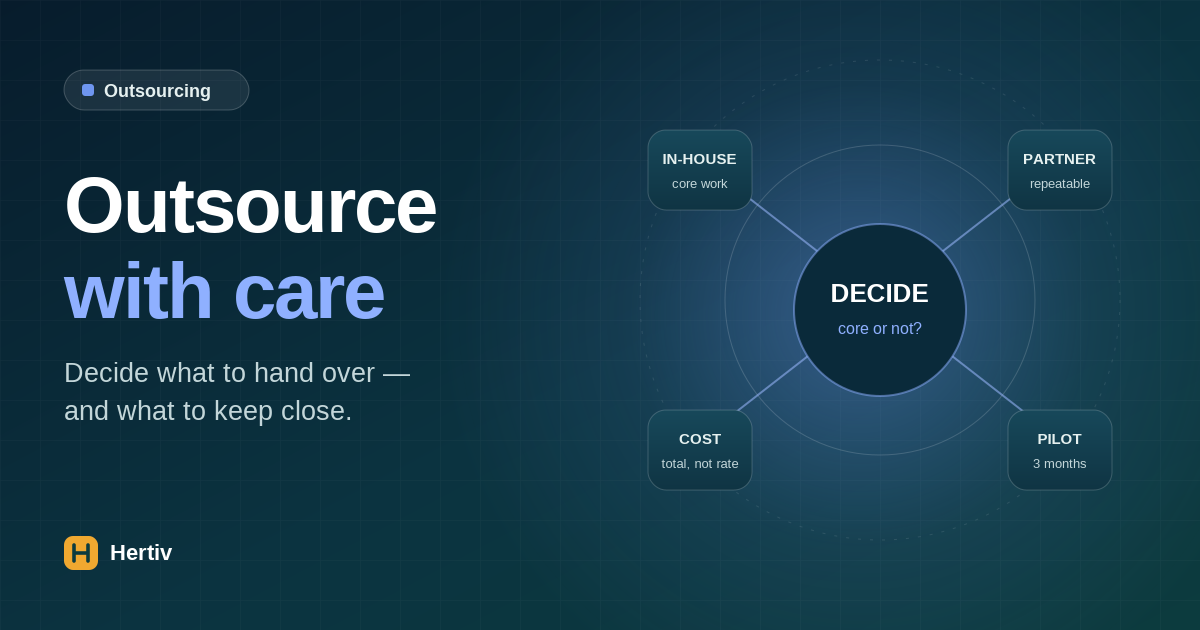
The test is simple. If a task is repeatable, well defined and easy to measure, a partner can usually do it well. If the task needs deep knowledge of your customers and changes every week, keeping it close is usually safer. A comparison of the two models is in outsourcing vs in-house development.
When does outsourcing make sense?
Outsourcing makes sense when the work is outside your core skills, when hiring would be slow or expensive, or when demand rises and falls and a fixed team would sit idle. Those three conditions cover most good outsourcing decisions.
Common cases include a startup that needs a mobile app but has no mobile team, a retailer that needs support coverage outside office hours, and a manufacturer that needs a one-off system integration. In each case the partner brings skills the business would take months to hire.
It also makes sense when the work needs a specific tool or certification. A dedicated development team can bring a full skill set on day one, while hiring the same mix would take a quarter or more. The saving is time as much as money.
When is outsourcing the wrong call?
Outsourcing is the wrong call when the work is the reason customers choose you, when quality is hard to check from the outside, or when the handover would take longer than doing the work yourself. In those cases the partner becomes a risk, not a shortcut.
Product strategy, pricing and the core customer relationship usually belong in-house. A partner cannot know your customers the way your own team does, and a bad call made by an outside team still lands on your brand.
It is also the wrong call when the business has no one to manage the partner. An unmonitored contract drifts: scope grows, quality slips and nobody notices until a customer complains. If you cannot spare a named owner for the relationship, wait until you can. Staff augmentation can be a middle step when you need extra hands but want to keep control.
What does outsourcing cost compared with hiring?
Outsourcing usually costs less than hiring for the same work, but the gap depends on the model. A project fee suits one-off work, a monthly retainer suits steady work, and a dedicated team suits work that needs the same people every week.
| Model | Typical cost | Best for | Watch out for |
|---|---|---|---|
| Project fee | Fixed price per scope | One-off builds | Change requests add cost |
| Monthly retainer | Fixed hours per month | Support, maintenance | Unused hours may be lost |
| Dedicated team | Monthly rate per person | Long-running products | Needs active management |
| In-house hire | Salary plus overhead | Core product work | Recruiting and ramp-up time |
Compare total cost, not the headline rate. A hire costs salary plus recruitment, equipment, benefits and management time, which often adds a quarter or more on top of salary. A partner rate looks higher per hour but includes those costs. Ask every vendor for the full price, and treat any figure you cannot verify as a planning range only. See the benefits of IT outsourcing for the other side of the cost picture.
How do you decide what to outsource?
You decide what to outsource by scoring each task on how core it is, how easy it is to measure, and how much it would cost to do well in-house. The tasks with the lowest core score and the clearest measures go first.
- List the work. Write down every recurring task and who does it today.
- Mark what is core. Flag anything that defines your product or your customer promise.
- Score measurability. Keep tasks with a clear output and a clear quality bar; hold back the rest.
- Price both options. Compare the partner quote with the full in-house cost, including management time.
- Run a small pilot. Hand over one bounded piece of work for a fixed period and judge the result.
- Decide on evidence. Expand, change partner or bring the work back based on what the pilot showed.
A pilot keeps the risk small. A three-month trial with one team and one service level tells you more about a partner than any sales deck. Guidance on running that first engagement is in how to outsource software development.
Example (hypothetical): a 40-person company weighs outsourcing support
Example (hypothetical): a 40-person software company has two support staff who cost $55,000 a year each in salary. With recruitment, equipment, benefits and management time adding about 25%, the true in-house cost is $110,000 times 1.25, which is $137,500 a year.
A support partner quotes $4,500 a month for the same coverage, which is $54,000 a year. The difference is $137,500 minus $54,000, which is $83,500 a year saved, before counting the time managers get back.
The company runs a three-month pilot with one product line. Response times improve, but the partner escalates two complex cases slowly, so the company keeps those cases in-house and outsources the rest. The pilot turns a guess into a measured decision, and the split keeps the risky work close.
What are the common mistakes?
The most common outsourcing mistakes are choosing the cheapest quote, handing over work with no owner, and measuring activity instead of outcomes. Each one is easy to avoid with a short contract and a weekly check.
- Choosing on price alone. The lowest quote often hides thin staffing or weak quality checks.
- No named owner. Without one person responsible on your side, issues drift until a customer reports them.
- Vague quality bars. If the contract does not define good work, you cannot enforce it.
- Handing over core work. Work that defines your product should stay with people who know your customers.
- No exit plan. Keep your data, logins and documentation so you can change partner or bring work back.
If the work you are considering is software, a partner for custom software development can take the build while your team keeps the product decisions.
Key takeaways
- Outsourcing works when the task is repeatable, measurable and outside your core skills
- Compare total cost, not headline rates: a hire costs salary plus about a quarter more in overhead
- Keep core work and customer relationships in-house, whatever the saving
- Run a small pilot before handing over a whole function
- Name one owner for the partner relationship and define quality in writing
- Keep an exit plan so you can change partner or bring work back
Frequently asked questions
Is outsourcing cheaper than hiring?
Usually, for non-core work. A partner rate includes recruitment, equipment and management, while a hire costs salary plus roughly a quarter more in overhead. Compare the full cost of both options for the same output, and run a pilot before committing.
What should never be outsourced?
Work that defines your product or your customer promise, such as product strategy, pricing and the core customer relationship. A partner cannot know your customers the way your own team does, and mistakes made outside still land on your brand.
How long should an outsourcing pilot run?
Three months is a practical length for most functions. It is long enough to see real quality and response times, and short enough to end cleanly if the partner does not meet the bar you set in writing.
What is the difference between outsourcing and staff augmentation?
Outsourcing hands a whole function or outcome to a partner, while staff augmentation adds individual specialists to your own team under your management. Augmentation suits teams that want extra hands but want to keep control of the work.
How do you check an outsourcing partner's quality?
Define the quality bar in the contract, such as response times, error rates or review scores, then check it weekly with real cases. Ask for references from similar clients and speak to them directly before signing.
Can you bring outsourced work back in-house?
Yes, if you kept your data, logins and documentation and the contract allows it. Keep an exit plan from the start, including handover steps and notice periods, so the move is a planned change rather than a rescue.


