IoT Smart Metering: How Connected Meters Work
IoT smart metering connects utility meters to the internet so readings, faults and usage reach the provider in near real time. Learn how it works.
On this page
Short answer
IoT smart metering is a system that connects electricity, water or gas meters to a network so they can send readings automatically, report faults and receive commands remotely. It replaces manual meter reading with continuous data that utilities and customers can both use.
What is IoT smart metering?
IoT smart metering is the use of connected meters and a communications network to collect utility usage data without anyone visiting the meter. Each meter measures consumption, stores the reading and sends it to the utility's systems on a schedule, or whenever something unusual happens.
A smart meter is more than a digital counter. It can record usage by time of day, detect leaks or tampering, flag a power outage, and accept remote commands such as disconnecting supply or updating its pricing schedule.
The system has four parts: the meter itself, the network that carries the data, the software that stores and analyses it, and the applications that turn it into bills, alerts and reports. A meter that cannot talk to the rest of the system is just a display.
Utilities use smart metering to bill accurately, find losses and plan capacity. Customers use it to see what they consume and when, which is the first step to using less.
How does an IoT smart meter work?
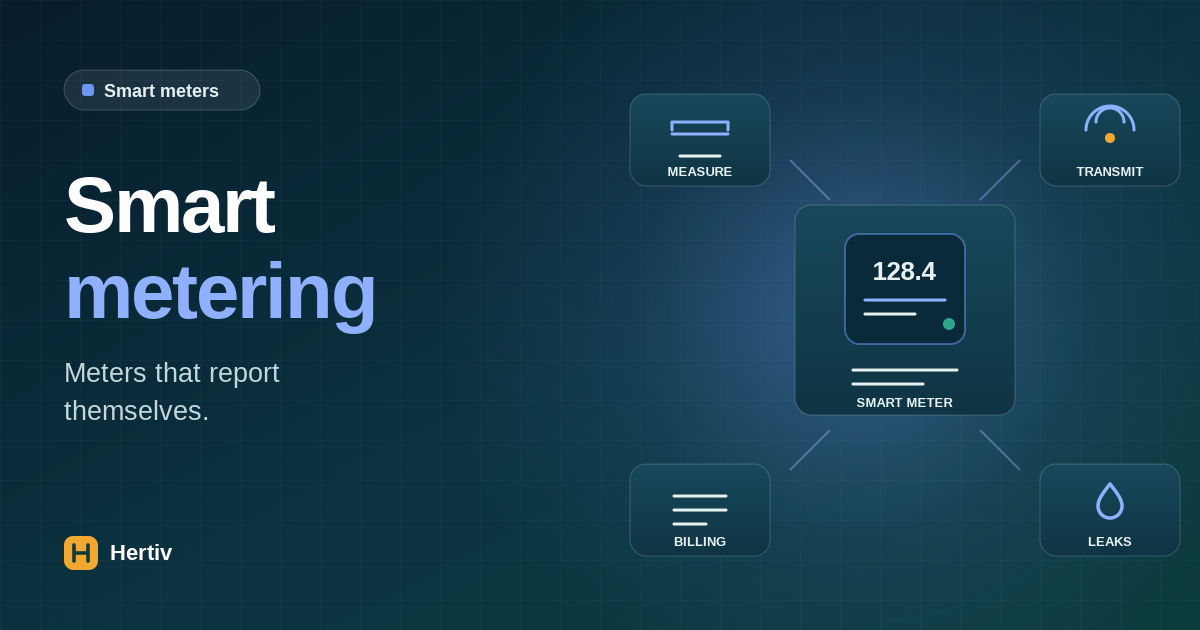
An IoT smart meter works by measuring consumption continuously, then sending the data through a network to the utility's head-end system. The path from meter to bill has four steps.
- Measure. Sensors in the meter record flow or power draw, often every 15 minutes, and store the readings locally.
- Transmit. The meter sends readings over a low-power network such as NB-IoT, LoRaWAN or a mesh radio, usually in small batches.
- Collect. A head-end system receives the readings, checks them for gaps and errors, and stores them in a meter data system.
- Use. Billing, outage detection, leak alerts and customer apps all draw on the same stored data.
Meters also work in reverse: the utility can send commands back, such as changing a tariff, limiting supply, or pushing a firmware update. Two-way communication is what separates a smart meter from a simple remote-read meter.
Because meters run on batteries or mains power for years, the network is designed for tiny messages and long sleep cycles. A meter that reports every 15 minutes sends far less data than a phone, but it must keep doing so reliably for a decade or more.
What do smart meters measure?
Smart meters measure more than total consumption. The exact readings depend on the utility, but most systems capture the same core set of values.
| Reading | What it shows | Used for |
|---|---|---|
| Interval consumption | Usage in each 15 or 30 minute block | Time-of-use billing, load profiles |
| Voltage and current | Quality of the electricity supply | Fault detection, grid planning |
| Flow rate | Water or gas moving through the meter | Leak detection, demand peaks |
| Tamper events | Cover opened, magnet, reverse flow | Revenue protection, safety |
| Outage flags | Loss of supply and restoration time | Outage maps, repair dispatch |
| Battery and signal | Meter health and network strength | Maintenance planning |
Interval data is the most valuable change. A monthly total tells a utility how much a customer used; interval data shows when, which makes time-based tariffs, demand response and leak detection possible.
What are the benefits of IoT smart metering?
IoT smart metering benefits utilities, customers and the grid itself, but the gains arrive in stages. Billing accuracy comes first, then loss reduction, then the deeper planning value of interval data.
- Accurate billing. Readings come from the meter, so estimated bills and disputed readings fall away.
- Faster fault finding. Outages and leaks are reported by the meter, often before a customer calls.
- Lower losses. Tamper alerts and flow analysis make theft and leakage easier to find.
- Better planning. Interval data shows real demand patterns, so capacity upgrades match actual need.
- Customer insight. Apps show households and businesses when they use the most, which supports saving and shifting load.
For water utilities, the biggest win is often leak detection: a meter that reports continuous night-time flow can flag a leak days before it surfaces. For electricity, it is outage detection and time-of-use pricing.
These benefits depend on the data actually being used. A meter that reports faithfully while nobody watches the alerts delivers little more than accurate bills.
How do you deploy a smart metering system?
You deploy a smart metering system in stages, starting with a pilot area, then scaling by district. A rushed rollout that installs meters faster than the network and software can support them creates a backlog of unread meters.
- Pick the pilot area. Choose a district with mixed building types and known network coverage, so the pilot tests real conditions.
- Test the network. Check signal strength at meter locations, including basements and metal cabinets, before ordering hardware.
- Install and commission. Fit meters, verify each one reports correctly, and link it to the right customer account.
- Validate the data. Compare smart readings against manual checks for a few weeks until the error rate is understood.
- Turn on the use cases. Start with billing, then add outage alerts, leak detection and customer apps one at a time.
- Plan maintenance. Track battery life, firmware versions and signal quality so replacements are planned, not reactive.
Data privacy and security belong in the plan from the start. Interval data reveals when a home is occupied, so access controls, encryption and clear rules about who sees what are part of the system, not an afterthought. Teams building connected device systems can draw on IoT device management practices for the same problems.
Example (hypothetical): a water utility finds hidden leaks
Example (hypothetical): a water utility serves 40,000 homes and loses about 18% of its water to leaks and theft. It installs smart water meters across one district of 5,000 homes as a pilot.
In the first month, the meters flag 120 homes with continuous flow between 2am and 4am, when normal use should be near zero. Crews visit the 40 worst cases and find 32 genuine leaks, mostly running toilets and cracked supply pipes.
Each leak averages 400 litres a day, so the 32 leaks waste 12,800 litres a day. Over a month that is about 384,000 litres, which the utility values at $0.80 per 1,000 litres, or roughly $307 a month from those 32 homes alone.
The pilot cost $150 per meter installed, or $750,000 for the district, so leak savings alone do not pay for it quickly. The business case rests on the whole package: accurate billing, fewer manual reads, faster leak response and better demand planning across all 5,000 homes.
What are the common mistakes?
The most common smart metering mistakes are treating it as a meter swap, under-testing the network, and collecting data nobody uses.
- Meters before systems. Installing meters before the head-end, billing and alerting software is ready leaves readings with nowhere to go.
- Skipping signal surveys. Meters in basements, behind metal doors or in rural areas may not reach the network at all.
- No data quality checks. Gaps, duplicates and drift creep in, and billing built on bad data creates disputes.
- Ignoring privacy. Interval data is personal data in many jurisdictions, so consent, access rules and retention limits need deciding early.
- One big-bang rollout. A pilot district teaches you about signal, installation time and customer questions before you commit to the whole network.
Key takeaways
- Smart meters send interval readings automatically, replacing manual reads and estimated bills
- Two-way communication lets utilities update tariffs, detect faults and respond to leaks remotely
- The value comes from using the data: billing, outage alerts, leak detection and demand planning
- Network coverage at the meter location, including basements, must be tested before rollout
- Interval data reveals household patterns, so privacy and access controls belong in the plan from day one
Frequently asked questions
How is a smart meter different from a traditional meter?
A traditional meter only shows a running total that someone must read in person. A smart meter records usage in short intervals, sends the data automatically, reports faults and can receive commands such as tariff changes or remote disconnection.
Do smart meters need the internet?
They need a network, but not a household internet connection. Most use low-power wide-area networks such as NB-IoT or LoRaWAN, which are built for small messages from many devices and work independently of home Wi-Fi.
How accurate are smart meter readings?
Smart meters are type-tested to the same accuracy standards as traditional meters, and remote readings remove the errors of manual reads and estimates. Data validation in the head-end system catches gaps and implausible values before billing.
Can smart meters detect leaks?
Yes, for water and gas. A meter that records continuous flow during hours when a home normally uses nothing is a strong leak signal. Utilities confirm the leak with a site visit before acting, since some night-time use is legitimate.
How long do smart meter batteries last?
Battery-powered meters are typically designed to last 10 to 15 years, depending on how often they report and how strong the signal is. Weak signal drains batteries faster, which is another reason to survey coverage before installing.
Do customers save money with smart meters?
Smart meters do not save money by themselves, but the data helps. Households that can see when they use the most can shift usage to cheaper hours or find waste, and utilities can offer time-of-use tariffs that reward that shift.


