6 Industries AI Robots Are Changing Most
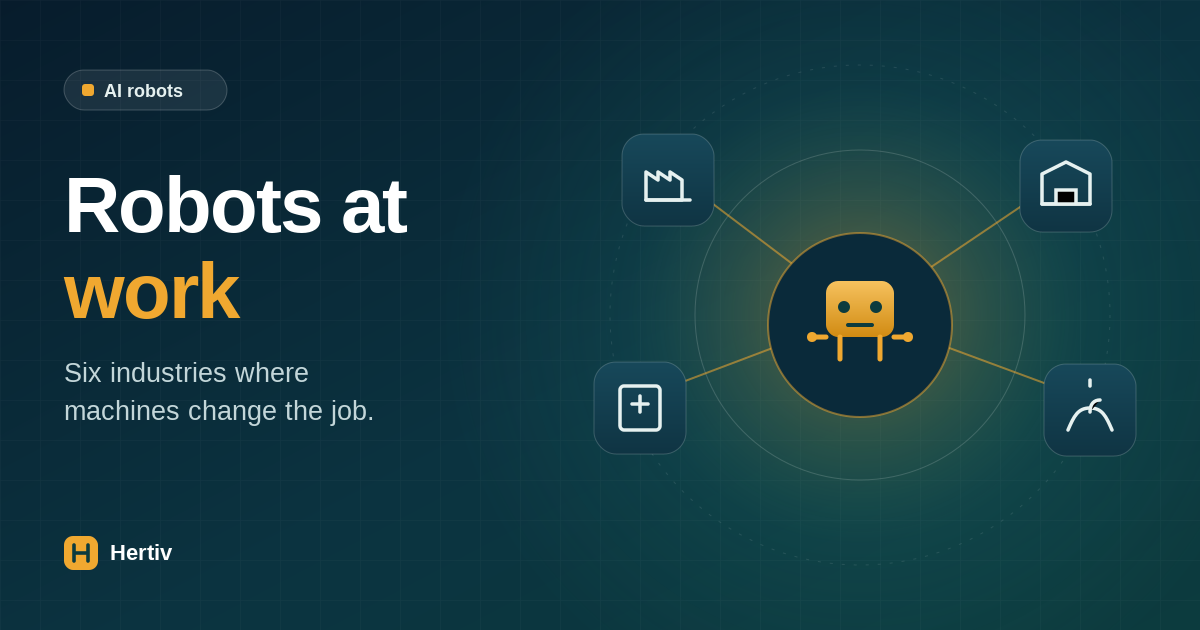
AI-powered robots weld, pick, harvest, scan and serve across factories, warehouses, hospitals, fields and sites. Here are the six industries they change most.
On this page
Short answer
AI-powered robots are machines that sense, decide and act on the shop floor, in warehouses, hospitals, fields, building sites and shops. They take on heavy, repetitive or precise work, while people handle judgment, exceptions and customer contact. The six industries where they change daily work most are manufacturing, logistics, healthcare, agriculture, construction and retail.
Which industries do AI robots change most?
The industries AI robots change most are the ones with heavy, repetitive or precise physical work and enough data to train on: manufacturing, logistics, healthcare, agriculture, construction and retail. In each of them, robots take on the tasks that are tiring, dangerous or hard to staff, and people move to the work that needs judgment.
The change is not about robots replacing whole jobs. It is about one part of a job changing: a welder who now supervises a robot cell, a nurse who no longer carries samples across a hospital, a picker who works beside a mobile robot instead of walking the warehouse. The human role shifts, and the robot does the part that is repetitive or risky.
| Industry | Robots in use | Main job | Human role |
|---|---|---|---|
| Manufacturing | Collaborative arms, welders | Assembly, welding, inspection | Supervise, programme, check |
| Logistics | Mobile pickers, sorters | Moving, picking, sorting | Exceptions and packing |
| Healthcare | Delivery and surgical robots | Carrying, precise surgery | Care and clinical decisions |
| Agriculture | Harvesters, sprayers | Picking, spraying, weeding | Planning and crop checks |
| Construction | Bricklayers, survey drones | Laying, surveying, lifting | Skilled trades and safety |
| Retail | Shelf scanners, cleaners | Stock checks, cleaning | Customers and merchandising |
What the six have in common is a clear task the robot can repeat and a person who stays in charge of the result. Where that split is unclear, robots stall. Collaborative robots in manufacturing shows the pattern in its most mature form.
Manufacturing and logistics
1. Manufacturing: best for repetitive assembly and welding
Manufacturing is where AI robots are most established. Collaborative arms work beside people on assembly lines, welding cells handle repetitive joints, and vision systems check parts as they pass. The robot repeats the same motion, and the person programmes, supervises and checks the result.
Workers spend fewer hours on heavy, repetitive tasks and more time on setup, quality checks and problem-solving. The plants that do this well treat the robot as a tool for the operator, and they train operators to programme and supervise the cell.
- Pros: steady quality on repetitive work; heavy lifting moves to the machine
- Cons: needs programming and maintenance skills; small-batch work is harder to automate
2. Logistics and warehousing: best for moving and picking
In logistics, mobile robots carry shelves and bins to pickers, sort parcels and move pallets across the warehouse. The picker stays in one place and the robot brings the work, which cuts walking time and speeds up orders. Vision and gripping systems handle more shapes than they used to, but fragile or odd items still need a person.
Warehouses adopt robots because the work is hard to staff at peak times and the task is easy to measure: picks per hour, errors per thousand and time per order. The human role becomes exceptions, packing and quality checks.
- Pros: faster picking with less walking; peak demand is easier to handle
- Cons: fragile or odd items still need people; layout changes cost time and money
Healthcare and agriculture
3. Healthcare: best for delivery and precise procedures
In healthcare, robots carry samples, medicines and linen through hospital corridors, and surgical robots help surgeons make precise movements. Delivery robots free nurses from carrying work, so they spend more time with patients, and surgical robots support the surgeon's hands.
The bar for robots in healthcare is higher than anywhere else, because a mistake affects a patient. That is why the robots that succeed here do narrow, well-tested jobs under human supervision, and clinical decisions stay with doctors and nurses.
- Pros: nurses spend less time carrying and more time caring; precise movements in surgery
- Cons: high safety bar; clinical decisions must stay with people
4. Agriculture: best for harvesting and spraying
In agriculture, robots pick fruit, spray crops and weed fields, working through the rows at a steady pace and at hours that suit the crop. Vision systems tell a ripe fruit from an unripe one, and targeted spraying puts chemicals only where they are needed.
The change is most visible where labour is scarce or the work is seasonal. Farmers still plan the crop, check the fields and make the calls on timing and quality; the robot does the repetitive pass through the field. Weather, mud and uneven ground remain hard problems, and robots that cannot handle them stay in the shed.
- Pros: steady work through long rows; spraying only where needed
- Cons: weather and uneven ground are hard; needs skilled setup and maintenance
Construction and retail
5. Construction: best for surveying and heavy lifting
On building sites, robots lay bricks, tie rebar and lift heavy panels, while drones map the site from above. The robot handles the repetitive, heavy part, and skilled tradespeople do the fitting, finishing and safety checks.
Construction is harder than a factory floor: every site is different and the ground changes as work progresses. The robots that work here are built for that variation: survey drones, lifting aids and machines that follow a plan set by a person on site.
- Pros: heavy lifting moves to machines; surveys are faster and more complete
- Cons: every site is different; skilled trades still do the fitting and finishing
6. Retail and hospitality: best for stock checks and cleaning
In retail and hospitality, robots scan shelves, clean floors after hours and carry items in hotels. A shelf-scanning robot walks the aisles, reads what is missing and sends the list to staff. The robot does the checking; the person does the serving.
The visible change for customers is small. Guests notice a clean floor and a stocked shelf, not the robot that checked them. The work that changes is the routine checking and cleaning, which frees staff for the customer contact that brings people back. IoT in robotics explains how these machines stay connected to the systems around them.
- Pros: shelves and floors are checked on a steady schedule; staff time goes to customers
- Cons: crowded aisles slow robots down; customer contact stays a human job
How to judge whether robots fit your operation
Judge whether robots fit your operation by looking at the task, not the technology. A robot is worth considering when the work is repetitive, heavy or precise, and the task is the same each time.
- Name the task. Pick one repetitive task: moving, picking, checking, lifting or cleaning. Vague goals such as 'use robots' are not a task.
- Check the variation. Does the task look the same each time, or does it change with weather, layout or customer behaviour? Robots handle low variation best.
- Work out the human role. Name who supervises, programmes and checks the robot, and what they stop doing. If no one owns the robot, it will sit idle.
- Run a small pilot. Put one robot on one task for a few weeks and measure the time, errors and staff feedback before buying more.
- Count the full cost. Include setup, programming, maintenance and training, not just the purchase price, and compare it with the cost of the task as it is done now.
A pilot that fails on one task is still useful: it tells you which tasks are ready for robots and which are not, and it costs far less than a site-wide rollout that stalls. The same staged approach applies to AI agents in manufacturing, where the pilot habit matters just as much.
What are the common mistakes?
The most common mistakes with AI robots are buying for the demo, skipping the human role, and underestimating setup and maintenance.
- Buying for the demo. A robot that looks impressive in a showroom may struggle with your variation, your layout or your weather.
- No named owner. If nobody supervises, programmes and maintains the robot, it stops being used within months.
- Forgetting maintenance. Robots need cleaning, calibration and parts. A maintenance plan is part of the purchase, not an afterthought.
- Expecting full replacement. Robots change parts of jobs, not whole jobs. Plans that assume staff disappear usually fail.
- Ignoring safety. Shared spaces need clear rules for where robots move, how they stop, and who can override them.
Key takeaways
- AI robots change parts of jobs, not whole jobs, and the human role shifts to supervision and judgment
- Manufacturing and logistics are the most mature, with collaborative arms and mobile pickers
- Healthcare and agriculture use robots for narrow, well-tested jobs under human supervision
- Construction and retail robots handle heavy, repetitive checking and cleaning work
- Judge a robot by the task: low variation, a named owner and a small pilot first
Frequently asked questions
Which industry uses AI robots most today?
Manufacturing uses them most, with collaborative robot arms, welding cells and vision inspection on production lines. Logistics is close behind, with mobile robots carrying shelves and bins to pickers. Both have repetitive tasks that are easy to measure, which is why they adopted robots first.
Do AI robots replace workers?
They replace parts of jobs, not whole jobs. A welder may supervise a robot cell instead of welding every joint, and a nurse may spend less time carrying samples. The work that needs judgment, exceptions and customer contact stays with people, and new roles appear around programming and supervision.
What is the difference between a robot and a cobot?
A cobot, or collaborative robot, is built to work beside people in a shared space, with force limits and sensors that stop it on contact. A traditional industrial robot usually works behind a fence at higher speed. Cobots suit smaller tasks and mixed workspaces, while fenced robots suit high-speed, repetitive lines.
Are robots safe to use around people?
They can be, with the right rules. Shared spaces need clear paths, speed limits, stop controls and someone who can override the robot. Safety depends on the setup and the training, not just the machine, so the risk assessment and the human role matter as much as the robot itself.
How much does an AI robot cost?
It depends on the machine, the setup, the programming and the maintenance, so there is no single figure. See vendor site for prices. Count the full cost, including setup, training and parts, and compare it with the cost of the task as it is done now before deciding.
What is the hardest part of adding robots?
The hardest part is usually the setup: fitting the robot to your variation, your layout and your data, and training the people who will supervise it. The machine itself is rarely the problem. A small pilot on one repetitive task is the best way to learn what the hard parts are for your site.


