Identity Tokenization for Enterprise AI Security
Identity tokenization swaps real names, emails and ID numbers for random tokens before data reaches an AI system. Learn how it works and how to roll it out.
On this page
Short answer
Identity tokenization replaces real identity details with random tokens before data reaches an AI system, so models, logs and search indexes never hold a real name. Only a guarded token vault can swap a token back, and only for an authorised request.
What is identity tokenization for enterprise AI security?
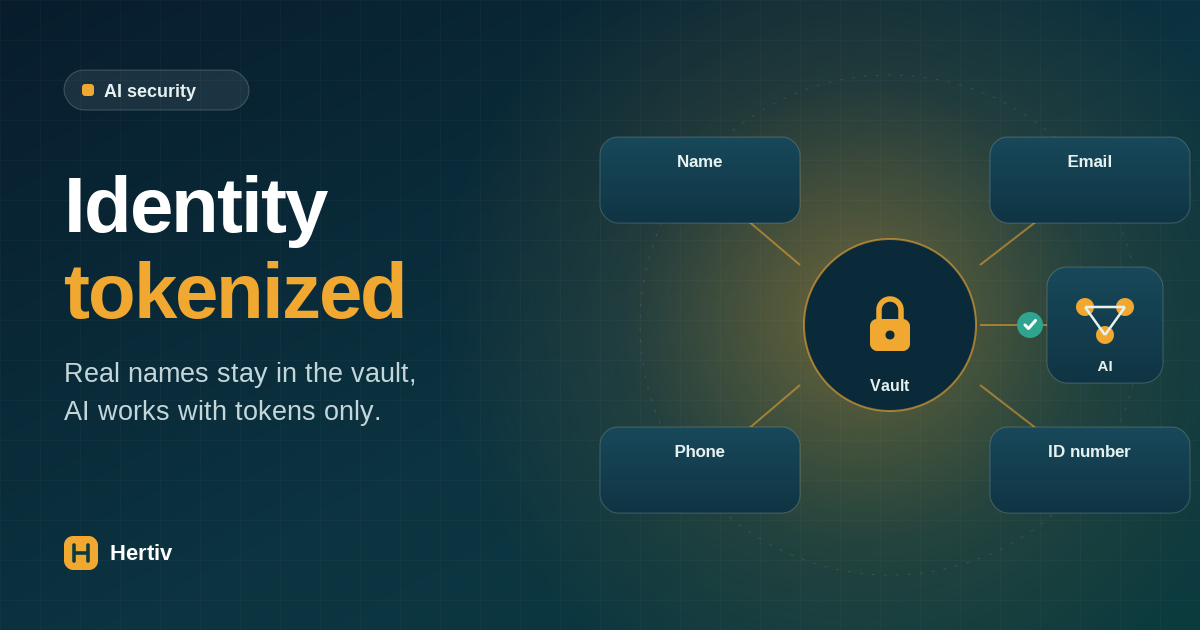
Identity tokenization is a way of replacing real identity details, such as names, email addresses and national ID numbers, with random reference values called tokens before the data reaches an AI system. The AI works with the tokens, while the real values stay in a separate, guarded store.
Think of a token as a ticket stub. The stub proves that a person exists in the system and lets the AI link their records together, but it carries no name, no email and nothing an attacker could use to find them. Only a small, controlled service can swap a token back to the real value, and only when a person with permission asks for it.
| Identity detail | What is stored for AI | What the AI can do with it |
|---|---|---|
| Full name | Random token, for example ID-48291 | Link records for the same person |
| Email address | One-way token or hash | Match accounts across systems |
| Phone number | Random token | Count users, never call them |
| National ID number | Random token, kept out of models | Prove uniqueness without exposure |
| Home address | Region code only | Analyse by area, not by person |
The point is simple: an AI model that never sees a real identity cannot leak one. That matters because model outputs, logs and training data all have a habit of travelling further than anyone planned. For the wider security picture, see AI security services.
How does identity tokenization work?
Identity tokenization works by intercepting identity fields at the point where data enters the AI pipeline and swapping each one for a token. The mapping between tokens and real values lives in a separate token vault that the AI system cannot reach directly.
The usual flow has four parts. First, the source system sends a record to the tokenization service, which replaces each identity field with a token. Second, the tokenized record goes to the AI system for training, search or inference. Third, the AI returns results that carry tokens, not names. Fourth, an authorised application swaps tokens back to real values only when it needs to act, such as sending an email to a customer.
Two design choices matter most. The token vault must be isolated from the AI platform, with its own access controls and audit log. And the tokens must be random or encrypted, never a simple reordering of the original value, so that nobody can reverse them by guessing. Tokenization vs encryption explains how the two techniques differ.
Why do AI systems need tokenized identities?
AI systems need tokenized identities because they copy data into places that are hard to control. Training sets, vector stores, prompt logs and cached answers can all end up holding personal data long after the original record was deleted.
Three risks make this worse. First, large language models can repeat fragments of their training data in answers, which means a name that went into training can come back out in a chat. Second, support and sales staff paste customer details into AI tools every day, and those prompts are often logged.
Third, a breach of an AI platform exposes whatever the platform stored, and tokenized data is far less useful to an attacker than real identities.
Tokenization does not remove the need for consent or for data rules. It reduces the damage when something goes wrong, and it lets teams use real business data for AI without putting real people in the data. Governance rules around this sit under AI governance.
Where does tokenization fit in an AI data pipeline?
Tokenization fits at the boundary between your business systems and your AI systems. Data leaves the customer database, passes through the tokenization service, and only then enters the model, the search index or the analytics store.
The order matters. Tokenize before the data is copied anywhere the AI can reach, including test environments, log files and third-party AI tools. A token applied after a copy has already been made is too late, because the copy still holds the real value. The same rule applies to backups: a backup of an AI store should hold tokens, not names.
Example (hypothetical): a clinic runs an AI triage tool that reads 400 patient messages a day. Each message carries a name and a phone number. The team tokenizes both fields before the messages reach the tool, so the tool sees 400 tokens and 400 texts. When a nurse needs to reply, the care app swaps the token back and shows the real contact. The AI processed 400 cases and never held a single real name.
Tokenization, encryption and masking: what is the difference?
Tokenization, encryption and masking are three different ways of hiding data, and they fit different jobs. Encryption scrambles a value with a key, and anyone with the key can unscramble it. Masking replaces part of a value with stars, which is useful for display but not for linking records. Tokenization replaces the whole value with a random reference.
The key difference is reversibility and purpose. Encryption is designed to be reversed by the key holder. Masking is usually one-way and loses the link between records. Tokenization keeps the link: the same person always gets the same token, so the AI can join their records, while the real value stays locked in the vault.
| Method | Reversible | Records still linkable | Best use |
|---|---|---|---|
| Tokenization | Yes, via the vault | Yes | AI training and search |
| Encryption | Yes, with the key | Yes | Storage and transit |
| Masking | No | No | Display on screens |
Most enterprise setups use more than one. Data is encrypted in transit, tokenized before it reaches AI, and masked when shown on a screen. Each layer protects a different stage.
How to roll out identity tokenization in 5 steps
Rolling out identity tokenization works best as a small, ordered project, not a big rebuild. Start with one AI use case and one data source, prove the pattern, then extend it.
- List the identity fields. Walk through the data the AI receives and write down every field that could identify a person: names, emails, phone numbers, IDs, addresses and account numbers.
- Decide what the AI actually needs. Most AI tasks need a link between records, not the real value. Mark the fields that can be tokenized and the few that must stay real, such as a delivery address.
- Put the token service in front of the AI. Route the data through the tokenization service before it reaches any model, index, log or third-party tool.
- Lock down the vault. Give the vault its own access controls, require approval for any detokenization, and log every swap. Test that the AI platform cannot reach the vault directly.
- Prove it with a test. Feed the AI a tokenized record and check the outputs, logs and stored data. If a real name appears anywhere, find the leak and fix the route before going live.
Keep the token vault under the same compliance checks as the rest of your data estate. The data security and compliance team should own the vault, not the AI project team.
Common mistakes
The most common mistake is tokenizing the model input but forgetting the logs. Prompts, error messages and audit trails often copy the original record, so the real identity still ends up stored. Tokenize at the boundary, and check every output channel.
A second mistake is using tokens that are easy to reverse. A token made by shuffling the letters of a name, or by hashing a value with no salt, can be undone by anyone who tries. Use random tokens from a proper service, and keep the mapping in the vault only.
A third mistake is tokenizing so much that the AI stops working. Some tasks genuinely need a real value, such as a delivery address or a payment reference. Tokenize what can be tokenized, and document the exceptions with a reason and an owner. Review the list every quarter, because new AI features often add new data flows.
Key takeaways
- Tokenization swaps real identity details for random tokens before AI sees the data.
- Tokens keep records linkable while the real values stay in a guarded vault.
- Tokenize at the boundary, before data is copied to any AI store or log.
- Random tokens are safe; shuffled or unsalted values are not.
- Roll out on one use case first, then extend the pattern.
Frequently asked questions
What is identity tokenization?
Identity tokenization replaces personal details such as names, emails and ID numbers with random reference values called tokens. The AI works with tokens, while the real values stay in a separate token vault that only authorised services can access.
Is tokenization the same as encryption?
No. Encryption scrambles a value with a key that anyone holding the key can reverse. Tokenization replaces the value with a random reference, and only the token vault can map it back. Both protect data, but they fit different stages of a pipeline.
Can an AI model still work with tokenized data?
Yes, in most cases. The model can link records for the same person, count users and analyse patterns using tokens. It only needs the real value when it must act, such as sending a message, and then an authorised app swaps the token back.
What happens if the token vault is breached?
A breach of the vault is serious, because the vault holds the mapping to real identities. That is why the vault needs its own access controls, approval for detokenization and a full audit log. Keep it isolated from the AI platform itself.
Does tokenization replace consent and data rules?
No. Tokenization reduces the damage when data leaks, but it does not remove the need for a lawful basis, consent where required, or retention limits. Treat it as one layer in a wider data protection plan, not as a replacement for it.
Where should tokenization sit in the pipeline?
At the boundary between business systems and AI systems, before data is copied to any model, index, log or third-party tool. Tokenizing after a copy has been made is too late, because the copy still holds the real value.


