How Much Does Hybrid Search Cost to Build and Run?
Hybrid search mixes keyword and vector search, and its cost comes from indexing, queries and reranking. Here is what each part costs and how to estimate your total.
On this page
Short answer
Hybrid search costs from roughly $150 to $1,000 a month for a mid-size deployment, plus a small one-off embedding pass. The vector index and reranking are usually the largest lines, and the total grows with document count, query volume and reranking depth.
What is hybrid search?
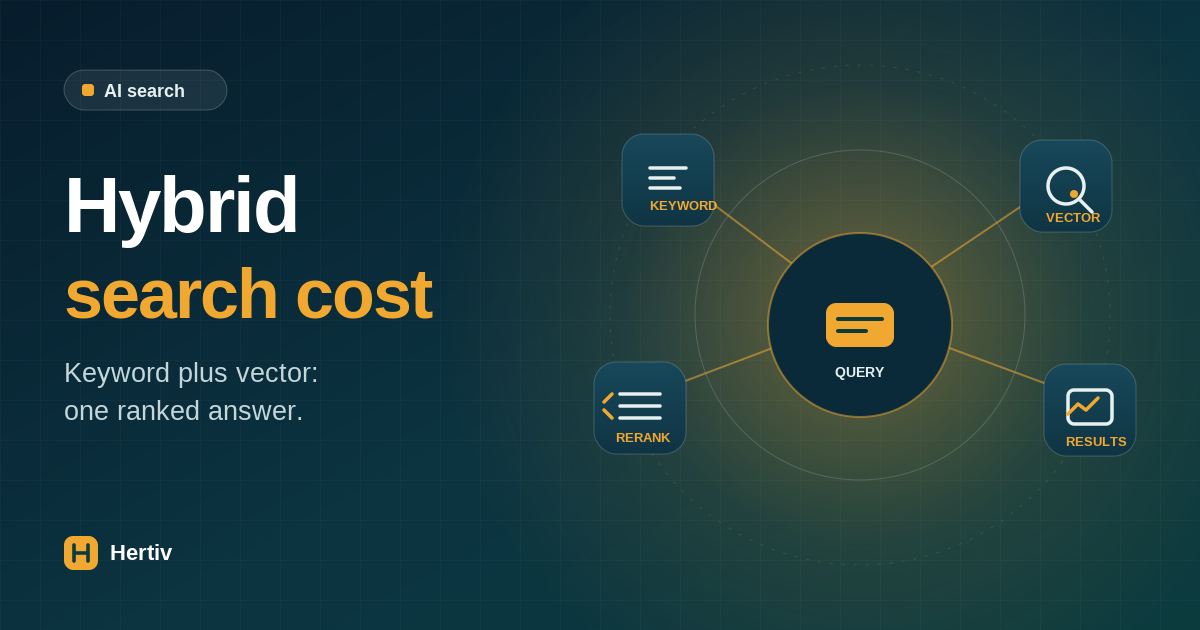
Hybrid search is a search method that combines keyword matching with vector similarity, so a query is answered by both exact words and meaning. A keyword index finds documents that contain the query terms, while a vector index finds documents whose meaning is close to the query, even when the words differ.
The two result lists are merged and usually reranked, so the final order reflects both signals. This matters because pure keyword search misses synonyms and paraphrases, while pure vector search can miss exact names, codes and product numbers.
| Part | What it does | What it needs |
|---|---|---|
| Keyword index | Matches exact terms and codes | Text index and storage |
| Vector index | Matches meaning and synonyms | Embeddings and memory |
| Reranker | Reorders the merged results | Compute per query |
| Query serving | Runs both indexes and returns answers | Servers and monitoring |
Hybrid search is the default choice for product search, support search and document search. Teams that already run semantic search often add a keyword layer rather than rebuilding from scratch.
What drives the cost of hybrid search?
The cost of hybrid search is driven by four things: how many documents you index, how often they change, how many queries you serve, and how much reranking you do. Index size sets storage and embedding cost, update frequency sets re-indexing work, and query volume sets serving cost.
The main cost drivers are:
- Document count and size. More documents mean more embeddings, more storage and a larger index to keep in memory.
- Embedding size. Larger vectors are more accurate but need more memory and slower similarity checks.
- Update frequency. Documents that change daily must be re-embedded and re-indexed, which repeats the one-off cost.
- Query volume and speed targets. More queries mean more compute, and a fast answer target usually needs the index held in memory.
- Reranking depth. Scoring 100 candidates per query costs far more than scoring 10.
Speed targets matter more than most teams expect. Answering in under 200 milliseconds usually needs the index held in memory and a small reranking window, while a slower target can use cheaper storage and a larger reranking window.
How much does each part cost?
Each part of hybrid search has its own cost shape, and the total is the sum of the parts rather than a single price. The ranges below are planning ranges for a mid-size deployment; treat them as starting points for your own estimate, not as vendor quotes.
| Part | Main cost driver | Planning range per month |
|---|---|---|
| Keyword index | Storage and servers | $20–$100 |
| Vector index | Memory for embeddings | $50–$400 |
| Embeddings | One-off per document, repeated on change | $5–$100 |
| Reranking | Compute per query | $30–$300 |
| Serving and monitoring | Servers, logs and alerts | $50–$200 |
For managed services, check the vendor's own pricing page, since prices change and depend on region and usage. The ranges above assume a catalogue or document set of tens of thousands of items and thousands of queries a day, not millions.
The vector index is usually the largest line. A million documents with 1,024-dimension vectors needs roughly 4 GB of memory for the vectors alone, before any overhead, so index size grows quickly with document count.
Build it yourself or buy a managed service?
Building hybrid search yourself gives you control over the ranking logic and the data, but you pay for engineering time, servers and ongoing maintenance. A managed service removes the operations work but charges per document and per query, and switching later takes effort.
| Option | Upfront work | Ongoing work | Best when |
|---|---|---|---|
| Build it yourself | Weeks of engineering | Servers, updates, tuning | Ranking logic is a core advantage |
| Managed service | Days of integration | Monthly bill, light tuning | Search must ship fast |
| Open-source stack | Days to weeks of setup | Self-hosted operations | Budget is tight and staff exist |
Small teams usually start with a managed service and move parts in-house only when the monthly bill or a specific ranking need justifies it. Large teams with existing search infrastructure often build the keyword side themselves and buy the vector side.
Whatever you choose, keep the ranking weights and the reranking rules in your own code or configuration. That way a vendor change does not force you to relearn how your search behaves.
How to estimate your hybrid search cost
You estimate hybrid search cost by counting documents, queries and reranking work, then pricing each part separately. A rough estimate done this way is usually close enough to choose between options.
- Count documents and estimate average size. This sets embedding cost, storage and index memory.
- Estimate queries per day and peak queries per second. Peak load, not the daily average, sets the server size.
- Price the embedding pass. Multiply document tokens by the embedding price on the vendor's pricing page.
- Price storage and memory for both indexes. The vector index is the bigger number; allow for overhead on top of raw vector size.
- Add reranking cost per query and a monitoring budget. Include logs, alerts and a small allowance for re-indexing changed documents.
Run the estimate for two sizes: today and twelve months from now. Search cost grows with content, so a design that is cheap today can become expensive as the catalogue doubles.
Example (hypothetical): a support search for 50,000 documents
Example (hypothetical): a software company wants hybrid search over 50,000 support articles, with about 20,000 queries a day. The keyword index is small, the vector index holds 50,000 embeddings, and the reranker scores the top 20 results of each query.
The arithmetic is straightforward. Embeddings are a one-off cost: 50,000 documents at an average of 500 tokens each is 25,000,000 tokens, and at $0.10 per million tokens that is $2.50.
Queries are the running cost: 20,000 queries a day is 600,000 a month, and at $0.0002 per reranked query that is $120 a month. Storage and serving add about $190 a month, so the total running cost is roughly $310 a month, plus the $2.50 one-off embedding pass.
The one-off embedding cost is trivial next to the monthly serving cost, which is the usual pattern: running the search costs far more over a year than building the index. If the document set doubles, the embedding pass doubles once, but the monthly bill grows every month after.
What are the common mistakes?
The most common hybrid search mistakes are paying for reranking you do not need, ignoring update costs, and tuning for a demo instead of real queries.
- Reranking everything. Scoring 100 candidates per query when the top 20 would do can triple the compute bill with no visible gain.
- Forgetting re-indexing. Documents that change weekly need fresh embeddings, so the one-off cost repeats all year.
- Choosing the largest embedding model by default. A smaller model is often close in quality and far cheaper to serve.
- Testing on clean queries only. Real users type typos, short phrases and product codes, which is exactly where hybrid search earns its keep.
- No cost alerts. Query volume can spike after a launch, so set a billing alert before you go live.
Key takeaways
- Hybrid search combines a keyword index with a vector index, then reranks the merged results
- Document count, query volume, update frequency and reranking depth drive the total cost
- The vector index is usually the largest monthly line, followed by reranking compute
- A managed service ships fastest; building in-house pays off when ranking is a core advantage
- Estimate by pricing each part separately, for today and for twelve months from now
Frequently asked questions
What is hybrid search in simple terms?
Hybrid search combines keyword matching, which finds exact terms, with vector search, which finds documents close in meaning. The two result lists are merged and reranked, so the final order reflects both exact words and meaning.
Is hybrid search better than vector search alone?
For most real queries it is. Vector search handles synonyms and paraphrases well but can miss exact product codes and names. Keyword search catches those. The combination covers both kinds of query, which is why it is the default for product and support search.
How much does hybrid search cost for a small site?
A small site with a few thousand documents and light traffic can often run hybrid search for under $150 a month, sometimes far less with an open-source stack. The main cost is the server holding the vector index, plus a small embedding pass when content changes.
Do I need a reranker for hybrid search?
Not always. Simple merging of the two result lists works for many cases. A reranker helps when ranking quality matters and the query set is messy, but it adds a per-query compute cost, so start without one and add it only if results look wrong.
How often should I re-index for hybrid search?
Re-index whenever content changes enough to matter: new or edited documents need fresh embeddings, while unchanged documents cost nothing to leave alone. Daily or weekly re-indexing fits most catalogues; near-real-time updates are only needed for fast-moving content.
Can hybrid search run on my existing keyword search?
Yes, in most cases. You keep the keyword index you already have and add a vector index beside it, then merge the results. This is the usual migration path and avoids rebuilding the search stack from scratch.


