Human in the Loop: What Does It Cost?
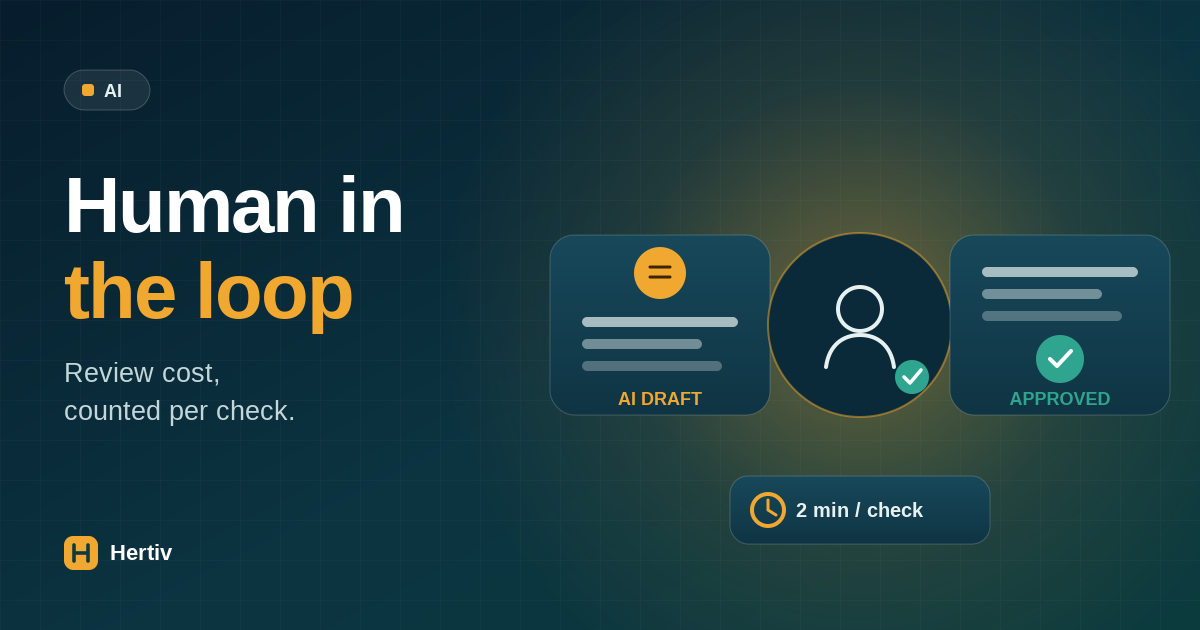
Human in the loop means a person checks AI output before it acts. Its cost is reviewer time plus tooling and training — here is how to estimate it.
On this page
Short answer
Human in the loop cost is the money a business spends to have people review AI output before it reaches a customer or triggers an action. The largest part is reviewer time, charged by the hour and driven by how many items need checking and how long each check takes. Tooling, training and quality checks add a smaller but real share.
What is human in the loop?
Human in the loop is a design where an AI system proposes an action or an answer, and a person reviews it before it goes out. The person can approve it, fix it or reject it, and the system learns from those decisions over time.
The pattern is common wherever a wrong answer is expensive: support replies that go to customers, documents that become contracts, loan decisions, medical summaries and content that carries the company name. The AI does the drafting and the routine work, and the human keeps the final say on the cases that matter.
It is different from full automation, where the system acts on its own, and from manual work, where people do everything. Human in the loop sits between the two: the machine moves fast on the easy cases, and people spend their time on judgement. For the full picture of how the pattern works, what human in the loop is explains the design in detail.
What makes up the cost of human in the loop?
The cost of human in the loop has four parts: reviewer time, tooling, training and quality checks. Reviewer time is almost always the largest, because it scales with volume.
| Cost part | What it covers | How it scales |
|---|---|---|
| Reviewer time | Hours spent checking AI output | Grows with volume and check depth |
| Tooling | Review queue, audit logs, dashboards | Mostly fixed, per seat or per month |
| Training | Teaching reviewers the rules and edge cases | Upfront, then refresher sessions |
| Quality checks | Second reviews, spot checks, metrics | Grows with the share sampled |
Reviewer time depends on three numbers: how many items the AI produces, what share needs a human check, and how long each check takes. A team that reviews every item pays far more than a team that only reviews the risky ones, which is why the review policy is the main cost lever.
Tooling costs are usually modest: a review queue with an audit trail, sometimes built into the AI product and sometimes bought separately. Prices vary by vendor, so check the vendor site for current pricing rather than relying on a figure in an article. Training is often underestimated: reviewers need to know the rules, the edge cases and when to escalate, and that knowledge has to be refreshed as the system changes.
How do you estimate human in the loop cost?
You estimate human in the loop cost by working from volume, review share and check time, then adding tooling and training on top. The formula is simple, but the inputs need real measurement, not guesses.
- Count monthly volume. How many items does the AI produce each month?
- Set the review share. What fraction needs a human check, and what fraction can go out unchecked?
- Measure check time. Time a sample of real reviews; do not guess. A simple check takes a minute or two, a hard one takes ten.
- Apply the hourly rate. Use the loaded cost of a reviewer, not the raw salary.
- Add tooling and training. Include the review tool, onboarding and refresher training.
- Compare with the cost of a mistake. A review is worth paying for when the mistake it catches costs more.
The review share is where most estimates go wrong. Teams often start by reviewing everything, then cut the share once they see which cases the AI handles well.
A common pattern is to review all high-risk items and only a sample of low-risk ones, which keeps cost down while keeping the risky cases covered. A short proof of concept is a good way to measure real check times before committing: AI proof of concept development covers how to run one with a fixed evaluation set.
Where does the cost hide?
The cost of human in the loop hides in places that do not show up in a simple hourly calculation. The biggest hidden cost is context switching: reviewers who check AI output between other tasks are slower than reviewers who work in focused blocks.
Other hidden costs include the time spent writing and updating the review rules, the meetings where edge cases are decided, and the rework when the AI's output format changes and reviewers have to learn a new layout. There is also the cost of slow decisions: if a review queue backs up, customers wait, and the delay itself costs money.
Governance adds another layer. Someone has to own the review policy, track accuracy, and decide when the review share can drop. That ownership is real work, and it belongs in the budget. If the programme has no AI governance yet, AI governance and responsible AI consulting is worth doing before the review team grows, because the policy decisions get harder to change later.
How do you keep the cost down without losing control?
You keep the cost down by reviewing less where the risk is low, and reviewing more where it is high. The goal is not to check everything, but to check the items where a mistake would hurt.
- Risk-based routing. Send high-risk items to humans and let low-risk ones through with a sample check.
- Confidence thresholds. Review items where the model is unsure, not the ones it handles well.
- Batch similar items. Reviewing ten similar drafts in one block is faster than ten scattered checks.
- Improve the prompt and data. Better inputs mean fewer corrections, which cuts review time directly.
- Track the fix rate. If reviewers rarely change anything, the review share can drop.
- Automate the easy checks. Format, length and banned-word checks can run before a human sees the item.
The fix rate is the key metric. When reviewers change less than one in ten items, the team can sample instead of reviewing everything. When they change half, the AI needs better data or a narrower job, not more reviewers. Cutting review time by improving the system is cheaper than hiring more reviewers.
Example: a support team that reviews AI drafts
Example (hypothetical): a support team uses an AI assistant that drafts 5,000 replies a month. Every draft goes to a reviewer, and each check takes 2 minutes.
That is 5,000 times 2 minutes, or 10,000 minutes a month, which is about 167 hours. At a loaded reviewer cost of $30 an hour, the review bill is about $5,010 a month.
The team then changes the policy: low-risk replies, such as password resets, go out unchecked, and only the 2,000 replies that touch billing or account changes get a human check. Review time falls to about 67 hours a month, costing about $2,010, a saving of about $3,000 a month. The risk stays covered because every reply that could cost the company money still passes a human.
What are the common mistakes?
The most common mistakes are reviewing everything forever, measuring nothing, and treating reviewers as a temporary fix for a weak system.
- Reviewing everything forever. If the fix rate is low, the review share should drop.
- Measuring nothing. Without check time and fix rate, the budget is a guess.
- No escalation path. Reviewers who cannot reach an expert will guess, and guessing is expensive.
- Reviewers as a patch. If the AI keeps making the same error, fix the data, not the review team.
- Ignoring reviewer fatigue. Tired reviewers miss errors; rotate the work and keep shifts short.
- No audit trail. If nobody can see who approved what, the review is theatre.
Key takeaways
- Reviewer time is the largest cost, driven by volume, review share and check time
- Risk-based routing is the main lever: check the risky items, sample the rest
- Measure real check times on a sample before you budget
- The fix rate tells you when the review share can safely drop
- Hidden costs include context switching, rule updates and queue delays
- Compare the review cost with the cost of the mistake it catches
Frequently asked questions
How much does human in the loop cost per month?
It depends on volume and review share. A team reviewing 5,000 AI drafts a month at 2 minutes each spends about 167 hours, which at $30 an hour is about $5,010 a month. Measure your own check time and volume before budgeting.
Is human in the loop worth the cost?
It is worth it when the mistake it catches costs more than the review. For billing, legal and safety decisions the answer is usually yes. For low-risk content, a sample check is often enough.
Can I reduce human in the loop cost over time?
Yes. As the AI improves and the fix rate falls, you can move from reviewing everything to reviewing a sample, and from a sample to risk-based routing. The savings come from a better system, not from skipping checks.
What is the cheapest way to add human review?
Start with a simple queue and a clear rule for what gets reviewed, then add tooling once the volume justifies it. A shared inbox and a spreadsheet can carry a small pilot; buy a review tool when the queue grows.
Do I need a person for every AI output?
No. Most teams review all high-risk outputs and only a sample of low-risk ones. The split depends on the cost of a mistake in each category, and it should be written down as a policy, not left to habit.
How do I know if my reviewers are too slow?
Time a sample of real reviews and compare check times across reviewers. If some checks take far longer than others, the review rules may be unclear, or the AI output may be hard to read. Fix the input before blaming the reviewer.


