How to Tokenize a Business Model Step by Step
Tokenizing a business model means turning a share of its revenue or ownership into digital tokens. Seven steps take an idea from sketch to working offer.
On this page
Short answer
To tokenize a business model means to represent a share of a business, its revenue or its assets as digital tokens on a blockchain, so many small investors can buy in and trade their share. The steps are: pick what to tokenize, set the legal structure, design the token, build the platform, run the compliance checks, launch the sale and then manage payouts and reporting.
What does it mean to tokenize a business model?
To tokenize a business model means to turn a part of a business into digital tokens that investors can buy, hold and, where the rules allow, sell. A token is a digital record that represents a claim, such as a share of revenue, a share of ownership, or a right to use a service.
The idea is simple: instead of selling the whole business to one buyer or raising money from a few large investors, the business sells many small pieces to many people. A coffee chain might tokenize future revenue from one shop. A software firm might tokenize a share of subscription income. A property business might tokenize ownership of a building.
Tokenization does not change the business itself. The shop still sells coffee, the software still needs customers, and the building still needs tenants. What changes is how ownership and income are divided and recorded, and how easily small investors can take part.
Which parts of a business can you tokenize?
Almost any part of a business that produces measurable value can be tokenized, but some parts are easier than others. Revenue and ownership are the most common, because they are easy to measure and split. Future services and loyalty points are also tokenized, though they work differently.
| What to tokenize | What the token gives | Good fit when |
|---|---|---|
| Revenue share | A share of future income | Income is steady and easy to measure |
| Ownership | A share of the business itself | Investors want a long-term stake |
| Single asset | A share of one property or machine | One asset is worth more than the whole firm |
| Future service | Credit for a service later | Customers want to prepay for value |
| Loyalty points | Rewards that can be traded | Customers already earn points |
Revenue share is usually the simplest starting point, because it does not change who owns the company. Ownership tokens raise harder questions about voting, control and exit, so they need more legal work. A business should pick the simplest part that still gives investors a clear reason to buy.
How to tokenize a business model step by step
You tokenize a business model in seven steps, from choosing what to tokenize to paying investors after the sale. Skipping a step usually creates work later, because token terms, legal duties and payouts all depend on the early decisions.
- Pick what to tokenize. Choose one clear thing, such as a share of revenue from one product line, and write down exactly what a token entitles its holder to.
- Set the legal structure. Work with a lawyer to decide whether the token is a security, a utility token or something else in each market where it will be sold.
- Design the token. Fix the total supply, the price, the payout schedule and what happens if the business is sold or closed.
- Build or buy the platform. Choose a tokenization platform or build one, with investor checks, payments, token issuance and reporting.
- Run the compliance checks. Set up identity checks, investor limits and record-keeping before anyone can buy.
- Launch the sale. Open the offer to the investors who are allowed to buy, and record each purchase on the blockchain.
- Pay and report. Split income per token on a fixed schedule, send statements, and keep records for audit and tax.
Step two deserves the most time. The legal structure decides who may invest, what disclosures are needed and how payouts are taxed. Teams that rush it often have to redesign the token after the sale has started, which is expensive and damages trust. A short legal review before the design is fixed saves far more than it costs.
What legal and compliance checks come first?
The legal and compliance checks that come first are: deciding how the token is classified, confirming who may buy it, and setting up identity checks and record-keeping. These checks differ by country, and a token that is legal in one market may be restricted in another.
In most markets, a token that gives a share of revenue or ownership is treated as a security, which means the offer needs disclosures, investor limits and sometimes a licence. A token that only gives access to a service is treated differently, but the line between the two is not always clear, so legal advice is needed before the design is fixed.
The practical checks are identity verification, sanctions screening and keeping a record of every investor and every transaction. These are the same checks a bank or a fund would run, and the platform should handle them automatically. A business that skips them risks fines and losing the ability to pay investors through banks.
How do token holders get paid?
Token holders get paid from the income the tokenized part of the business earns, split per token on a fixed schedule. The business collects the income, deducts agreed costs and fees, and pays the rest to holders, usually in bank transfer or a stablecoin, depending on the offer terms.
The payout terms must be written down before the sale: how often payouts happen, what costs are deducted first, and what happens in a quarter with no income. Investors should be able to work out what they will receive from a stated income figure, without needing to ask.
Reporting matters as much as the payment. Each payout should come with a statement showing the income, the deductions and the per-token amount. Clear statements keep investors informed and make tax reporting possible. Teams that already tokenize real-world assets treat reporting as part of the product, not as an afterthought, because it is what investors judge the offer by.
Example (hypothetical): tokenising a membership business
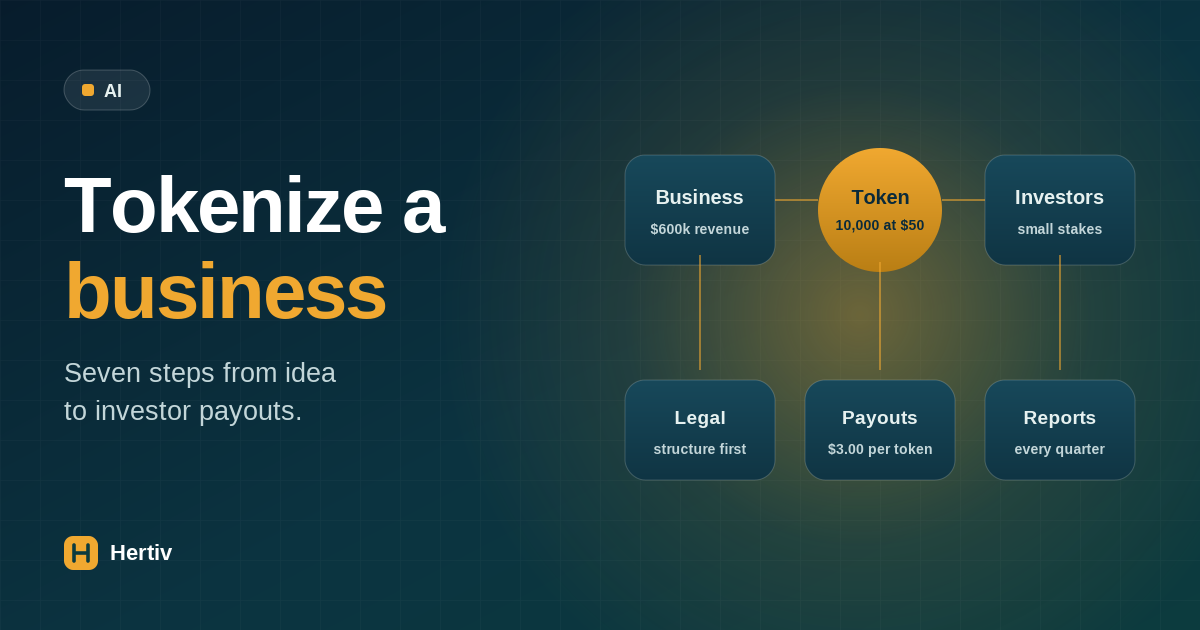
Example (hypothetical): a fitness business earns $600,000 a year from memberships and decides to tokenize 5% of that revenue. It issues 10,000 tokens at $50 each, raising $500,000, since 10,000 times $50 equals $500,000.
Each year, 5% of $600,000 is $30,000, since 5% of $600,000 equals $30,000. Split across 10,000 tokens, that is $3.00 per token per year, since $30,000 divided by 10,000 equals $3.00.
An investor holding 200 tokens paid $10,000 and receives $600 a year, since 200 times $3.00 equals $600. The return is modest, which is the point: the token is a share of real income, not a promise of fast growth, and the business should say so plainly in the offer.
Common mistakes
The most common mistake is tokenizing the wrong thing. A business that tokenizes a vague idea, such as "a share of our future", leaves investors guessing what they own. A clear, measurable claim, such as a share of revenue from one product line, is easier to price, to pay out and to explain.
- Promising returns. Stating what investors will earn, when income depends on a business that may grow or shrink.
- Skipping legal advice. Designing the token first and asking a lawyer later, when the design may already break the rules.
- No exit plan. Selling tokens with no way for holders to sell them, leaving investors stuck.
- Weak payout records. Paying investors without statements, so nobody can check the maths.
- Tokenizing everything at once. Putting the whole business on chain before one part works.
The businesses that do well start small, with one clear part of the model, one market and one payout schedule. They prove the process works, then tokenize more. A small working offer teaches more than a large one that never launches.
Key takeaways
- Tokenization turns a share of revenue or ownership into many small digital pieces
- Revenue share is usually the simplest part to tokenize first
- Legal structure and payout terms must be fixed before the sale
- Holders are paid per token from real income, on a fixed schedule
- Start with one clear part of the business, not the whole model
Frequently asked questions
Do I need a lawyer to tokenize a business model?
Yes, in almost every case. The token's legal classification decides who may buy, what must be disclosed and how payouts are taxed, and the rules differ by country. A short legal review before the design is fixed costs far less than redesigning a token after the sale has started.
What is the difference between tokenizing a business and an asset?
Tokenizing an asset means selling shares in one thing, such as a building or a machine. Tokenizing a business model means selling shares in how the business earns, such as a share of revenue from a product line. The business version is more flexible but needs clearer terms, because income can rise and fall.
How many tokens should a business issue?
That depends on the price per token and the amount being raised. A common approach is to fix the total raise first, then choose a token price that keeps the minimum investment affordable, and divide one by the other. The number itself matters less than the terms each token carries.
Can token holders vote on business decisions?
Only if the token terms say so. Most revenue-share tokens give no voting rights, while ownership tokens sometimes do. The business should state the rights clearly in the offer, because investors who expect a say and get none are unlikely to invest again.
What happens if the business is sold?
The token terms should say what happens: holders may be paid out, may keep a claim on the new owner, or may convert to shares. If the terms are silent, the sale can become a dispute. This clause should be written before the first token is sold.
Is tokenization only for large companies?
No. Small businesses tokenize single assets or revenue streams, and the minimum raise can be modest. What matters is not size but clarity: a measurable income stream, a legal structure and a way to pay holders. A small business with clear books is easier to tokenize than a large one without them.


