How to Name an App: A Practical Checklist for Product Teams
Naming an app means balancing clarity, distinctiveness and legal availability. Check trademarks, app store conflicts, domains and pronounceability before you commit.
On this page
Short answer
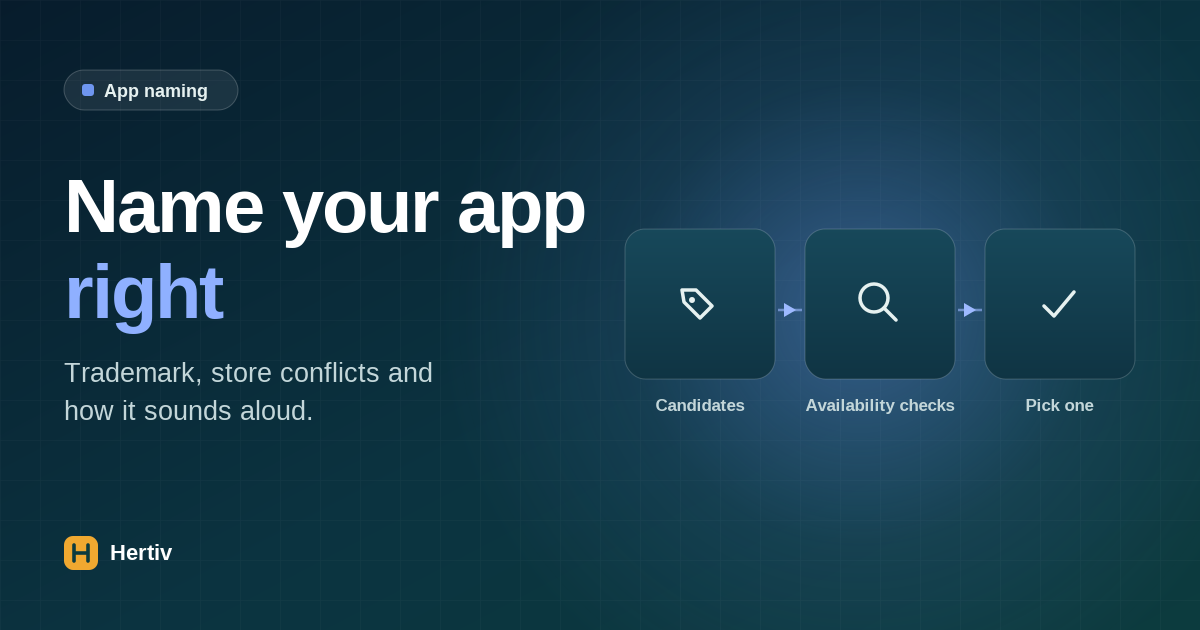
Start with two or three candidate names rooted in the product's core benefit, then filter them by trademark availability, app store conflicts, domain and handle availability, spelling ease and how they sound aloud. Pick the one that survives all filters, not the one you like most in a meeting.
What makes an app name work
A good app name is short, easy to spell from hearing it, distinctive enough to be searchable, and legally available in the markets you sell in. Everything else is taste.
The practical constraints matter more than most teams expect. Apple and Google both cap the visible name in listings and on home screens, so long names get truncated. Users often hear a name before they see it, in a podcast, a referral or a support call, which makes phonetic clarity a real requirement.
A useful mental filter is the support test: could a customer repeat the name to a colleague without spelling it out? If not, the name will cost you in organic search and word of mouth for years.
Three qualities carry most of the weight:
- Memorability in one hearing or one glance
- Searchability, so your app is findable and not buried under a common word
- Ownability, meaning no trademark clash and no confusion with a bigger product in the same category
The naming approaches and when each fits
Most app names fall into a handful of patterns, and each pattern carries different trade-offs for search, memorability and legal risk. Choose the pattern before you generate candidates, or you will end up comparing unlike things.
| Approach | Example pattern | Strengths | Watch out for |
|---|---|---|---|
| Descriptive | Function in plain words | Instantly clear | Hard to trademark, generic search results |
| Suggestive | Hint at the benefit | Clear plus ownable | Can drift from the roadmap |
| Invented | Made-up word | Highly ownable, trademark-friendly | Needs marketing to teach meaning |
| Compound | Two short words joined | Descriptive and distinctive | Crowded space, similar names |
| Evocative | Feeling or metaphor | Memorable, brand-flexible | Vague for new users |
| Founder or place | Personal or geographic | Story value | Limiting and often hard to trademark |
Descriptive names are easiest to explain and hardest to protect. Invented names are the reverse. Suggestive and compound names sit in between and are the most common choice for consumer apps because they balance clarity with legal room.
For B2B products, clarity usually beats cleverness because buyers search by function. An operations tool named after its job will surface in procurement conversations far more naturally than an abstract word.
Consider how the name reads alongside your existing brand. If the parent company name is already established, a descriptive app name often inherits trust faster.
How to check a name before you commit
Validate each shortlisted name in this order, cheapest checks first, so you eliminate failures before spending on legal review. The whole cycle usually takes a few days for two or three candidates.
- Trademark search. Look in the classes and jurisdictions where you sell. In the US that means the USPTO database, in the EU the EUIPO register, in the UK the IPO, and in the Gulf the relevant national registries. A paid search by an attorney is worth it before launch, not before shortlisting.
- App store search. Search the exact name and close variants on both the App Store and Google Play. Note apps in adjacent categories too, because reviewers flag confusing similarity.
- Domain and handles. Check the obvious domain and its common alternatives, plus handles on the platforms you will actually use. You do not need every variant, but you do need one clean canonical domain.
- Search results. Search the name on its own and with your category. If page one is full of unrelated businesses, your organic discovery will suffer.
- Pronunciation test. Send the name in a voice note to five colleagues and ask them to type it. If they misspell it, fix the name, not the spelling.
- Legal clearance. Once one name survives, have a lawyer run the formal clearance in your launch markets.
Building and scoring a shortlist
Generate more candidates than you think you need, then score them against written criteria so the decision is not a matter of who speaks loudest in the room. A shortlist of five is workable; a list of forty is not.
Start with a structured generation session. Pull words from the product's core verbs, the user's goal, the emotional payoff and the category vocabulary. Combine them. Then cut anything that fails the obvious filters: too long, hard to spell, already taken, or sounds like a competitor.
Score the survivors on a simple scale, for example one to five on each of: clarity, distinctiveness, pronounceability, availability, and room to grow. Weight clarity and availability highest for B2B, and distinctiveness and pronounceability highest for consumer.
Example (hypothetical): A scheduling app shortlists three names. Name A scores clearly on clarity but fails the trademark check in the UK. Name B is distinctive but three of five testers misspell it from audio. Name C scores moderately on everything and passes all checks. The team picks C, not because it is the most exciting but because it is the only one with no disqualifying failure.
Once you choose, secure the domain, the store listings and the main handles within the same week. Names get registered by others quickly once they appear in public.
Common naming mistakes
Most naming problems come from skipping checks rather than from a lack of creativity. These are the failures that show up repeatedly.
- Choosing in a vacuum. A name that the founding team loves can be confusing to users. Test with people outside the company.
- Ignoring trademarks until launch. Renaming after you have printed materials, built listings and earned reviews is expensive and slow.
- Naming for today's feature. If the roadmap will widen, a name tied to one function will fight the product later.
- Clever spellings. Dropped vowels and swapped letters feel distinctive to the team and look like typos to everyone else.
- Copying category leaders. Similarity to a known app invites store rejection and permanent confusion.
- Forgetting the spoken form. Support calls, referrals and podcasts all use audio, and audio is where odd spellings break.
- No international check. A word that means something unfortunate in another language is a common and avoidable problem.
Treat naming as a short engineering task with defined inputs and pass or fail criteria. That framing keeps the discussion productive and gets you to a decision faster.
Finalising the name and shipping it
Naming ends with paperwork, not consensus. Once you have a cleared name, lock it down across the places users will encounter it and record the decision so it does not reopen later.
Secure the canonical domain, the developer accounts and the store listings, and reserve the handles on the platforms you plan to use. File the trademark in your core markets with advice from counsel. Then prepare the naming kit: the written name, the casing, the pronunciation note for support teams, and the one-line description that appears in store listings.
Brief the people who will say the name most: support, sales, and anyone writing documentation. A consistent pronunciation and spelling across those teams prevents a slow drift into variants that fragment your search presence.
Finally, keep the shortlist. If the product pivots or expands into markets where the name is blocked, a validated second choice saves weeks. When you are ready to build the product behind the name, our mobile app development and web application development teams can take it from concept to release.
Key takeaways
- Name first for what the app does or who it serves, then for cleverness
- Run a trademark search in your target markets before any design or marketing spend
- Check app stores, domain variants and social handles for the exact name and close variants
- Say every candidate aloud on a phone call to catch spelling and pronunciation failures
- Avoid names that box you in if the product roadmap is likely to widen
- Reserve the final choice across stores and handles the same week you decide
Frequently asked questions
Should an app name describe what the app does?
Descriptive names are easiest for users to understand and hardest to trademark. For B2B products, a descriptive or suggestive name usually helps discovery. For consumer apps, a more distinctive name can stand out, provided marketing teaches the meaning.
Do I need a trademark before launching an app?
You do not need a registered trademark to launch, but you should complete a clearance search in your target markets first. Launching on an unsearched name risks a forced rename after you have built reviews, listings and brand recognition.
How many names should I shortlist?
Three to five vetted candidates is enough. More than that slows the decision and usually means the criteria are unclear. Score each candidate on clarity, distinctiveness, pronounceability, availability and room to grow.
Is it a problem if the domain is taken?
Not necessarily, but you need one clean canonical domain for the product. If the exact match is unavailable, a short, unambiguous variant is acceptable. Avoid variants that users will mistype or that look like a different business.
How do I test whether a name is easy to spell?
Send the name in a voice note to several people who have not seen it written and ask them to type it. If most misspell it, the name will cause search and support problems. Repeat the test with a small group before finalising.
Can I rename an app after launch?
Yes, and many products do, but the cost is real: store listings, reviews, links, support material and search equity all need updating. If your target markets or product scope are likely to change, validate the name for those cases before launch.


