How to Implement Penetration Testing in Your Company
Penetration testing finds the holes an attacker would use before they do. Here is how to plan, scope, run and act on a test without disrupting your product.
On this page
Short answer
Penetration testing is a controlled, authorised attempt to break into your systems the way an attacker would, so your team finds and fixes the weak points first. It is planned in advance, limited to systems you approve, and ends with a report that ranks each finding by risk and tells you how to fix it.
What is penetration testing?
Penetration testing is a controlled, authorised attempt to break into your systems the way an attacker would, so you find the weak points before a real attacker does. A tester, usually an outside specialist, probes your applications, networks and people for flaws, then reports exactly what they found and how it could be used.
It differs from a vulnerability scan, which only lists known weaknesses from a database. A penetration test goes further: the tester tries to use a weakness to reach data or take control, which shows whether the weakness actually matters in your environment. To see how the two differ, read what is penetration testing.
Tests are planned in advance, run under a written agreement, and limited to the systems you approve. The tester stops at agreed boundaries and records evidence, so nothing is changed or damaged without your knowledge. Results feed directly into wider cybersecurity services work such as patching and access fixes.
What should a penetration test cover?
A penetration test should cover the systems an attacker would actually target, not every asset you own. The scope usually starts with what holds your most sensitive data or controls access to it.
| Area | What the tester checks | Why it matters |
|---|---|---|
| Web application | Login, input handling, session control | Most customer data passes through it |
| API | Authorisation, rate limits, data exposure | APIs are often reachable without a browser |
| Network | Open ports, segmentation, exposed services | Shows what an outsider can reach |
| Cloud configuration | Storage, identity and access settings | Misconfiguration is a common entry point |
| People | Phishing and social engineering | Staff are often the easiest way in |
| Mobile app | Storage, transport and API calls | Apps carry tokens and cached data |
Agree the scope in writing before testing starts. Anything outside the list is off limits, and anything inside it is fair game. A clear scope also keeps the test legal: the tester only touches systems you own or have permission to test.
How do you scope a penetration test?
Scoping is where most tests succeed or fail. A scope that is too wide wastes time on low-value systems; one that is too narrow misses the paths an attacker would take.
- List your crown-jewel assets. Customer data, production systems, financial tools and admin consoles come first.
- Decide the test types. Choose between web, API, network, cloud and people testing based on where the risk sits.
- Set rules of engagement. Write down what is in scope, what is forbidden, and how the tester should behave if they find something critical.
- Agree timing and blackout windows. Pick hours when a disruption hurts least, and name the people to call if something breaks.
- Define how findings are reported. Ask for severity, evidence and fix steps for each finding, not just a list of issues.
Share the scope with the teams that run the systems in it. A test that surprises your operations team looks the same as a real incident, and the confusion costs more than the test itself.
How do you run the test without breaking things?
A well-run test rarely causes outages, because the tester works in stages and checks with you before risky steps. The risk is highest with denial-of-service style checks and with tests against production databases, so those are usually limited or run against a copy.
- Test a staging copy first where the behaviour matches production closely enough to trust the results.
- Take a backup before the test window, so any accidental change can be undone quickly.
- Name a contact on each side who can be reached during the test window.
- Write down stop conditions that end the test immediately, such as a service going down.
- Ban destructive payloads that delete data or change records in production.
Keep a shared channel open during the test window. If a tester finds a critical flaw, they tell you the same day rather than waiting for the final report, so you can start fixing it immediately. This is where the penetration testing cost is repaid: an early warning is worth more than a polished report.
What happens after the test?
After the test you get a report that lists each finding with its severity, the evidence the tester collected, and the steps needed to fix it. Good reports rank findings by risk, not by count, so your team knows what to fix first.
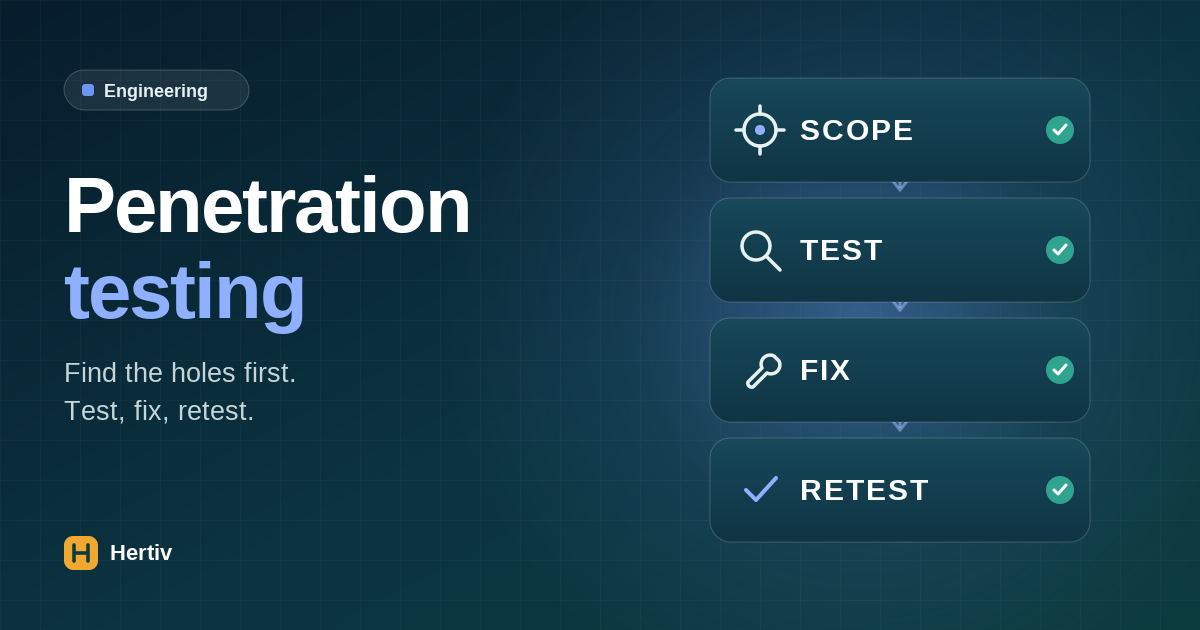
Fix the critical and high findings first, then ask the tester to retest them. A retest confirms the fix works and that it did not break something else. Findings that you accept as a risk should be written down with a reason, not left in the report unread.
Feed the results into your wider security work. Repeated findings, such as the same misconfiguration in several services, point to a process gap rather than a one-off mistake. A vulnerability assessment and penetration testing cycle repeated once or twice a year keeps that picture current.
Example: a mid-size SaaS company runs its first test
Example (hypothetical): a 120-person SaaS company runs its first penetration test against its web app and API. The test finds 48 issues: 6 critical, 14 high, 18 medium and 10 low.
The team estimates 3 engineer-days to fix each critical issue and 1 day for each high one. That is 6 x 3 = 18 days plus 14 x 1 = 14 days, or 32 engineer-days in total. With two engineers on the fixes, the critical and high findings are cleared in about 16 working days.
The test itself cost $18,000 and the retest $4,000, a total of $22,000. The medium and low findings go into the normal backlog. The retest confirms all 20 critical and high issues are fixed, and the company books the next test for the same quarter next year.
What are the common mistakes?
The most common penetration testing mistakes are testing the wrong scope, treating the report as the end of the work, and running tests so rarely that the results are out of date before they are fixed.
- Testing only the public website. Attackers also use APIs, cloud settings and staff, so the scope should cover those too.
- Skipping the retest. A fix that is never verified is a guess, and the next test finds the same issue again.
- Ignoring the human side. A phishing test often finds the fastest way in, and it is cheap to run.
- Testing once and never again. Systems change every release, so a test from last year describes a system that no longer exists.
- Choosing the cheapest tester. A low price often means automated scans only, with no manual testing of your logic.
Key takeaways
- Penetration testing proves a weakness can be used, not just that it exists
- Scope in writing before testing starts, and share it with the teams that run the systems
- Test a staging copy first and agree stop conditions for anything risky
- Fix critical and high findings first, then retest them before closing the project
- Repeat the cycle once or twice a year so results stay current
Frequently asked questions
How often should we run a penetration test?
Once or twice a year is a sensible rhythm for most teams, plus a test after a major change such as a new product, a migration or a merger. Tests tied to releases catch new issues while the code is still fresh in the team's mind.
Is penetration testing the same as a vulnerability scan?
No. A scan lists known weaknesses automatically, while a penetration test tries to use them to reach data or take control. Scans are cheap and frequent; penetration tests are deeper, slower and run by a person who follows the attack path.
Do we need permission to test our own systems?
Yes. Even for systems you own, get written permission from the owner and from any cloud or hosting provider whose rules cover the test. Without it, the test can breach contracts or the law, and the results may not be usable.
What does a penetration test report contain?
It lists each finding with its severity, the evidence the tester collected, and the steps needed to fix it. Good reports also describe the attack path, so your team can see how the tester moved from the first flaw to the data.
Should we test production or staging?
Staging is safer for risky checks, but production shows the real configuration, so most teams test both. The common pattern is to test staging thoroughly and run a limited, careful pass against production with agreed stop conditions.
What happens if the tester finds something critical?
The tester tells you the same day, not in the final report. Your team can then start the fix immediately while the test continues. This is standard practice and should be written into the rules of engagement before testing starts.


