How to Hire Generative AI Professionals
Hiring generative AI professionals starts with naming the job: prompt engineer, ML engineer or data engineer, each with different skills and interview tests.
On this page
Short answer
A generative AI professional is someone who builds, runs or improves software that uses large language models or other generative models. Hiring one starts with naming the exact job, because prompt engineer, ML engineer, data engineer and AI product manager are different roles with different skills. Write the job down first, then hire against it, and you will avoid paying for skills you do not need.
What is a generative AI professional?
A generative AI professional is a person whose work centres on generative models: large language models that write text, image models that make pictures, or speech models that talk. Some design prompts and workflows, some build the software around the model, and some prepare and check the data the model uses.
The title on a CV tells you little on its own. Two people can both call themselves AI engineers while one spends the day writing prompts and testing outputs and the other trains models and tunes infrastructure. Ask what the person actually built, what data it used, and how they knew it worked.
The safest way to think about the field is as a team, not a single hire. Most working AI products need at least a person who understands the model, a person who builds the software, and a person who checks the output. One hire rarely covers all three.
Which generative AI roles do you actually need?
The roles you need depend on what you are building. A support chatbot needs a prompt engineer and a software engineer, while a document-processing product needs a data engineer and an ML engineer as well. Hiring the wrong role first is the most expensive mistake in AI hiring.
Use the table to match the job to the role before you write the advert. If you cannot name the role, you are not ready to hire, and a short AI proof of concept with a contractor can tell you what you need.
| Role | Main job | When you need one |
|---|---|---|
| Prompt engineer | Designs prompts and checks outputs | Chatbots, drafting, support tools |
| ML engineer | Trains, tunes and runs models | Custom models, fine-tuning |
| AI software engineer | Builds the app around the model | Almost every AI product |
| Data engineer | Prepares and moves the data | RAG, search, document work |
| AI product manager | Decides what to build and why | Teams with more than one AI hire |
| Evaluation specialist | Builds test sets and measures quality | Regulated or high-risk use |
Start with the software engineer if you are unsure. Every generative AI product is software first, and a good engineer who has shipped with model APIs can learn the prompting work faster than a prompt specialist can learn to ship software.
Where do you find generative AI professionals?
Generative AI professionals are found in the same places as other engineers, but the signal is different. Job boards and LinkedIn work, yet the best candidates often show their work in public: open-source projects, blog posts about a build, or talks at meetups. A candidate who can show a working demo beats one with a longer CV.
Specialist recruiters can help for senior roles, but they charge a large fee, so use them only when the hire is senior and the market is thin. For most teams, a clear advert, a fair process and a real task to solve will bring in good applicants without a recruiter.
Do not limit the search to people with the words generative AI in their title. Many strong candidates come from search, data engineering or backend work, and they learn the model side quickly. If you need help scoping the team, a AI readiness assessment can show which roles your project actually needs.
How to test skills before you hire
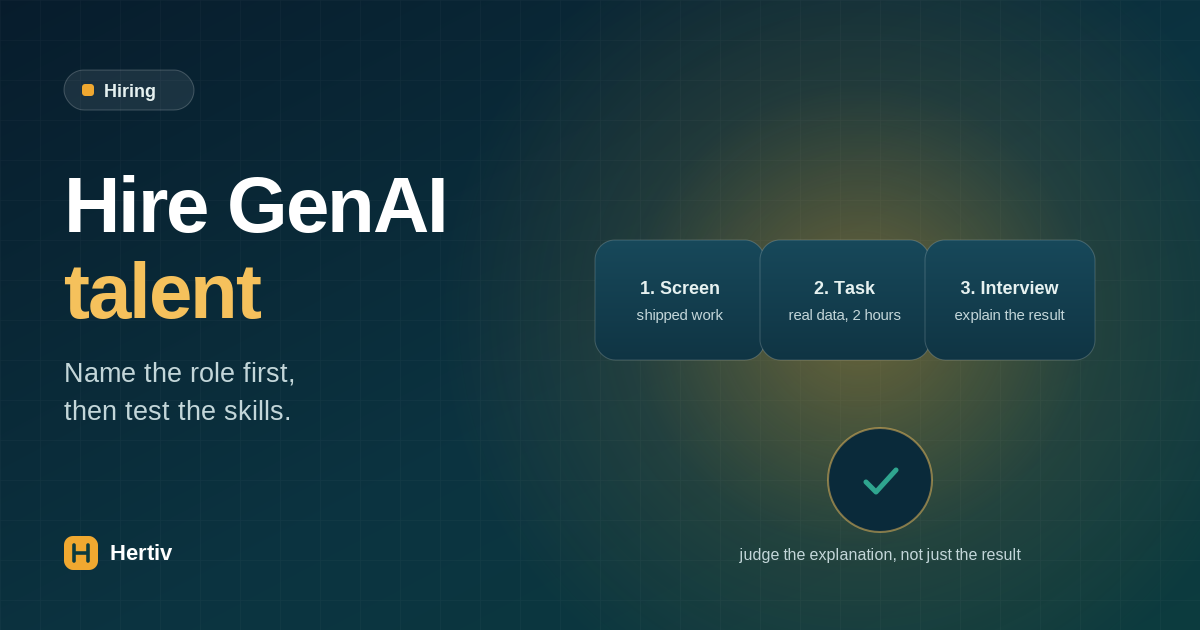
Test skills with a small, realistic task, not a quiz. Give the candidate a sample of your real data, a clear goal, and two hours, then ask them to show what they built and explain their choices. The explanation matters more than the result, because it shows how they think about quality, cost and failure.
For a prompt engineer, the task can be writing prompts for five real support questions and grading the answers. For an ML engineer, it can be fine-tuning a small model on a sample set and reporting the result. For a software engineer, it can be wiring a model API into a small app with error handling and logging.
Always check how the candidate handles a wrong answer. Ask what they would do when the model invents a fact or refuses a fair request. A good answer names a concrete check, such as citing sources, adding a human review step, or blocking the output, rather than promising the model will be right.
How to hire generative AI professionals in 6 steps
Hiring in order saves time and money. Each step answers one question before you spend on the next, so you do not interview fifty people for a job you have not defined.
- Write the job in one page: the product, the first three months of work, and how success will be measured.
- Pick the role from the table above, and list the three skills that matter most.
- Advertise where your candidates already are, with the salary range and the real task included.
- Screen CVs for shipped work, not keywords, and keep a short list of six to eight people.
- Run a two-hour practical task on your own data, then a one-hour interview about the result.
- Check two references by asking what the person built and what they would do differently next time.
Move fast once you find the right person. Good candidates often have more than one offer, and a slow process loses them. If the role is new to your team, hire AI engineers through a trial project first, so both sides can check the fit before a full offer.
Example (hypothetical): hiring two people in four weeks
Example (hypothetical): a small software company wants a support chatbot and plans to hire one prompt engineer and one AI software engineer. The hiring manager writes a one-page job for each role and advertises both in the same week.
Thirty people apply for each role. A fifteen-minute screen for each applicant takes about seven and a half hours per role, so fifteen hours in total. Six finalists per role take a two-hour practical task and a one-hour interview, which is eighteen hours of the team's time per role, or thirty-six hours in total.
Adding the two rounds together, the team spends about fifty-one hours over four weeks and makes two offers. The lesson is that hiring is mostly screening: the advert brings the applicants, but the practical task is what separates the people who can do the job from the people who can only describe it.
Common mistakes
The most common mistake is hiring for a job you have not defined. An advert that asks for everything, from prompt engineering to model training to data pipelines, attracts nobody good, because the best candidates know what they do well and skip vague jobs.
Another mistake is testing with trivia instead of real work. Asking a candidate to name model versions or recite paper titles tells you nothing about whether they can ship. A small task on your own data tells you almost everything.
A third mistake is skipping the reference check. Two short calls can reveal whether the candidate shipped the work they claim or only watched someone else ship it. Finally, do not set the salary from a headline. Pay varies widely by country and seniority, so check current ranges for your market and say the range in the advert, or good candidates will not apply.
Key takeaways
- Name the exact role before you advertise; prompt engineer, ML engineer and data engineer are different jobs.
- Start with a software engineer if you are unsure; every AI product is software first.
- Test with a small task on your own data, and judge the explanation, not just the result.
- Ask how the candidate handles a wrong answer; a good answer names a concrete check.
- Hiring is mostly screening: plan about fifty hours of team time for two hires over four weeks.
Frequently asked questions
What does a generative AI professional do?
A generative AI professional builds, runs or improves software that uses generative models, such as large language models. Some design prompts, some build the app around the model, and some prepare the data. The exact work depends on the role, so always ask what the person actually built.
How much does it cost to hire a generative AI professional?
Pay varies widely by country, seniority and role, and it changes fast as the market moves. Check current salary ranges for your market and role before you advertise, and put the range in the advert. A trial project can also show the cost before a full hire.
Do I need a prompt engineer or an ML engineer?
It depends on the product. A chatbot or drafting tool needs a prompt engineer first, while a custom or fine-tuned model needs an ML engineer. If you are building an app around a model API, hire the software engineer first and add the other roles later.
Can I hire generative AI professionals remotely?
Yes, most of this work is remote-friendly, because the tools, data and tests live online. Remote hiring widens the pool, but it needs a clear practical task and a written process, or time zones and distance will slow every decision down.
How long does it take to hire a generative AI professional?
A focused process takes about four weeks from advert to offer for one role, if the job is defined and the team can interview quickly. Slow decisions add weeks, and good candidates often take another offer while they wait.
Should I hire full-time or use a contractor first?
A contractor or trial project suits a first AI hire, because it tests the role before you commit to a salary. Hire full-time once the product direction is clear and the work will last more than a few months.


