How to Get a Million Downloads for Your App
A million downloads takes a strong store listing, one channel that works, and steady growth over months. Here is how teams plan the climb.
On this page
Short answer
Reaching a million downloads takes a clear app idea, a store listing that converts, one distribution channel that works and steady growth over many months. There is no single trick: teams that get there combine app store optimisation, press, paid ads and referrals, then measure which channel brings users who stay.
What does it take to reach a million downloads?
Reaching a million downloads means convincing a million people to install your app, which takes a product worth installing, a store listing that converts and a distribution channel that keeps working. Most apps that get there do it over 12 to 24 months, not in a launch week.
The maths sets the pace. A million downloads in 18 months means about 55,000 downloads a month, or roughly 1,800 a day. A team that cannot yet get 100 downloads a day has a distribution problem to solve before it worries about the million.
Start by checking the basics: the app solves one clear problem, the store listing shows it in the first three seconds, and the app holds a rating that does not scare people away. Growth tactics on top of a weak listing waste money, because most visitors leave without installing.
Which channels actually drive downloads?
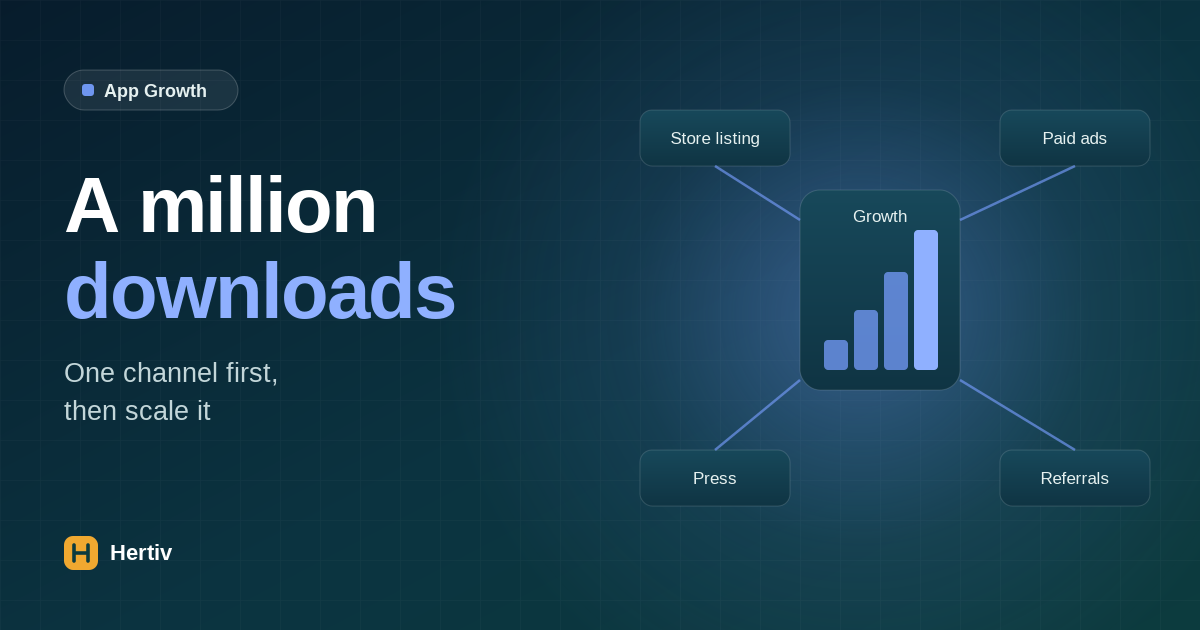
Downloads come from a small set of channels, and each one suits a different kind of app. The table below shows where downloads usually come from and what each channel needs to work.
| Channel | How it works | What it needs |
|---|---|---|
| App store search | People find the app by searching | Keywords, ratings and screenshots |
| Paid ads | Ads in social feeds and search | Budget and a cost per install target |
| Press and blogs | Coverage brings a spike of installs | A story worth writing about |
| Influencers | Creators show the app to followers | A creator whose audience matches |
| Referrals | Users invite friends for a reward | A reward both sides value |
| Word of mouth | Users recommend the app unprompted | A product people talk about |
Most apps find one channel that works first and build from there. A team that spreads a small budget across six channels learns nothing, while a team that tests one channel properly learns whether it can scale. For the launch itself, see mobile app launch tips.
How does app store optimisation fit in?
App store optimisation, or ASO, is the work of making the store listing convert more of the people who see it. It covers the title, keywords, screenshots, video preview, ratings and reviews, and it matters because the store is where most installs happen.
The first screenshot does most of the work. People decide in seconds, so the first image should show the main benefit in plain words, not a logo or a feature list. The next two screenshots should show the next two benefits, in the order a new user cares about them.
Ratings matter more than most teams expect. An app at 4.5 stars converts far better than one at 3.5, and a run of recent one-star reviews about crashes will sink a listing. Fixing the bugs that cause bad reviews is an ASO task, not just an engineering one. For the detail, see how app store optimisation drives downloads.
How do you plan a launch that compounds?
A launch that compounds is a sequence, not a single day. The team lines up a small group of early users, fixes what they report, then opens the next channel only when the listing converts well enough to make the traffic worth buying.
A workable sequence looks like this:
- Ship to a small group. Invite a few hundred users, watch where they drop off, and fix the worst problems first.
- Fix the listing. Rewrite the screenshots and description until the install rate improves.
- Earn one press story. Pitch one outlet with a clear angle and a working demo.
- Test paid ads small. Spend a little to learn the cost per install before spending a lot.
- Add referrals. Once users stay, give them a reason to invite friends.
- Repeat what works. Put more budget behind the channel with the lowest cost per retained user.
Each step depends on the one before it. Paid ads before the listing is fixed just buys installs that do not stay, and a referral scheme before users like the product invites nobody.
How do you measure what is working?
Measure downloads by channel, cost per install and how many users are still active after 30 days. Downloads alone say little: an app with a million installs and few active users has a retention problem, not a growth problem.
Track three numbers every week: installs per channel, cost per install per channel, and day-30 retention. A channel with cheap installs and poor retention is worse than a channel with dear installs and strong retention, because the second one builds a user base that stays.
Set a target for each channel before spending on it. If paid ads need to bring installs at under a set cost to be worth it, write that number down and stop the channel when it misses for two weeks running. Growth without a target becomes spending without a result. For the build itself, see mobile app development.
Example (hypothetical): a fitness app's first year
Example (hypothetical): a fitness app launches with a store listing that converts 30% of visitors. In its first month it gets 10,000 store visits, so 10,000 x 30% = 3,000 installs. Of those, 40% are still active after 30 days, so the app keeps 1,200 users.
The team improves the screenshots and the conversion rate rises to 40%. The same 10,000 visits now bring 10,000 x 40% = 4,000 installs, and at the same 40% retention the app keeps 1,600 users, which is 400 more users a month from the same traffic.
Over 12 months at that rate, the app adds about 1,600 users a month, or 19,200 users in a year. That is a long way from a million, which is the point: the team now knows it needs roughly 50 times more traffic, and it can plan press, ads and referrals against a real number instead of a hope.
The lesson is to work the maths before the tactics. A team that knows its conversion rate and retention can say exactly how much traffic it needs, and which channel is most likely to bring it.
What are the common mistakes?
The most common mistakes teams make chasing a million downloads are buying installs before the listing converts, spreading budget across too many channels, and counting installs instead of active users.
- Paid ads too early. Ads send traffic to a weak listing, and most visitors leave without installing.
- Too many channels at once. Testing six channels with a small budget teaches nothing about any of them.
- Counting installs, not retention. A million installs with few active users is a dead app with a big number.
- Ignoring reviews. A run of one-star reviews about crashes will undo a good press story.
- No referral plan. Apps that grow fastest give happy users a reason to invite friends.
- Quitting after the launch spike. Launch traffic fades in days; steady growth takes months of work.
Key takeaways
- A million downloads needs about 1,800 installs a day for 18 months
- Fix the store listing before spending on ads
- Test one channel properly instead of six badly
- Count active users after 30 days, not raw installs
- Work the maths: conversion rate times traffic equals growth
Frequently asked questions
How long does it take to get a million downloads?
Most apps that reach a million downloads take 12 to 24 months of steady growth. A million in 18 months means about 55,000 downloads a month, or roughly 1,800 a day. A launch spike helps, but it fades in days, and the long climb comes from a listing that converts and one channel that keeps working.
What is the cheapest way to get app downloads?
App store search is usually the cheapest source, because it needs optimisation work rather than ad spend. A listing with the right keywords, clear screenshots and a strong rating brings installs every day without a budget. Paid ads are faster but cost money per install, so they only make sense once the listing converts well.
Do I need paid ads to reach a million downloads?
Not always, but most apps use them at some point. Press, referrals and word of mouth can carry an app a long way if the product is strong. Paid ads help when the team knows its cost per install and its retention, and can show that each install is worth more than it costs.
What is a good conversion rate for an app store listing?
A listing that turns 30% to 40% of visitors into installs is doing well, though the figure varies by category and by how the traffic arrives. Search visitors convert better than ad clicks, because they were already looking for the app. Test screenshots and the first image first, since they move the number most.
Why do my downloads keep dropping after launch?
Launch traffic comes from press, friends and early users, and it fades in days. After that, downloads settle to whatever the store listing and the working channels bring every day. If the baseline is low, the listing or the channel is the problem, not the launch. Fix the listing, then build one channel at a time.
What is the difference between installs and active users?
Installs count everyone who downloaded the app, while active users count the people still using it after a set period, usually 30 days. An app can have a million installs and few active users if most people delete it. Growth plans should target active users, since they are the ones who pay, share and stay.


