How to Build a Medical Startup That Reaches Patients
A medical startup turns a clinical problem into a product doctors and patients can use. Here is how to validate, fund and build one without skipping the rules.
On this page
Short answer
A medical startup is a young company that builds a product or service for healthcare, such as a diagnostic tool, a patient app or a clinical workflow system. Building one means proving the clinical need, meeting the regulations for the market you sell in, testing with real clinicians and patients, and funding a longer road to revenue than most software startups face.
What is a medical startup?
A medical startup is a young company that builds a product or service for healthcare, such as a diagnostic aid, a patient app, a clinical workflow tool or a medical device. It differs from a general software startup because its product touches patient care, which brings clinical evidence, safety rules and data privacy into every decision.
Medical startups fall into a few shapes, and the shape decides the rules you face and the time it takes to reach paying customers.
| Type | What it does | Main hurdle |
|---|---|---|
| Diagnostic aid | Helps clinicians read scans, tests or signals | Clinical evidence and device rules |
| Patient app | Booking, reminders, monitoring, self-care | Privacy rules and patient trust |
| Clinical workflow | Scheduling, referrals, records, triage | Hospital buying cycles and integration |
| Medical device | Hardware that measures or treats | Certification and manufacturing |
| Health data platform | Collects and analyses care data | Data access and consent |
The shape also decides who pays. A patient app may charge patients or insurers, a workflow tool usually sells to hospitals, and a diagnostic aid often needs a clinic or a health system to adopt it. Healthcare business ideas for startups shows the shapes founders pick most often.
What rules apply before you build?
The rules that apply to a medical startup depend on what the product does and where it is sold. A product that diagnoses, treats or monitors a condition is usually treated as a medical device, which means it needs a clearance or approval before it can be sold, while a general wellness app usually does not.
Health data brings its own rules. In the United States, patient health information is covered by HIPAA, which sets how data is stored, shared and protected. In Europe, the GDPR covers health data too, with strict consent and security requirements. If your product handles patient data, you need to design for those rules from the first line of code, not add them later.
Other rules to check early:
- Device classification. Find out whether your product counts as a medical device in each market you plan to sell in.
- Clinical evidence. Some products need a study or a trial before they can be marketed.
- Data residency. Some markets require health data to stay inside the country.
- Liability and insurance. A product that influences care needs cover for the risks it creates.
Talk to a regulatory adviser before you build, not after. A product built the wrong way for its market may need to be rebuilt, and that costs far more than an early conversation. How to build a healthcare app covers the compliance side of health software in more depth.
How do you validate the idea with clinicians?
You validate a medical startup idea by testing it with the clinicians and patients who would use it, in their real working day, not in a demo. A product that looks good in a pitch and fails in a busy clinic will not survive its first pilot.
Start by watching the work. Spend time in the clinic or ward where the problem lives, and note what people actually do, where they wait, and what they work around. The real problem is often one step away from the one the founder first named, and the observation is what finds it.
Then test the idea in small steps:
- Interview ten clinicians. Ask how they handle the problem today and what a fix would have to do to be worth using.
- Test a paper version first. A sketch or a simple form can show whether the workflow fits before any code is written.
- Run a small pilot. One clinic, a few weeks, with clear measures such as time saved or errors avoided.
- Ask patients too. A product patients will not use fails however much clinicians like it.
Keep a record of what each test taught you. A pilot that shows the idea does not work is still useful, because it stops you spending a year building the wrong product. How to develop an mHealth app patients use covers patient testing in more depth.
How do you fund a medical startup?
A medical startup usually needs more money and more time before revenue than a general software startup, because regulation, clinical testing and hospital sales cycles all take months. Founders plan for that by mixing funding sources instead of relying on one.
The common sources, in the order most founders use them:
- Founders and grants. Personal savings, research grants and public innovation funds cover the earliest validation work.
- Angel investors. Individuals with health or technology experience fund the first product and the first pilot.
- Seed and venture funds. Health-focused funds invest once there is evidence from clinicians and a pilot.
- Strategic partners. A hospital, insurer or device company may fund a pilot in exchange for early access.
- Revenue. Pilot fees and early contracts arrive later than in most startups, so plan the runway to reach them.
Investors in health ask for evidence that other investors do not: clinical results, a regulatory path and a named buyer. A pitch without those three is a pitch for a software company, not a medical one, and health investors will notice the gap.
Budget for a longer runway than you think. A pilot that takes six months to start, a review that takes three months to clear, and a hospital budget cycle that runs once a year can easily add a year to the plan.
How to build it, step by step
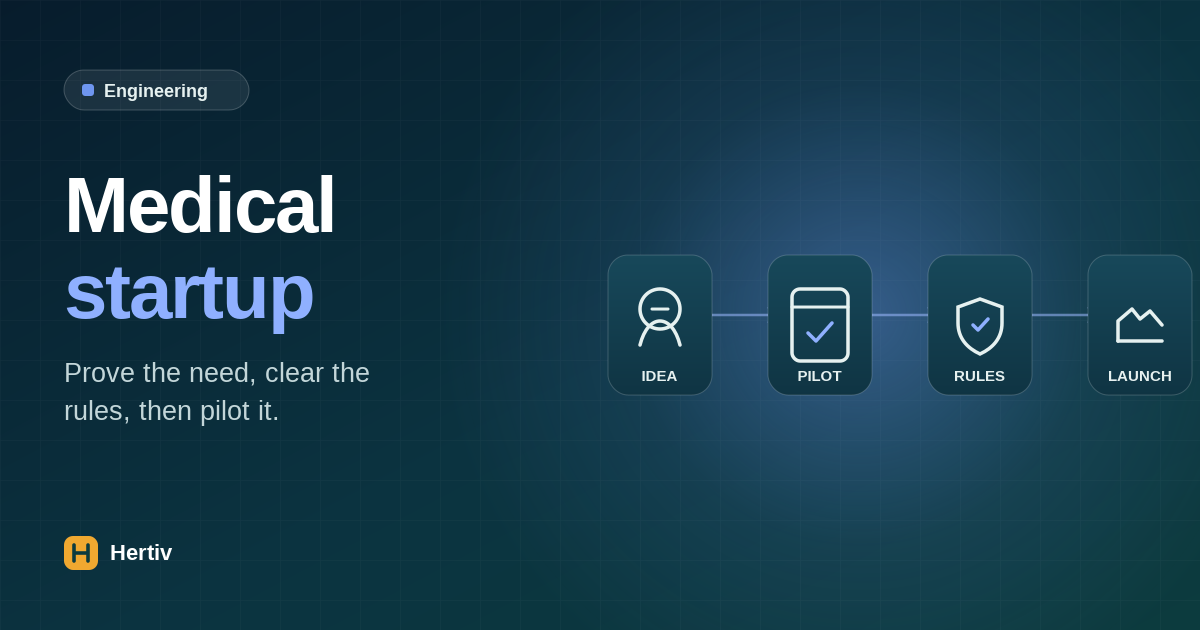
You build a medical startup by proving the need, clearing the rules, testing with real users, and only then scaling. A workable sequence:
- Name the clinical problem in one sentence. Write down whose problem it is, what happens today, and what changes if it is fixed.
- Check the rules. Find out whether the product is a medical device, which data rules apply, and what evidence is needed.
- Talk to ten clinicians and ten patients. Confirm the problem is real and that a fix would be used.
- Build the smallest testable version. One workflow, one clinic, with the safety and privacy basics built in.
- Run a pilot with clear measures. Agree in advance what success looks like, such as minutes saved per shift or errors avoided.
- Fix what the pilot shows, then seek funding. Evidence from a real pilot is what health investors and buyers ask for.
- Plan the sales path. Hospitals buy slowly, so line up the pilot site, the budget holder and the decision process early.
Keep the team small until the pilot proves the idea. A clinician adviser, a regulatory adviser and a small engineering team cover most of what the first year needs, and a large team before the pilot only burns the runway faster.
Example (hypothetical): a first-year budget
Example (hypothetical): two founders plan the first year of a medical startup building a triage aid for small clinics. They budget $60,000 for two engineers, $40,000 for a clinician adviser and pilot support, $25,000 for regulatory advice and testing, $15,000 for cloud hosting and security, and $10,000 for travel to pilot sites.
Those five lines add up to $60,000 + $40,000 + $25,000 + $15,000 + $10,000 = $150,000. The team adds a 15% reserve, which is $22,500, bringing the first-year budget to $172,500.
The reserve matters more here than in most startups, because a regulatory question or a pilot delay can add months. The example shows why medical founders raise for eighteen months of runway rather than twelve: the road to the first paying customer is longer, and the budget has to cover it.
What are the common mistakes?
The most common medical startup mistakes are building before checking the rules, skipping clinical validation, and underestimating how long hospitals take to buy.
- Ignoring regulation until late. A product built without the device and data rules may need to be rebuilt.
- No clinician in the loop. A product designed without the people who will use it rarely fits their working day.
- Skipping the pilot. A demo is not evidence; a pilot with measured results is.
- Short runway. A twelve-month plan that needs eighteen months will run out of money mid-pilot.
- Selling to the wrong person. The clinician who likes the product is rarely the person who signs the budget.
Key takeaways
- A medical startup is a healthcare product company, and patient safety rules shape every decision
- Check device classification and data rules before you build, not after
- Validate with clinicians and patients in their real working day, starting with a small pilot
- Plan for a longer runway than a software startup, because regulation and hospital sales take time
- Evidence from a real pilot is what investors and hospital buyers ask for first
Frequently asked questions
What is a medical startup?
It is a young company that builds a product or service for healthcare, such as a diagnostic aid, a patient app, a clinical workflow tool or a medical device. It differs from a software startup because its product touches patient care, which brings clinical evidence, safety rules and data privacy into every decision.
Do I need a clinician on the team?
Yes, in practice. A clinician adviser helps you understand the real workflow, tests the product with colleagues, and gives the pilot credibility with hospitals. A startup without clinical input usually builds a product that does not fit the working day.
Does every medical startup need FDA approval?
No. It depends on what the product does and where it is sold. A product that diagnoses, treats or monitors a condition is usually treated as a medical device and needs a clearance or approval, while a general wellness app usually does not. Check the classification in each market early.
How long does it take to reach paying customers?
Longer than most software startups. Regulation, clinical testing and hospital buying cycles all take months, and a hospital budget decision may only happen once a year. Founders usually plan for eighteen months or more of runway before the first contract.
How much does it cost to start one?
It varies widely, but a first year with a small team, a clinician adviser, regulatory advice and a pilot usually costs in the low hundreds of thousands of dollars. The regulatory and pilot work are the lines that surprise founders who only budget for engineering.
Where do medical startups find funding?
Early funding usually comes from founders, grants and angel investors with health experience. Health-focused venture funds invest once there is evidence from a pilot. Hospitals and insurers sometimes fund pilots in exchange for early access to the product.


