How to Build an End-to-End ML Platform That Ships
An end-to-end ML platform takes a model from raw data to a monitored service in production. Here is what to build, in what order, and what to skip until later.
On this page
Short answer
An end-to-end ML platform is the set of tools and services that carry a model from raw data to a monitored service in production: data ingestion, feature preparation, training, evaluation, deployment and monitoring. You build it in layers, starting with one model path that works, then adding shared tooling only when a second team needs it.
What is an end-to-end ML platform?
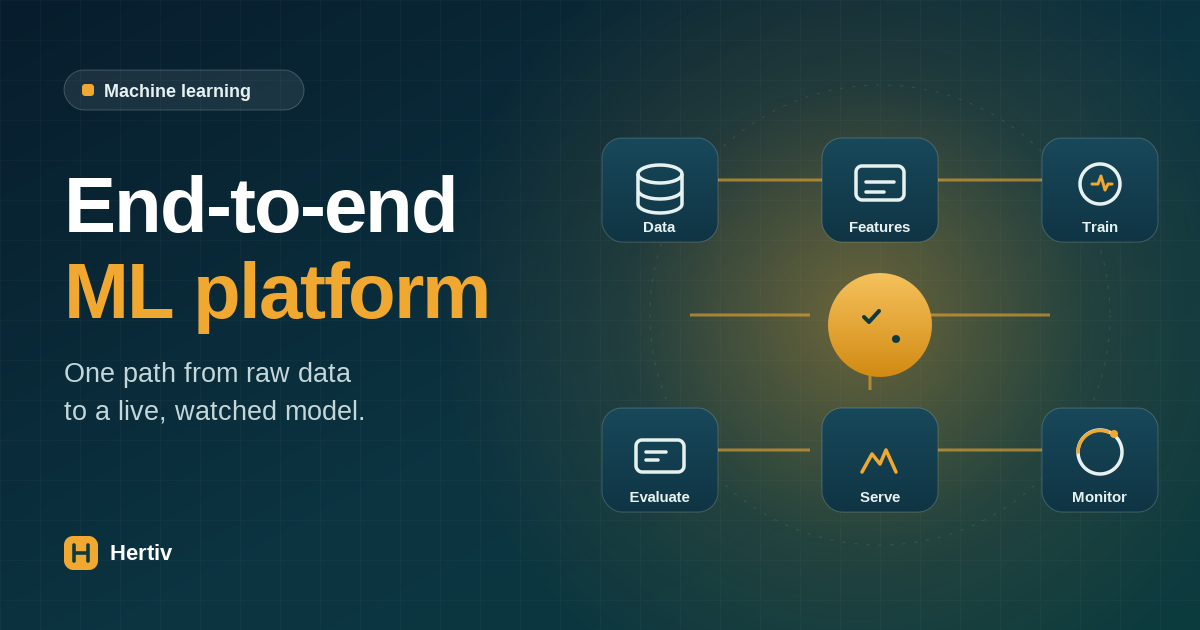
An end-to-end ML platform is the shared set of tools, data pipelines and services that carry a machine learning model from raw data to a working service in production, and keep it running there. It covers data ingestion, feature preparation, training, evaluation, deployment and monitoring in one connected path, so a model does not have to cross six separate hand-built systems to reach users.
The point of the platform is to remove repeated work. Without it, each team builds its own data jobs, its own training scripts and its own deployment scripts, and each one breaks in a different way. With it, teams reuse the same tested path, and the differences between models sit in the code and data, not in the plumbing around them.
| Stage | What it does | What good looks like |
|---|---|---|
| Data ingestion | Brings raw data in on a schedule | Versioned sources, logged runs |
| Feature preparation | Turns raw data into model inputs | Same features in training and serving |
| Training | Runs experiments and records results | Reproducible runs with tracked metrics |
| Evaluation | Tests the model before release | A fixed test set, checked every time |
| Deployment | Ships the model as a service | Rollback in minutes, not days |
| Monitoring | Watches predictions and data in production | Alerts when accuracy or data drifts |
Start with one model path, not the whole platform. A platform that serves one real model teaches you what the second model needs, while a platform built in advance for ten models usually guesses wrong about at least half of them. Machine learning development teams usually begin with the data and serving layers, because those are where models stall most often.
What are the parts of the platform?
The parts of an ML platform fall into four groups: data, training, serving and operations. Each group has its own tools, but they share one rule: the same code and the same data definitions should run in training and in production, or the model you tested is not the model you shipped.
The data group covers ingestion, storage and feature preparation. A feature store is the usual centrepiece: it computes features once and serves the same values to training jobs and live services. Without one, training and serving drift apart silently, and the model behaves differently in production than it did in tests.
The training group covers experiment tracking, a model registry and compute. Experiment tracking records which data, code and settings produced each model, so a result can be reproduced months later. The registry stores approved models with a version number, so deployment always picks a known artifact.
The serving group covers APIs, batch scoring and the infrastructure around them. The operations group covers monitoring, alerting, retraining triggers and access control. Monitoring is not optional: models decay as data changes, and without it you find out from users instead of from your own dashboards.
How do you design the data layer?
You design the data layer by deciding what a feature means, where it is computed and how it is stored, before you worry about model choice. Most platform failures are data failures: a feature that means one thing in training and another in serving, or a source that changes without notice.
Keep three rules. First, write each feature definition once and reuse it in training and serving. Second, version your datasets, so an experiment can be rerun on the exact data it used. Third, log data quality checks at ingestion, such as missing values, unexpected ranges and late arrivals, so bad data is caught before it trains a model.
Storage choices follow from access patterns. Training reads large batches, so it wants cheap bulk storage. Serving reads single rows fast, so it wants a low-latency store. A common pattern is to compute features in batch for training and keep the same features in a fast store for live requests, with both fed from the same definitions.
How do you build training and evaluation?
You build training and evaluation around a fixed test set that never changes during a project, so every experiment is judged against the same bar. Without it, teams compare models trained and tested on different data, and the comparison means nothing.
Training needs a standard way to launch a run, record its settings and store its result. An experiment tracker does this: each run logs the dataset version, the code version, the hyperparameters and the metrics. When a model performs well, the registry stores it with those details attached, so anyone can see exactly how it was built.
Evaluation needs more than one number. Check the model on the slices that matter, such as new users, rare cases and the segments your business cares about. A model that scores well on average and badly on one important slice is not ready, even if the headline metric looks good.
Keep a human review step before a model is promoted to production. The review checks the evaluation results, the data lineage and the rollback plan. MLOps consulting often starts here, because a clear promotion path is what turns experiments into a service you can trust.
How to build the platform in 6 steps
Build the platform in thin layers, one working model path at a time, rather than designing every layer up front.
- Pick one model and one user. Choose a model with a clear owner and a real decision it will support. Everything you build serves this path first.
- Build the data path. Ingest the source data, define the features once, and store them so training and serving read the same values.
- Ship a simple model. Train a baseline, evaluate it on a fixed test set, and deploy it behind an API with logging. A simple model in production beats a strong model in a notebook.
- Add experiment tracking and a registry. Record every run and store approved models with versions, so results are reproducible and deployments are explicit.
- Add monitoring and alerts. Track prediction volume, input drift and error rates, and set alerts that a person actually reads.
- Generalise only when a second team asks. Turn the first path into shared tooling once a second model needs it. Shared tooling built before the second user arrives usually solves the wrong problem.
Each step should leave the platform working. If a step cannot be finished, the previous steps still serve the first model, which keeps the project useful while the platform grows.
Example (hypothetical): a first platform for one team
Example (hypothetical): a retail company has five data scientists, and each one spends about 6 hours a week fixing data jobs and copying features between notebooks. That is 5 people times 6 hours, or 30 hours a week spent on plumbing instead of modelling.
The team builds a thin platform for one demand-forecast model. They define the features once in a shared store, add experiment tracking, and deploy the model behind an API with basic monitoring. The data work drops to about 2 hours a week per person, which is 5 times 2, or 10 hours a week. The saving is 30 minus 10, or 20 hours a week, which the team puts into a second model.
The second model reuses the same feature store, the same tracking and the same deployment path, so it ships in weeks rather than months. The platform paid for itself not by being complete, but by serving the first model well enough that the second one was cheap.
What are the common mistakes?
The most common ML platform mistakes are building for ten models before the first one ships, letting training and serving use different features, and treating monitoring as a later step.
- Building everything up front. A platform designed without a real model in production guesses at requirements and usually gets them wrong.
- Different features in training and serving. If the two paths compute features differently, the model you tested is not the model you shipped.
- No fixed test set. Without one, experiments cannot be compared and the team argues about results instead of improving them.
- Skipping monitoring. Models decay as data changes. Without monitoring, the first sign of trouble is a user complaint.
- One shared account for everything. Shared credentials make it impossible to tell which team or job caused a problem, and they make access hard to revoke.
- Treating the platform as a product, not a service. A platform needs an owner, a backlog and users who give feedback, or it slowly stops matching what teams need.
If your team is planning the data and serving layers, data engineering support for the ingestion and feature work is usually the fastest place to start.
Key takeaways
- Build one working model path first, then generalise it into shared tooling
- The same feature definitions must run in training and in production
- A fixed test set and experiment tracking make results comparable and reproducible
- Monitoring is part of the platform, not an add-on after launch
- Measure the platform by time saved per model, not by how many tools it has
Frequently asked questions
What is an end-to-end ML platform?
It is the shared tooling that carries a model from raw data to a monitored service in production: ingestion, features, training, evaluation, deployment and monitoring in one connected path, so teams reuse one tested path instead of building separate systems for each model.
How long does it take to build an ML platform?
A thin platform serving one model can take a few weeks when the data is ready. A full shared platform for many teams takes months, and it should grow from the first working path rather than being designed up front.
Do we need a feature store from day one?
Not always. A feature store matters once two or more models share features, or when training and serving start to drift. For a first model, shared feature definitions in code are often enough.
What is the difference between MLOps and an ML platform?
MLOps is the set of practices for running models reliably: tracking, testing, deployment and monitoring. The ML platform is the tooling that makes those practices easy to follow. Think of MLOps as the way of working and the platform as the tools that support it.
How do we know the platform is working?
Track time from idea to production for a model, the share of models with monitoring, and how often a run can be reproduced. If new models ship faster and old ones are watched, the platform is working.
Should we build or buy the platform?
Buy the parts that are standard, such as experiment tracking or serving, and build only the parts tied to your data and rules. Building everything from scratch is rarely the fastest path.


