How to Build an App on Cardano: A Practical Guide
Build an app on Cardano with Plutus or Aiken contracts, a Lucid or Mesh front end, and a wallet. Learn the tools, the steps and the costs.
On this page
Short answer
Building an app on Cardano means writing smart contracts in Plutus or Aiken, connecting a wallet, and building a front end that submits transactions to the chain. This guide covers the tools, the five build steps, the costs and the mistakes to avoid.
What does it mean to build an app on Cardano?
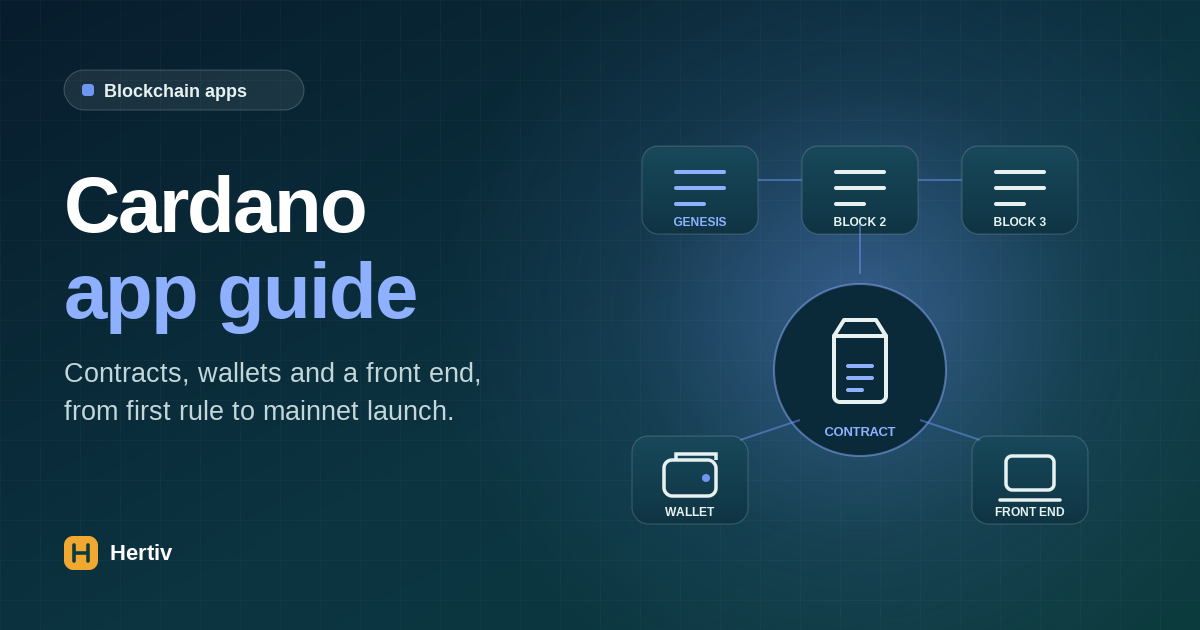
Building an app on Cardano means writing smart contracts and a front end that talk to the Cardano blockchain, so users can hold tokens, vote, trade or prove ownership without a central server. The app runs partly on chain, in Plutus smart contracts, and partly off chain, in a normal web or mobile front end.
Cardano is a proof-of-stake blockchain with a layered design. The settlement layer moves ADA and native tokens, while the computation layer runs smart contracts. Most apps use both: the front end gathers user input, an off-chain component builds the transaction, and the contract checks the rules before the transaction is confirmed.
Cardano apps are often called dApps. They differ from a normal web app because the shared state lives on the blockchain, not in a company database. A comparison of Cardano and Solana shows how the two chains take different paths to the same goal.
| Part of the app | Where it runs | What it does |
|---|---|---|
| Front end | Web or mobile | Shows balances, forms and buttons to the user |
| Wallet connection | Browser wallet | Signs transactions with the user's keys |
| Off-chain code | Your server or the browser | Builds transactions and reads chain data |
| Smart contract | On the Cardano chain | Checks rules and moves tokens |
| Indexers | Your server | Tracks on-chain events for fast display |
Which tools do you need to build on Cardano?
You need a wallet, a contract language, a transaction builder and a way to read chain data. The standard stack is a wallet such as Eternl or Lace, Plutus or Aiken for contracts, and a library such as Lucid or Mesh for building transactions in the front end.
Plutus is Cardano's original contract language, written in Haskell. Aiken is a newer language built for Cardano contracts that many teams find faster to learn. Both compile to the same on-chain format, so the choice is about your team's skills rather than what the chain supports.
For the front end, Lucid and Mesh are the two common libraries. They connect a wallet, build transactions and submit them to the chain. A guide to creating web3 dApps covers the same front-end pattern for other chains, and most of it applies here too.
| Tool | What it is for | Who uses it |
|---|---|---|
| Plutus | Smart contracts in Haskell | Teams with Haskell experience |
| Aiken | Smart contracts in a Rust-like language | Teams starting fresh on Cardano |
| Lucid / Mesh | Building and submitting transactions | Front-end developers |
| Eternl / Lace | Browser wallets | Users signing transactions |
| Blockfrost / Koios | Chain data APIs | Apps that need fast reads |
How do Cardano smart contracts work?
A Cardano smart contract is a validator script that checks whether a transaction is allowed. It does not run the transaction itself; instead, it approves or rejects a transaction that a user has already built. This is different from Ethereum, where the contract runs code when called.
Cardano uses the eUTxO model. Each transaction spends unspent outputs and creates new ones, and the validator checks the inputs, outputs and signatures. The contract can require a signature, a deadline, a minimum payment or a token to be present before it allows the spend.
This model has two practical effects. First, the cost of a transaction is known before it is submitted, because the script runs off chain to check it. Second, contracts are easier to reason about, because each transaction states exactly what it spends and creates. A guide to smart contract development explains the shared concepts in more depth.
What are the steps to build a Cardano app?
Building a Cardano app follows five steps: define the contract rules, write and test the contract, build the front end, connect a wallet, and test on the testnet before going live. Each step has a clear output, so the work stays in order.
Start by writing the contract rules in plain language. For a marketplace, the rule might be: the buyer pays, the seller's token moves to the buyer, and a small fee goes to the platform. Turn those rules into validator checks before writing any code.
Then write the contract in Plutus or Aiken and test it against a local node. After that, build the front end with Lucid or Mesh, connect a wallet, and test the full flow on the Cardano testnet with test ADA. Only move to mainnet once the testnet flow works end to end.
- Write the rules. List every check the contract must make, in plain language.
- Write the contract. Implement the checks in Plutus or Aiken and test them locally.
- Build the front end. Add forms, balances and transaction building with Lucid or Mesh.
- Connect a wallet. Let users sign with Eternl, Lace or another Cardano wallet.
- Test on testnet. Run the full flow with test ADA before touching mainnet.
Example: a ticket sale app on Cardano
Example (hypothetical): a small events team wants to sell 500 tickets as Cardano native tokens, so buyers can prove ownership and resell them without a central ticket office. The team builds one validator contract and a simple web front end.
The contract rule is simple: a buyer pays 20 ADA, and the contract releases one ticket token to the buyer's address. The contract also holds a 2 ADA fee for the platform. The front end shows the tickets left and the price, and the wallet signs the payment.
The arithmetic is easy to check. At 20 ADA per ticket and 500 tickets, total sales are 500 x 20 = 10,000 ADA. The platform fee is 500 x 2 = 1,000 ADA, so sellers receive 9,000 ADA. The team tests this on testnet with 10 tickets first: 10 x 20 = 200 ADA in, 20 ADA in fees, 180 ADA to the seller.
Testing on testnet catches the usual problems early. The team finds that the wallet connection fails when the user has no funds, and that the front end shows the wrong count after a sale. Both are fixed before the mainnet launch.
How much does it cost to build an app on Cardano?
The cost of building an app on Cardano depends on the size of the team and the complexity of the contracts, not on the chain itself. A simple app with one contract and a web front end takes a small team a few weeks. A marketplace with escrow, royalties and admin tools takes longer.
The main cost drivers are contract development, front-end work, testing and audit. Contracts need more testing than normal code because a bug on chain cannot be patched by redeploying the same contract. An audit is the largest single cost for most teams, and prices vary widely, so check the vendor site for current rates.
Transaction fees on Cardano are low and predictable, so running costs are usually small. The team pays for a node or a data API, hosting for the front end, and a small amount of ADA for testing. For most apps, the build cost is far larger than the running cost.
| Cost area | What drives it | How to keep it down |
|---|---|---|
| Contract development | Number of rules and edge cases | Keep the contract small and simple |
| Front end | Screens, wallet flows, states | Reuse a wallet library, not a custom one |
| Testing | Testnet runs and edge cases | Write tests before the front end |
| Audit | Contract size and risk | Get the audit after the contract is stable |
| Running costs | Node, API and hosting | Use a hosted API instead of your own node |
What are the common mistakes?
The most common mistakes when building on Cardano are treating it like Ethereum, skipping testnet testing, and putting too much logic in the contract. Each of these is easy to avoid once you know the model.
Cardano contracts validate transactions rather than running them, so code written for Ethereum does not transfer directly. Teams that copy an Ethereum design often end up with a contract that cannot express the rule they need. Start from the eUTxO model and design the flow around it.
Skipping testnet testing is the other common error. A contract that works locally can still fail on chain when the wallet, the indexer or the fee calculation behaves differently. Test the full flow on testnet with real wallets before launching.
- Copying an Ethereum design. Cardano validates transactions; it does not run contract code on demand.
- Skipping testnet. Local tests do not catch wallet or indexer problems.
- Overloading the contract. Keep the contract small and move display logic off chain.
- No audit. A contract that moves other people's money should be reviewed by a second team.
- Ignoring fees. Fees are low, but a busy app still needs a budget for them.
Key takeaways
- A Cardano app pairs Plutus or Aiken contracts with a normal web or mobile front end
- Cardano contracts validate transactions under the eUTxO model, they do not run on demand
- Lucid and Mesh build transactions; Eternl and Lace let users sign them
- Test the full flow on testnet with real wallets before launching on mainnet
- Keep the contract small, move display logic off chain, and get an audit before launch
Frequently asked questions
Do I need to know Haskell to build on Cardano?
No. Plutus is written in Haskell, but Aiken is a newer contract language that is easier to learn, and the front end uses TypeScript with Lucid or Mesh. Many teams write contracts in Aiken and the app in TypeScript, so Haskell is not required.
Is Cardano good for beginners in blockchain development?
Cardano is a fair choice for beginners because transaction fees are low and predictable, and the eUTxO model makes costs known before submission. The trade-off is that the contract model differs from Ethereum, so there is a learning curve if you come from that world.
What wallet should a Cardano app support?
Support the two most common browser wallets, Eternl and Lace, and add others only if your users ask for them. Wallet libraries such as Lucid and Mesh handle the connection, so supporting a second wallet is usually a small change.
How long does it take to build a simple Cardano app?
A simple app with one contract and a web front end usually takes a small team three to six weeks, including testnet testing. A marketplace or lending app with several contracts and an audit takes longer, often two to four months.
Do Cardano apps need their own node?
No. Most apps read chain data through a hosted API such as Blockfrost or Koios, which is simpler than running a node. Run your own node only if you need full control over the data or have very high request volumes.
What is the difference between a Cardano dApp and a normal web app?
A Cardano dApp stores its shared state on the blockchain and lets users sign transactions with their own wallet, while a normal web app stores state in a company database. The front end can look the same, but the trust model and the data layer are different.


