How to Build an AI Call Centre Agent That Works
An AI call centre agent answers routine calls, checks the caller's intent and hands off to a human when it should. Here is how to build one that callers trust.
On this page
Short answer
An AI call centre agent is a voice system that answers calls, understands what the caller wants, pulls the right information from your systems and either resolves the request or passes it to a human agent with context. You build one by picking a single call type, connecting telephony, speech and your CRM, testing it on real calls, and keeping a human handoff in place from day one.
What is an AI call centre agent?
An AI call centre agent is a voice system that answers inbound calls, understands what the caller wants in plain speech, and either resolves the request itself or passes the call to a human agent with the full context. It is not a phone menu. Callers speak naturally instead of pressing keys, and the system decides what to do from what they say.
A typical call centre agent listens, transcribes the speech, works out the caller's intent, and then takes an action: checking an order, booking an appointment, resetting a password, or updating a record. When the request is outside its scope, or the caller asks for a person, it hands off to a human agent who can see the transcript and what has already been tried.
The difference from a general voice assistant is the scope. A call centre agent is built for one queue and a small set of call types, with clear rules about when it must hand off. That narrow scope is what makes it reliable enough to put on a real phone line.
What does an AI call centre agent need to work?
An AI call centre agent is several parts working together, and a weak link in any one of them shows up as a bad call. The table below lists the parts and what each one does.
| Part | What it does | Why it matters |
|---|---|---|
| Telephony | Receives and places calls, handles hold and transfer | Call quality and handoff depend on it |
| Speech recognition | Turns caller speech into text in real time | Errors here confuse every later step |
| Language model | Works out intent and drafts replies | Decides what the caller actually wants |
| Knowledge base | Supplies the facts the agent may quote | Stops the agent inventing answers |
| Business systems | CRM, orders, bookings and account records | Let the agent act, not just talk |
| Handoff | Passes the call and context to a human | Keeps difficult calls from going in circles |
Two of these parts deserve extra attention. Speech recognition has to cope with accents, background noise and poor mobile connections, so test it on real recordings from your own callers, not on clean demo audio. The knowledge base has to be current, because an agent quoting an old policy or an old price is worse than one that says it does not know.
How do you build an AI call centre agent?
You build an AI call centre agent in small steps, starting with one call type and proving it works before you add the next. A common sequence looks like this:
- Pick one call type. Choose a high-volume, low-risk call, such as order status or appointment changes, where the answer comes from one system and a wrong answer is easy to catch.
- Collect real calls. Gather a sample of recorded calls of that type, with the outcomes, and use them to define intents, edge cases and the exact wording of a good answer.
- Connect telephony and speech. Wire the phone line to a speech service, test call quality on real networks, and confirm that hold, transfer and voicemail behave correctly.
- Connect the knowledge base and systems. Give the agent read access to the facts and records it needs, with clear rules about what it may change and what needs a human.
- Build the handoff. Define the exact moments the agent must pass the call on, such as a request for a person, a complaint, or a failed lookup, and make sure the human sees the transcript.
- Test on real calls, then go live quietly. Run the agent on a small share of live calls with a human listening in, fix the failures you find, and raise the share only when the failure rate is acceptable.
Resist the urge to cover every call type at once. Each new call type needs its own sample calls, its own intents and its own tests, so the work grows with the scope. One call type working well teaches you more than five half-built ones. For the design and handoff decisions, AI voice agent development covers the patterns that matter most.
How do you connect it to your phone system and CRM?
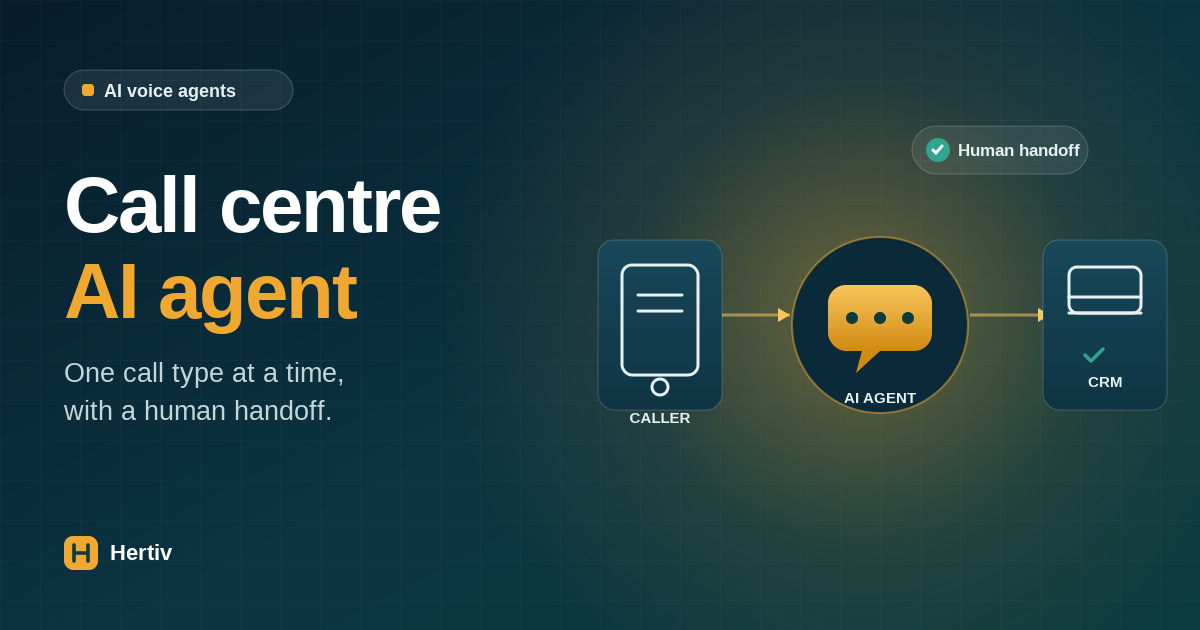
Connecting the agent to your phone system and CRM is the part that takes the most engineering time, and it is where most projects stall. The agent needs to receive calls, look up the caller, act on their records, and log what happened, all while the caller is still on the line.
Start with the phone side. Most teams connect through a cloud telephony provider that supplies a phone number, call routing and a stream of audio. The agent's speech service listens to that stream and speaks its replies back down the same line. Test this path with real callers on mobile networks, because latency and audio quality vary, and a slow reply feels like the agent is not listening.
On the CRM side, the agent needs two things: a way to look up the caller by phone number or account number, and a way to write a note about the call when it ends. Keep the permissions narrow.
The agent should read the records it needs and update only the fields its call type requires, such as a booking or an order status. Anything involving payments, refunds or account changes should go through an approval step or a human agent until the system has proved itself.
Example (hypothetical): a support team pilots a call centre agent
Example (hypothetical): a support team takes 500 calls a day, and about 300 of them are order-status checks that follow the same pattern. The team decides to automate only that call type and leave everything else with human agents.
The team collects 200 recorded order-status calls and builds the agent around them. It connects the phone line, the speech service and the order system, and it sets a rule: if the order cannot be found after two attempts, the call goes to a human with the transcript.
After two weeks of testing on a small share of live calls, the agent handles 300 order-status calls a day. Each call takes about 4 minutes of agent time, so the team saves 300 times 4 minutes, which is 1,200 minutes, or 20 hours of human agent time a day. The human agents use that time on the 200 remaining calls, which are the ones that actually need judgement.
The pilot works because the scope is narrow and the handoff is clear. The team knows exactly which calls the agent handles, what it does when it fails, and how much time it saves. That evidence is what justifies adding the next call type.
What are the common mistakes?
The most common mistakes are launching too wide, skipping real-call testing, and treating the handoff as an afterthought.
- Automating every call type at once. A broad launch multiplies the intents, the edge cases and the failure modes. Start with one call type and prove it.
- Testing on clean audio only. Real callers phone from cars, busy streets and poor connections. If the speech service only works on studio-quality audio, it will fail on the first live day.
- No handoff, or a handoff without context. A caller who repeats their story to a human after talking to the agent will not call back. Pass the transcript and the actions taken.
- Letting the agent invent answers. If the knowledge base has no answer, the agent must say so or hand off. An invented policy or price creates complaints that cost more than the call saved.
- No one reviewing failed calls. Without a weekly review of calls the agent got wrong, the same failures repeat for months.
- Ignoring the cost of the human side. Someone has to maintain intents, update the knowledge base and review failures. Budget for that work or the agent will quietly get worse.
How do you know if the call centre agent is working?
You know the agent is working when the numbers move in the right direction and callers are not complaining. Track a small set of measures weekly, on real calls, rather than relying on vendor dashboards alone.
Useful measures include the share of calls the agent resolves without a human, the share that hand off and why, the average time a caller waits before reaching a person, and the rate of repeat calls about the same issue. A rising repeat-call rate is a warning sign: it usually means the agent gave an answer that did not hold up.
Listen to a sample of calls yourself, including the failures. For a deeper guide to the build itself, see how to build an AI voice agent.
The transcript will show you whether the problem is speech recognition, a missing intent, a stale fact or a handoff that arrived too late. Fix the most common failure first, then re-measure. If you are planning a broader rollout, AI agents for customer support covers how to design the handoff and evaluation around the agent.
Key takeaways
- Start with one high-volume, low-risk call type and prove it before adding more
- Speech recognition and a current knowledge base decide call quality more than the model
- A clear handoff with full context is what keeps difficult calls from going in circles
- Test on real calls from your own callers, including noisy mobile connections
- Review failed calls weekly and fix the most common failure first
Frequently asked questions
How long does it take to build an AI call centre agent?
A narrow pilot for one call type typically takes a few weeks when the phone system and CRM are already accessible. Connecting telephony, speech and business systems takes most of the time. A full rollout across many call types takes months, because each type needs its own sample calls, intents and tests.
Does an AI call centre agent replace human agents?
No, it handles the routine calls and passes the rest to humans. The aim is to free human agents for the calls that need judgement, such as complaints, complex orders and account changes. Teams that treat the agent as a replacement usually end up with frustrated callers and more repeat calls.
What happens when the agent cannot answer a caller?
The agent should hand the call to a human with the transcript and the actions already taken, so the caller does not repeat themselves. Define the handoff triggers in advance: a request for a person, a complaint, a failed lookup, or a topic outside the agent's scope.
How do you stop the agent giving wrong answers?
Ground every factual answer in your own knowledge base and business systems, and give the agent no way to invent prices, policies or dates. When the facts are missing, the agent should say so or hand off. Regular reviews of failed calls catch the gaps early.
Can an AI call centre agent handle payments?
It can, but payments should stay behind an approval step or a human agent until the system has proved itself. Keep the agent's permissions narrow, log every payment-related action, and make sure the caller can always reach a person to confirm or reverse a transaction.
What does an AI call centre agent cost to run?
Costs depend on call volume, the telephony provider, the speech and model services, and the maintenance work. Managed services usually charge per minute or per call, while self-hosted options cost engineering time instead. See the vendor site for current pricing, and budget for ongoing maintenance.


