How to Assess an Enterprise for AI Integration
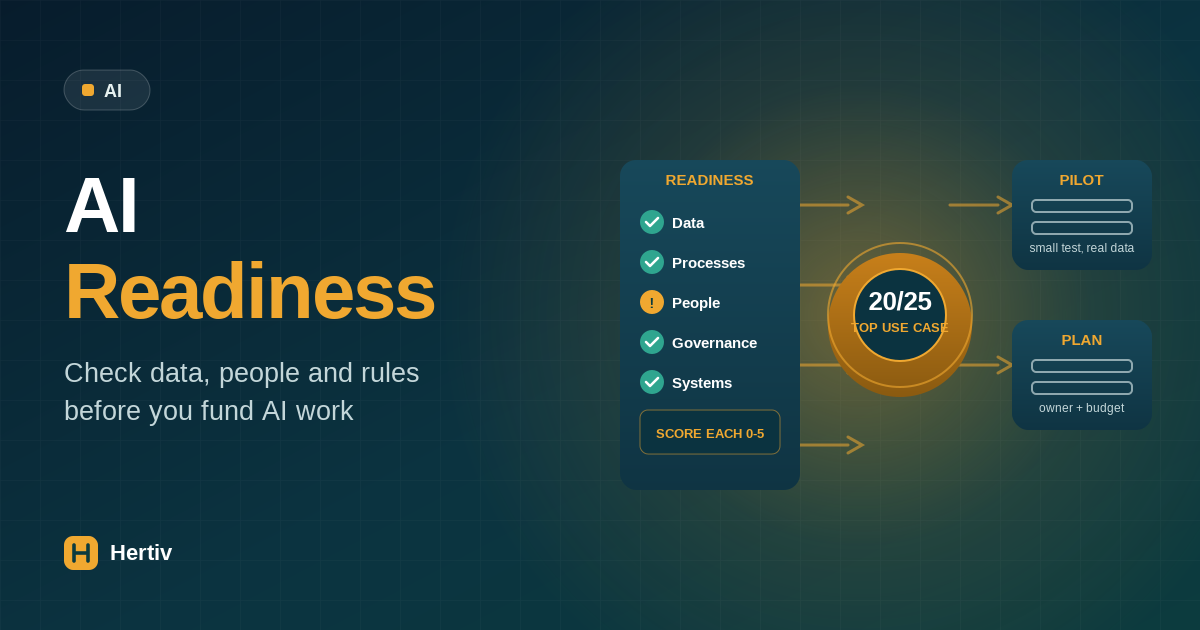
Assessing an enterprise for AI means checking data, processes, people, rules and systems, then ranking use cases. Here is how to run the check.
On this page
Short answer
Assessing an enterprise for AI integration means checking whether the business is ready to use AI in its real work, by looking at its data, processes, people, rules and systems, and then ranking the use cases worth doing first. The result shows what is ready, what needs fixing, and what should wait.
What does it mean to assess an enterprise for AI integration?
Assessing an enterprise for AI integration means checking whether the business is ready to use AI in its real work, by looking at its data, its processes, its people, its rules and its systems, and then ranking the AI use cases that are worth doing first. The result is a clear picture of what is ready, what needs fixing, and what should wait.
An assessment is not a purchase decision. It does not start by picking a tool. It starts by asking where the business loses time or money today, whether AI can help in those places, and whether the business has what the AI needs to work: clean data, a process that can change, and people who will use the result.
The output is usually a short report: a score for each readiness area, a ranked list of use cases with expected effort and benefit, and a plan for the first project. That report is what a leadership team uses to decide whether to fund AI work and where to start. An AI readiness assessment is the structured version of this check, run over about three weeks.
What should you check? Five readiness areas
You should check five areas: data, processes, people, governance and systems. A business that is strong in four and weak in one will still struggle, because AI projects fail on their weakest area, not their strongest.
| Area | What good looks like | Warning sign |
|---|---|---|
| Data | Key data is recorded, labelled and easy to reach | Data lives in spreadsheets and people's heads |
| Processes | The process is written down and followed the same way | Every team does the same job differently |
| People | Staff want the change and have time to learn | Teams are already overloaded and sceptical |
| Governance | Someone owns data, risk and decisions | No one can say who approves an AI tool |
| Systems | Tools can share data through APIs | Core systems cannot talk to each other |
Data is usually the hardest area. An AI model can only learn from what the business has recorded, so if the records are incomplete or inconsistent, the model will copy those gaps. Most assessments find that data work takes longer than the AI build itself. AI consulting that ends in a plan you can fund covers how these findings become a funded project.
How do you score and rank AI use cases?
You score and rank AI use cases by judging each one on the same five measures: value, data readiness, effort, risk and fit with the business. Each measure gets a score from 0 to 5, so a use case can score at most 25, and the ranking shows which one is worth doing first.
Value means the money or time the use case would save or earn, measured in the business's own terms, such as hours saved per week or errors avoided. Data readiness means whether the data the AI needs already exists and is clean enough to use. Effort covers the build, the integration and the change to the process, not just the model.
Risk covers what happens if the AI is wrong, and who is responsible. A use case that touches customers or money scores lower on risk than an internal drafting tool. Fit means whether the use case supports what the business is already trying to do, rather than being interesting on its own. A use case that scores high on value but low on data readiness is a later project, not a first one.
How to run the assessment in six steps
You run the assessment by working through six steps in order, from finding the pain to writing the plan. Each step has a clear output, so the team knows when it is done.
- List where the business loses time or money. Talk to the teams that do the work, not only to managers, and write down the ten most painful tasks.
- Check the data for those tasks. For each task, ask what data exists, where it lives, and whether it is clean enough for a model to use.
- Score the five readiness areas. Give data, processes, people, governance and systems a score each, and write down the evidence for each score.
- Score and rank the use cases. Use the five measures above, and pick the top one or two as the first project.
- Test the top use case with a small pilot. Build a proof of concept on real data with a fixed test set, and measure whether it helps.
- Write the plan. Set out the first project, the data work it needs, the owner, the budget and the measure of success.
The pilot is the step that matters most. An assessment that ends with a report and no pilot leaves the team guessing, while a small pilot on real data shows whether the idea works and what it costs. An AI proof of concept in four weeks is the usual way to run that test.
Example (hypothetical): a manufacturer scores three use cases
Example (hypothetical): a manufacturer with 400 staff wants to use AI, and lists three use cases: drafting replies to supplier emails, predicting machine breakdowns, and checking the quality of parts from photos. Each use case is scored from 0 to 5 on value, data readiness, effort, risk and fit, for a maximum of 25.
Drafting supplier replies scores 4 for value, 4 for data readiness, 3 for effort, 5 for risk and 4 for fit, giving 20 out of 25. Predicting breakdowns scores 3 for value, 3 for data readiness, 4 for effort, 3 for risk and 2 for fit, giving 15 out of 25.
Checking parts from photos scores 5 for value, 2 for data readiness, 2 for effort, 4 for risk and 3 for fit, giving 16 out of 25.
The team picks drafting supplier replies first, because it scores highest and its data already exists in the email system. Photo checks score highest on value but lowest on data, because the factory has no labelled photos of good and bad parts, so that project waits until the data is collected. The ranking makes the decision visible instead of a matter of opinion.
What happens after the assessment?
After the assessment, the team funds the first project and starts the data work it needs. The first project should be small, with a clear owner and a measure of success that the business cares about, such as hours saved per week or errors avoided, rather than a technical score.
The team should also fix the weakest readiness area before it blocks the next project. If data was the weak area, that means agreeing who owns each data set, cleaning the worst records, and writing down how new data should be recorded. If governance was weak, it means naming the person who approves AI tools and writing the rules for customer data.
Finally, the team should review the assessment every six months. Data improves, staff learn, and systems change, so a use case that scored low in the first assessment may be ready by the second. The assessment is a working document, not a one-off report. AI governance and responsible AI consulting covers the rules that keep that review honest.
What are the common mistakes?
The most common mistakes are starting with a tool, scoring use cases on enthusiasm, and skipping the pilot. Each of these leaves the business with AI that nobody uses or trusts.
- Starting with a tool. Picking a model or vendor before knowing the problem wastes the budget on the wrong thing.
- Scoring on enthusiasm. A use case that excites the team but has no data is a later project, not a first one.
- Ignoring the weakest area. A project fails on its weakest readiness area, so fix that first.
- Skipping the pilot. A report without a small test on real data is a guess, not a decision.
- No owner. If nobody owns the project and its measure of success, it drifts.
- Measuring the model, not the business. A high accuracy score means little if staff save no time.
An honest assessment saves more money than any single AI project, because it stops the wrong projects before they start. How to evaluate an LLM application before launch covers the checks to run once the first project is built.
Key takeaways
- An assessment checks readiness first; it does not start by picking a tool
- Score five areas: data, processes, people, governance and systems
- Rank use cases on value, data, effort, risk and fit, each from 0 to 5
- A small pilot on real data is what turns the assessment into a decision
- Fix the weakest readiness area before it blocks the next project
Frequently asked questions
What is an AI readiness assessment?
An AI readiness assessment is a structured check of whether a business can use AI in its real work. It looks at data, processes, people, governance and systems, scores each area, and ranks the AI use cases worth doing first, ending with a plan for the first project.
How long does an assessment take?
A focused assessment usually takes two to four weeks, depending on how many teams and systems are involved. Most of the time goes to talking to the teams that do the work and checking the data, not to writing the report itself.
Who should be involved in the assessment?
The teams that do the work, the people who own the data, and the managers who will fund the project. An assessment run only with managers misses the data problems and process gaps that decide whether AI work succeeds.
What if the assessment says the business is not ready?
That is a useful result. It usually means data work or process fixes must come first, and the report should say exactly what to fix and in what order, so the business can become ready instead of funding an AI project that would fail.
How is a use case scored?
Each use case is scored from 0 to 5 on value, data readiness, effort, risk and fit, for a maximum of 25. The ranking shows which use case is worth doing first, and a use case that scores high on value but low on data readiness is a later project, not a first one.
Do we need a pilot after the assessment?
Yes. A small proof of concept on real data, with a fixed test set and a clear measure of success, is what shows whether the top use case actually helps. An assessment that ends with a report and no pilot leaves the team guessing.


