How Generative AI Started: The Ideas Behind ChatGPT
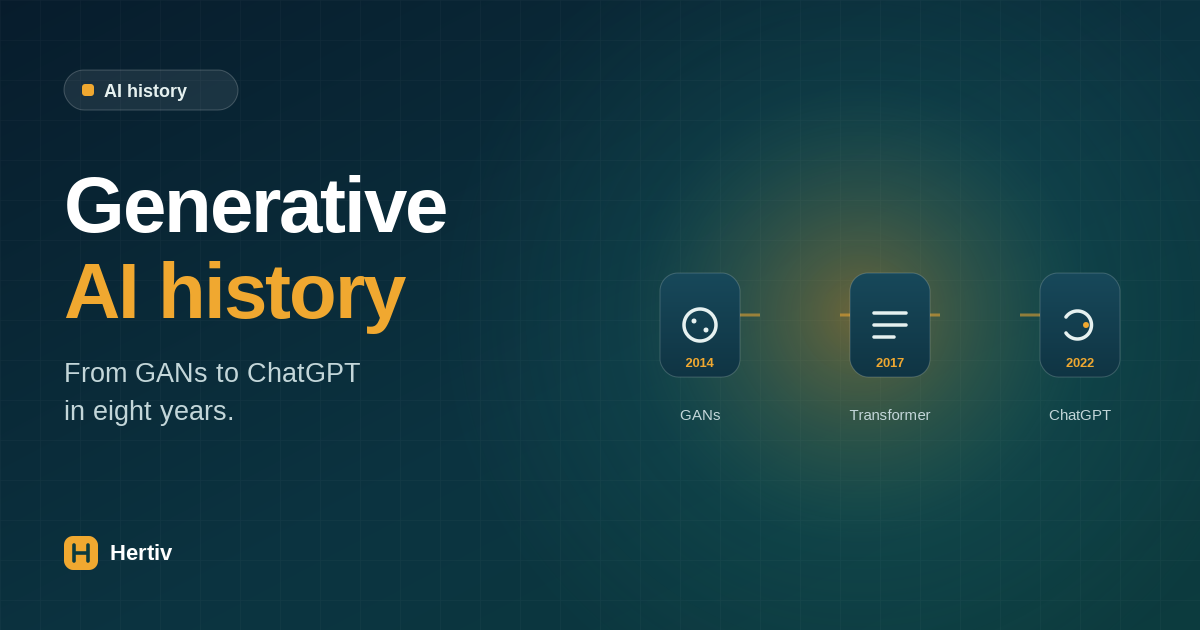
Generative AI started with GANs in 2014, the transformer in 2017 and large language models after that. Here is the timeline that led to ChatGPT.
On this page
Short answer
Generative AI started with a series of research ideas that taught machines to create new content: GANs in 2014, the transformer in 2017, and large language models trained on huge amounts of text. ChatGPT in 2022 was the moment those ideas reached everyone.
How did generative AI start?
Generative AI started as a research idea: teach a machine to create new text, images or sound instead of only sorting, scoring or predicting what already exists. The field grew in steps, with each step solving one limit of the last.
The story is not a single breakthrough. Early chat programs in the 1960s could only reply with canned lines. Statistical models in the 1990s could guess the next word in a sentence but forgot the start of a paragraph. The modern form arrived when three things came together: large amounts of text and images to learn from, computing power to train big models, and model designs that could keep track of long passages.
That combination turned a lab curiosity into a tool people use every day. The rest of this article walks through the steps in order, so you can see which idea each later model built on.
| Year | Idea | What it solved |
|---|---|---|
| 2014 | GANs | Learning from feedback on made-up output |
| 2017 | Transformer | Remembering long passages with attention |
| 2018-2020 | Large language models | One model for many language tasks |
| 2022 | ChatGPT | A chat box anyone could use |
What came before modern generative AI?
Before modern generative AI, computers could already generate text and pictures, but only in narrow ways. A 1960s program called ELIZA matched patterns in a typed sentence and replied with a question built from the same words. It felt like a conversation, yet it understood nothing and could not say anything new.
Later models used statistics. A Markov chain guesses the next word from the last few words, which produces sentences that start well and then drift. Hidden Markov models and early neural networks improved the grammar but still lost the thread over long passages, because they could only remember a short window of context.
These early systems mattered because they set the goal: a model that keeps the whole passage in mind and produces text that stays on topic from start to finish. They also showed the hard part, which was memory. Each later idea in this article is mainly a better way to remember context.
What changed in 2014 with GANs?
In 2014, a paper by Ian Goodfellow and colleagues introduced generative adversarial networks, known as GANs. A GAN trains two models against each other: one creates images, and the other judges whether each image is real or made up. The creator improves each time the judge catches it, and the judge improves each time it is fooled.
This setup produced images that looked real for the first time at scale. It showed that a model could learn the shape of a whole set of pictures, such as faces, and then draw new faces that were not copies of any training image. The same idea later worked for sound and video.
GANs had limits too. Training was unstable, and a model could collapse to making only a few kinds of image. But the core lesson stuck: a model learns more when it gets feedback on its own output, not only when it is told the right answer. That lesson reappears in every later step.
Why did the 2017 transformer matter?
In 2017, researchers at Google published 'Attention Is All You Need', which introduced the transformer. A transformer reads a whole passage at once and uses a mechanism called attention to weigh which earlier words matter most for each new word it writes.
Attention solved the memory problem. Older models read one word at a time and forgot early words by the end of a long sentence. A transformer can look back across the whole passage, so a pronoun at the end of a paragraph can still link to the noun it refers to at the start.
The transformer also trained far faster, because it could process many words in parallel instead of one after another. That speed made it practical to train on huge amounts of text. Nearly every large language model since then, including the GPT family and BERT, is built on the transformer.
How did large language models take over?
Large language models took over by scaling up the transformer and training it on very large collections of text. The model learns by predicting the next word, over and over, across books, articles, code and web pages. After enough training, the model can write, summarise, translate and answer questions without being rebuilt for each task.
OpenAI's GPT series showed the pattern. Each version trained on more text with a larger model, and each version handled a wider range of tasks. BERT, released by Google in 2018, showed the same idea could improve search, by reading a query in both directions instead of only left to right.
Training at this scale needs large computing budgets and careful data handling, so only a few organisations could build the biggest models. At the same time, smaller open models made the same techniques available to everyone. The result was a split: a few very large general models, and many smaller models tuned for one job.
What made ChatGPT the turning point?
ChatGPT, released in late 2022, was the turning point because it put a large language model behind a plain chat box that anyone could use. The model underneath was not brand new, but the way it was trained to follow instructions and hold a conversation was. People could ask for a draft, a summary or an explanation in ordinary words and get a useful answer in seconds.
Two training steps made the difference. First, the model was fine-tuned on examples of people asking questions and giving good answers. Then human reviewers ranked its replies, and the model was trained to prefer the replies people ranked highest. This step is called reinforcement learning from human feedback, and it made the model far more helpful and far less likely to ramble.
Within months, chat became the default way to use generative AI, and every major software company shipped its own version. The spark was not one model or one paper. It was the moment the research, the computing and the interface all lined up at once.
Example (hypothetical): how a model picks the next word
Imagine a small model that has read the sentence 'The library closes at'. It must pick the next word from three candidates: 'nine', 'midnight' and 'banana'. The model scores each candidate and turns the scores into probabilities that add up to one.
Say the scores give 'nine' a probability of 0.5, 'midnight' 0.3 and 'banana' 0.2. The three probabilities add up to 1.0, as they must. The model picks 'nine', the most likely word, and the sentence becomes 'The library closes at nine'. A real model does the same thing over tens of thousands of possible words, and it repeats the step for every word in its reply.
This is the whole trick, repeated at scale. The model never looks up a fact. It predicts, checks the result against the words around it, and keeps going until the answer is complete. When a reply sounds confident but wrong, it is usually because the most likely next word was not the true one.
What are the common mistakes?
The first mistake is treating ChatGPT as the start of generative AI. It was the moment the public noticed, but the ideas behind it are years older: GANs in 2014, the transformer in 2017, and large language models in 2018 and 2020. Knowing the earlier steps helps you judge which claims about a new model are new and which are repackaged.
The second mistake is assuming bigger always means better. A larger model can write more fluently, but a smaller model trained on the right data can beat it on one narrow task, and it costs far less to run. The right question is not how big the model is, but whether it fits the job and the budget.
The third mistake is trusting the output because it reads well. A model predicts likely words, not verified facts, so a fluent paragraph can still contain a wrong date, a made-up reference or a confident guess. Check names, numbers and quotes against a source you trust before you use them.
Key takeaways
- Generative AI began as a research idea, not a single product launch.
- GANs in 2014 showed a model could learn from feedback on its own output.
- The 2017 transformer solved the memory problem with attention.
- Large language models scaled the transformer up with more text and compute.
- ChatGPT in 2022 made the technology usable by anyone through chat.
Frequently asked questions
When did generative AI start?
There is no single start date. The key steps were GANs in 2014, the transformer in 2017, the first large language models in 2018 and 2020, and ChatGPT in late 2022. Each step built on the one before it.
Who invented GANs?
Generative adversarial networks were introduced in a 2014 paper by Ian Goodfellow and colleagues. A GAN trains two models against each other: one creates images and the other judges whether they are real.
What is a transformer in AI?
A transformer is a model design introduced in 2017 that reads a whole passage at once and uses attention to weigh which earlier words matter most. It is the design behind nearly every large language model since.
Was ChatGPT the first generative AI?
No. ChatGPT was the first generative AI tool most people used, but the ideas behind it were years old. Earlier tools could already generate text, images and code, just not through a simple chat box.
Why did generative AI take off in 2022?
Three things lined up: the research was ready, the computing was affordable enough, and the chat interface made the model easy for anyone to use. The interface, not just the model, was the turning point.
Is bigger always better for a language model?
Not always. A larger model can write more fluently, but a smaller model trained on the right data can beat it on one narrow task and costs far less to run. Fit the model to the job and the budget.


