How Does a Small Language Model Work?
A small language model turns text into tokens, passes them through a compact stack of transformer layers and predicts the next token. Here is how each step works.
On this page
Short answer
A small language model works by breaking text into tokens, converting them into numbers, and passing them through a stack of transformer layers trained to predict the next token. Because it has far fewer parameters than a large model, it trains on less data, fits in a few gigabytes of memory and can answer on a laptop or phone without a data centre.
What is a small language model?
A small language model is a language model with a few hundred million to a few billion parameters, built to run on ordinary hardware instead of a data centre. It uses the same transformer design as a large model, with fewer layers and narrower internal dimensions, so it needs less memory and answers faster.
The size difference is practical, not theoretical. A model with 3 billion parameters stored at 2 bytes per parameter needs about 6 gigabytes of memory, which fits on a good laptop. A model with 70 billion parameters needs about 140 gigabytes at the same precision, which needs server hardware. That gap decides where each model can run.
| Model size | Parameters | Memory at 2 bytes each | Where it runs |
|---|---|---|---|
| About 1 billion | 1,000,000,000 | About 2 GB | Phone, laptop, browser |
| About 3 billion | 3,000,000,000 | About 6 GB | Laptop, single server |
| About 7 billion | 7,000,000,000 | About 14 GB | Workstation, small server |
Small does not mean simple. The model still reads context, follows instructions and produces fluent text; it is simply weaker at broad reasoning and open-ended writing than a large one. For a focused task, that trade is often worth it. What is a small language model covers when to choose one over a large model.
How does tokenization work?
Tokenization is the first step: the model splits input text into tokens, which are short pieces of words or single characters. Common words become one token, while rare words split into several pieces. The word "unhappy" might become two tokens, "un" and "happy", because the model has seen both pieces often.
Each token is then turned into a number, its token ID, which is the model's real input. A 500-word email becomes roughly 650 tokens, since a token covers about three quarters of a word on average in English. That count matters because the model reads a fixed window of tokens, and longer documents cost more time and memory to process.
Tokenization also explains why the same text can cost different amounts in different models: each model has its own vocabulary, so the same sentence splits into a different number of tokens. Short, common words are cheap; long, rare words are expensive.
What happens inside the transformer layers?
Inside the model, each token ID is converted into a vector, a list of numbers that captures what the token means in context. The token vectors then pass through a stack of transformer layers, often between 20 and 40 layers in a small model, and each layer refines the vectors using the tokens around them.
The key mechanism is attention: each layer lets every token look at the other tokens in the input and decide which ones matter for its meaning. In the sentence "the bank approved the loan", attention helps the model treat "bank" as a financial institution, not a river bank, because "loan" is nearby.
After attention, a feed-forward step reshapes each vector, and the result passes to the next layer. At the end of the stack, a final layer converts the last vector into probabilities over the whole vocabulary, and the model picks the most likely next token. It then repeats the process, feeding its own output back in, one token at a time.
How is a small model trained?
A small model is trained in two stages. First comes pre-training: the model reads a large collection of text and learns to predict the next token, over and over, until its internal weights capture grammar, facts and common patterns. A small model trains on far less text than a large one, which is why it can be built by a small team.
Second comes fine-tuning: the model is trained further on examples of the task it will do, such as support replies, summaries or classification. Fine-tuning teaches the model the format and tone of the task, and it needs far fewer examples than pre-training. LLM fine-tuning covers how this stage is planned and measured.
Many small models also learn from a larger teacher model, a technique called distillation. The teacher produces answers on training examples, and the small model learns to match them. Distillation passes on much of the teacher's skill for a specific task while keeping the model small enough to run anywhere.
How do quantization and distillation shrink a model?
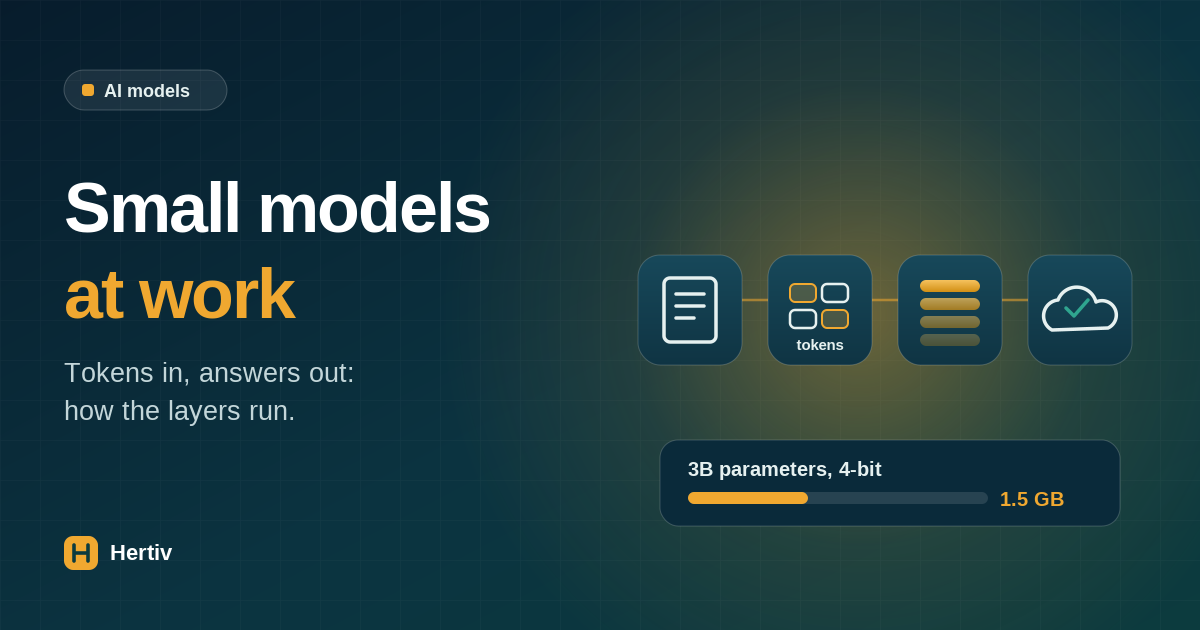
Quantization shrinks a model by storing its weights with fewer bits. A weight stored at 16 bits takes 2 bytes; the same weight at 8 bits takes 1 byte, and at 4 bits it takes half a byte. A 3-billion-parameter model drops from about 6 gigabytes at 16-bit precision to about 3 gigabytes at 8-bit and about 1.5 gigabytes at 4-bit.
The trade is accuracy: fewer bits means less precise weights, so answers can get slightly worse, especially on hard reasoning. In practice, 8-bit and 4-bit versions of small models keep most of their quality on focused tasks, which is why they are the standard way to ship a model on a phone or laptop.
Distillation shrinks a model a different way, by training a smaller architecture to copy a larger one. The two techniques combine well: distil a large model into a small one, then quantize the small one for the device. That is how a capable assistant ends up running inside an app with no network connection.
Example (hypothetical): a support team runs a model on a laptop
Example (hypothetical): a support team of four handles 200 tickets a day and wants a model that drafts replies on a laptop, with no customer data leaving the office. They pick a 3-billion-parameter model, quantized to 4 bits, which needs about 1.5 gigabytes of memory and runs on an ordinary laptop.
Each ticket is about 500 words, or roughly 650 tokens, so 200 tickets use about 130,000 input tokens a day. The model drafts a reply for each ticket, and a human reviews it before sending. It handles 150 of the 200 drafts well enough to send with light edits, while 50 go back for a full human rewrite.
The time saving is easy to check. If each good draft saves 4 minutes of typing, 150 drafts save 600 minutes, or 10 hours, across the team each day. The cost is the laptop the team already owns, plus the one-off fine-tuning on past tickets. The limit is also clear: the model cannot answer questions outside its training and the ticket history, so new product issues still need a human.
What are the common mistakes?
The most common mistakes are picking a model by size alone, skipping the evaluation set, and expecting a small model to reason like a large one.
- Choosing by parameter count. A well-trained 3-billion-parameter model often beats a poorly trained 7-billion one. Test on your own task, not on the size label.
- No evaluation set. Without twenty or so real examples with known good answers, you cannot tell whether a quantized model is still good enough.
- Expecting broad reasoning. Small models are strong on focused tasks and weak on open-ended reasoning. Give them a narrow job.
- Ignoring the token window. Long documents get cut off when they exceed the context window, so chunk and summarise before feeding them in.
- Skipping the fallback. When the model is unsure, it should say so or hand off, not invent an answer.
- Forgetting retrieval. A small model with your documents attached often beats a larger model without them. RAG vs fine-tuning explains when retrieval is the better move.
Cost is the other half of the decision: how much a small language model costs covers training, hosting and running costs in detail.
Key takeaways
- A small model uses the same transformer design as a large one, with fewer layers
- Text becomes tokens, tokens become vectors, and layers predict the next token
- A 3-billion-parameter model needs about 6 GB at 2 bytes per parameter
- Quantization to 4 bits cuts that to about 1.5 GB with a small accuracy trade
- Distillation teaches a small model to copy a larger teacher on one task
- Test the quantized model on your own examples before shipping it
Frequently asked questions
How many parameters does a small language model have?
There is no fixed line, but most small language models have a few hundred million to a few billion parameters, commonly 1 to 8 billion. The useful definition is practical: a small model runs on a laptop, a phone or a single server, while a large model needs data-centre hardware.
Why do small language models answer faster?
Fewer parameters mean fewer calculations per token, and the whole model fits in fast local memory instead of being spread across servers. That removes network delays and keeps the time per token low, which is why small models feel instant on a device.
Can a small language model work without the internet?
Yes, that is one of the main reasons to use one. Once the model file is on the device, it runs locally with no network calls, so it works offline and keeps the input data on the device. This suits field work, private documents and places with poor connectivity.
What is quantization in simple terms?
Quantization stores the model's weights with fewer bits, such as 4 bits instead of 16, which shrinks the model file and the memory it needs. The weights become slightly less precise, so answers can lose a little quality, but on focused tasks the difference is usually small.
Is a small language model better than a large one?
It depends on the task. A small model is better when you need low cost, fast answers, offline use or data privacy. A large model is better for broad reasoning, open-ended writing and tasks where the answer needs wide knowledge. Many teams use both.
How do I pick a small language model for my product?
Shortlist two or three models in the size your hardware can run, fine-tune or prompt each on your task, and test them on a fixed set of real examples. Pick the one with the best results on your data, not the one with the best public benchmark scores.


