How Do Apps Make Money? The Models That Actually Pay
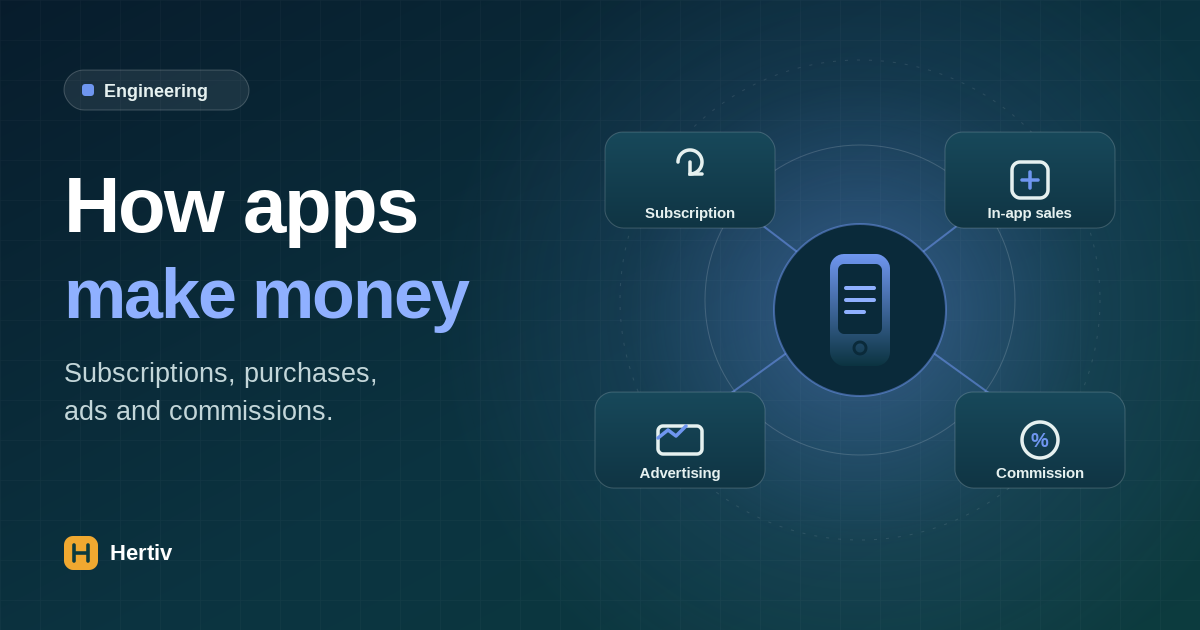
Apps make money through subscriptions, in-app purchases, advertising, commissions and paid downloads. The right model depends on how often people use the app.
On this page
Short answer
Apps make money by charging users directly, selling things inside the app, showing ads, taking a cut of transactions, or selling data and services to businesses. Most profitable apps combine two or three of these models rather than relying on one.
How do apps make money?
Apps make money by charging for access, for features, for goods and services, or for attention, and most successful apps combine more than one of these streams so that a weakness in one is covered by another.
The direct streams are subscriptions, one-off in-app purchases and paid downloads. The indirect streams are advertising, affiliate commissions, transaction fees and selling a service or data product to businesses. A free app with no revenue model is a cost, not a business, so the model has to be chosen before the app is built, not after launch.
Which model works depends on how the app is used. An app people open daily can sell a subscription. An app people open once a month cannot, and needs a different stream. That is why the same app category can support very different business models.
The main app revenue models compared
The main app revenue models differ in when the user pays, how predictable the income is, and what the app must deliver to earn it, so the choice shapes the product as much as the pricing page.
| Model | How it earns | Best for | Main risk |
|---|---|---|---|
| Subscription | Monthly or yearly fee | Apps used weekly or more | Churn when value drops |
| In-app purchase | One-off items or currency | Games, media, tools | Unpredictable income |
| Paid download | Upfront price | Niche tools, no ongoing cost | Hard to grow after launch |
| Advertising | Fees from advertisers | Free apps with large audiences | Needs very high volume |
| Commission | A cut of each transaction | Marketplaces, bookings, delivery | Depends on transaction volume |
| Freemium | Free base, paid upgrade | Tools with a clear premium tier | Most users never pay |
| Business services | Fees from companies | Apps with a business audience | Long sales cycles |
Subscriptions are the most common choice for consumer apps today, because they produce recurring income and the app store handles billing. Advertising only works at scale: an app with 10,000 daily users earns little from ads, while an app with a million can earn a lot.
Subscriptions and in-app purchases
Subscriptions and in-app purchases are the two direct ways to charge users, and the choice between them comes down to whether the value is ongoing or one-off.
A subscription fits when the app delivers fresh value regularly: new content, new features, synced data or an ongoing service. The user pays for continued access, so the app must keep earning the payment every month. A subscription that stops improving will see cancellations rise within a few billing cycles.
An in-app purchase fits when the value is a single item or a fixed bundle: a filter pack, a level, a report, a pack of credits. The user pays once and owns it. Games use this model heavily, selling currency and items, because each purchase is small and the decision is quick.
App stores take a commission on both. The exact rate depends on the store and the developer's programme, so check the current store terms before forecasting revenue. See what custom software development costs for the build side of the same decision.
Advertising, commissions and marketplaces
Advertising and commissions earn money from third parties rather than from the user, which lets the app stay free but ties income to audience size and transaction volume.
Advertising works when the app has a large, returning audience and the ads can be shown without breaking the experience. The app earns per thousand views or per click, so income grows with usage. The trade-off is that ads can push users away, and privacy rules limit how precisely ads can be targeted.
Commissions work when the app connects buyers and sellers: food delivery, travel bookings, freelance work, second-hand goods. The app takes a percentage of each completed order. The model only pays when transactions happen, so the app must keep both sides of the marketplace active.
Some apps earn from businesses directly: a fitness app that sells aggregated insights to gyms, or a travel app that charges hotels for placement. These deals are negotiated rather than automatic, so they suit apps with a clear business audience. The cost of building a marketplace app like Airbnb shows what the commission model has to pay back.
How to choose a revenue model for your app
You choose a revenue model for your app by matching how often people use it, what they value most, and how much they will pay, then testing that choice with real users before committing to it.
- Map usage frequency. Daily use supports subscriptions; monthly use points to one-off purchases or commissions.
- Find the moment of value. Identify the action users care about most, and charge near that moment, not far from it.
- Check what competitors charge. Users compare your price with the app they already use, so a model that is unusual for the category needs a clear reason.
- Estimate the store commission. Work out what the app store keeps, because it changes the margin on every model.
- Test with a small audience. Offer the model to a limited group first and measure conversion and retention before a full launch.
Most apps end up with a primary model and a secondary one: a subscription plus a one-off purchase, or a free tier with ads plus a paid tier without them. The secondary stream matters when the primary one dips.
Example: a fitness app with 10,000 downloads
Example (hypothetical): a fitness app is downloaded 10,000 times in its first month. Of those, 5% subscribe at $5 a month, so 500 subscribers pay $2,500 a month in total.
The app store keeps a 15% commission on the first year of subscriptions, which is $375 a month, leaving $2,125 a month for the developer. Over a year that is $25,500, before running costs.
The app also sells a one-off workout pack for $10. If 2% of the 9,500 non-subscribers buy it, that is 190 buyers and $1,900 in the first month, of which the store keeps 30%, or $570, leaving $1,330. Total first-month income is $2,125 plus $1,330, or $3,455.
The arithmetic shows why retention matters more than downloads: if half the subscribers cancel after month one, monthly subscription income falls to $1,062.50 before commission. Keeping subscribers is worth more than finding new ones.
What are the common mistakes?
The most common mistakes in app monetization are choosing a model that does not fit how the app is used, charging before the app proves its value, and forgetting the app store commission in the forecast.
- Subscription for a rarely used app. If people open the app once a month, they will not pay monthly for it.
- Paywall before value. Asking for payment before the user has seen what the app does kills conversion.
- Ads in a paid app. Showing ads to people who already paid is the fastest way to lose them.
- Ignoring the store commission. Forecasts that forget the 15 to 30% the store keeps overstate income badly.
- One model only. A single income stream leaves the app exposed when that stream weakens.
- Copying a competitor's price. A competitor's model fits their costs and audience, not necessarily yours.
If you are planning the build as well as the business model, mobile app development covers the delivery side.
Key takeaways
- Most profitable apps combine two or three revenue streams
- Subscriptions fit apps used weekly; ads need a very large audience
- Commissions only pay when transactions happen, so both sides of the marketplace matter
- App store commission of 15 to 30% must be in every forecast
- Retention matters more than downloads once the app is live
Frequently asked questions
Do free apps make money?
Yes, if they have a revenue model. Free apps earn through advertising, in-app purchases, subscriptions for premium features, or commissions on transactions. A free app with no model at all earns nothing, no matter how many downloads it gets.
How much do apps earn from advertising?
It depends on audience size, geography and ad format. Advertising pays per thousand views or per click, so income grows with usage. Small apps earn very little from ads, which is why most small apps charge users directly instead.
What is the difference between freemium and a free trial?
Freemium gives a free version forever and charges for premium features. A free trial gives full access for a limited time, then charges for continued use. Freemium suits tools with a clear upgrade; trials suit apps whose value is obvious within days.
Do app stores take a cut of in-app purchases?
Yes. Both major app stores take a commission on in-app purchases and subscriptions. The rate depends on the store, the developer's programme and whether the subscription is in its first year, so check the current store terms before forecasting.
Can an app make money without users paying anything?
Yes, through advertising or by selling a service to businesses, such as placement fees or aggregated insights. Both need scale or a business audience, so they are harder for a new app than charging users directly.
Which revenue model is best for a first app?
For most first apps, a freemium model with a subscription works best: a free version that proves value, and a paid tier for the users who use it most. It is easier to convert existing users than to find paying users from scratch.


