How Big Data Is Changing the Finance Industry
Big data is changing finance by turning transaction records, market feeds and customer behaviour into faster risk checks and sharper lending decisions.
On this page
Short answer
Big data in finance means using very large volumes of transaction records, market feeds, customer behaviour and outside data to make faster and better decisions. Banks, lenders and insurers use it to check risk, spot fraud, price products and serve customers, where a human analyst could only look at a small sample before.
What does big data mean in finance?
Big data in finance means working with volumes of data too large and too varied for spreadsheets and nightly batch reports. A bank sees millions of transactions a day, plus market prices, customer messages, device signals and outside data such as company filings and economic indicators.
Three traits define it. Volume is the sheer amount: every card payment, transfer and login is a record. Variety is the mix: structured account data sits next to free text, images and sensor data. Velocity is the speed: prices move in milliseconds and fraud must be stopped while the transaction is still being approved.
The change is not that banks suddenly have data. Banks have always had data. The change is that they can now analyse it as it arrives, join it across systems that used to be separate, and act on it in the same moment a customer taps a card or applies for a loan. That is what turns a record-keeping system into a decision-making one.
If you are building the plumbing for this work, see data engineering services for how teams move and prepare data at this scale.
Where does financial big data come from?
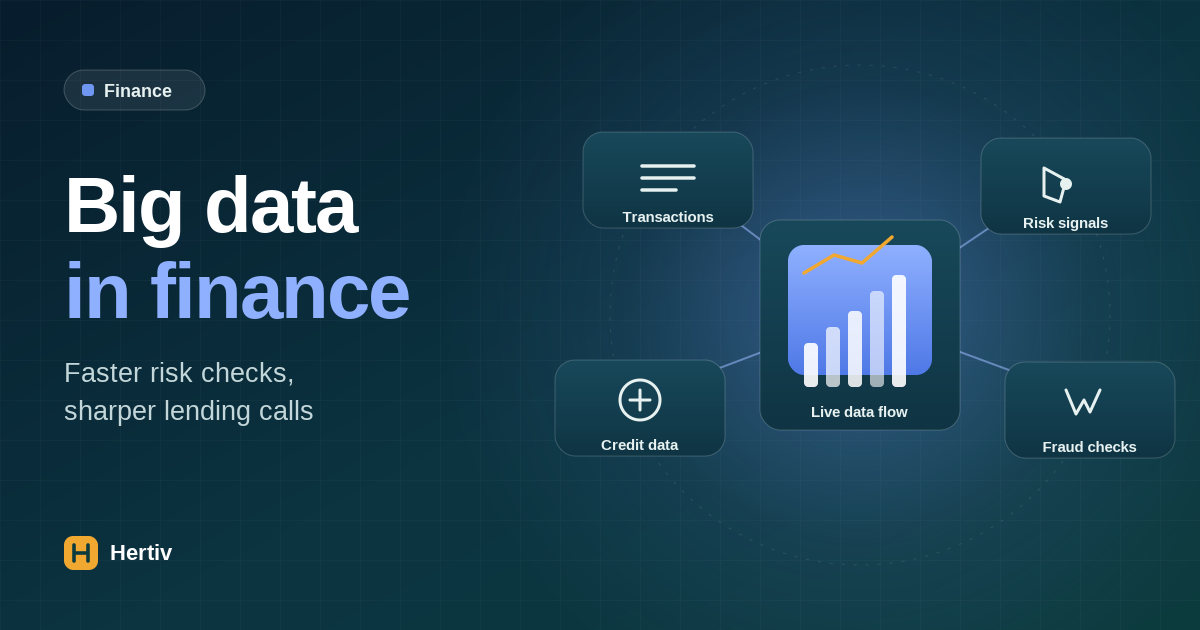
Financial big data comes from transactions, customers, markets and outside sources. The table below shows the main sources and what each one is used for.
| Source | What it contains | What it is used for |
|---|---|---|
| Transactions | Payments, transfers, card swipes | Fraud checks, spending patterns, cash flow |
| Customer data | Accounts, applications, messages, app use | Service, product offers, churn signals |
| Market data | Prices, volumes, news, filings | Trading, valuation, risk limits |
| Device and location | Login device, IP address, travel signals | Fraud checks, identity verification |
| Outside data | Credit bureaus, registries, economic data | Lending decisions, stress testing |
| Documents | Contracts, statements, claims | Compliance checks, underwriting |
No single source is enough on its own. A fraud check that only looks at the transaction amount misses the device and the location, and a lending decision that only looks at a credit score misses the cash flow in the applicant's accounts. The value comes from joining sources, which is also where most of the engineering work sits.
How does big data change risk and fraud detection?
Big data changes risk and fraud detection by checking every transaction as it happens, against patterns learned from millions of earlier ones. The old way was to review a sample after the fact; the new way is to score the transaction before it clears.
A card payment is a good example. When a card is used, the bank checks the amount, the merchant, the location, the device, the time of day and the customer's recent spending, all in a fraction of a second. A payment that fits the pattern goes through. One that breaks it, such as a large purchase in a new country minutes after a small local one, is blocked or sent for a check.
The same idea applies to credit risk. A lender can watch cash flow, payment timing and account balances over months, instead of relying only on a credit score taken at application time. That gives an earlier warning when a borrower is getting into trouble, and it lets the lender act before a loan goes bad.
The limit is data quality. A model trained on incomplete or biased records will make confident mistakes, so teams that run these systems spend much of their time cleaning and checking the data, not building models. For the forecasting side of this work, see predictive analytics services.
How does big data change lending and credit decisions?
Big data changes lending by letting lenders look at a borrower's real cash flow and behaviour instead of only a credit score. That opens lending to people and small businesses that a score alone would reject.
A small business is the clearest case. A traditional score may say little about a young company, but its bank statements show regular income, on-time supplier payments and a growing customer base. A lender that reads those signals can approve a loan that a score-based check would refuse, and it can set the limit from the actual cash flow rather than a generic band.
For consumers, the same shift shows up in faster decisions. An application that used to take days of manual review can now be decided in minutes, because the checks run against live account data and outside records at once. The applicant still needs to meet the lender's rules; the data just makes the check faster and more complete.
The risk is fairness. If the data includes signals that track a protected group, the model can repeat that pattern without anyone intending it. Lenders that use these models need to test them for that effect and keep a human in the loop for borderline cases.
How does big data change trading and customer service?
Big data changes trading by feeding models with market data, news and order flow in real time, and it changes customer service by giving agents the full picture of a customer in one screen.
In trading, the shift is speed and breadth. A trading desk can watch thousands of instruments, read news as it breaks, and adjust positions in seconds. The models do not remove risk; they change where the risk sits, because a model that misreads a news event can act on it faster than a human could stop it. That is why trading firms put limits and kill switches around their models.
In customer service, the shift is context. When a customer calls, the agent can see recent transactions, open applications and past messages without asking the customer to repeat them. The bank can also spot customers who are likely to leave, for example when spending drops and logins fall, and reach out before they close the account.
For teams using AI agents to handle these conversations, see AI agents for finance teams for how the handoff to a human is kept smooth.
Example (hypothetical): a lender cuts fraud losses
Example (hypothetical): a lender approves 10,000 loan applications a month. About 2% of them, or 200 applications, are fraudulent, and each fraudulent loan costs the lender $1,500 on average. That is 200 times $1,500, or $300,000 a month in fraud losses.
The lender adds a real-time check that scores each application against transaction patterns, device signals and outside records. The check catches 60% of the fraudulent applications before money is sent. That saves 60% of $300,000, which is $180,000 a month.
The check costs $25,000 a month to run, including the data feeds and the team that reviews flagged cases. The net saving is $180,000 minus $25,000, which is $155,000 a month, or $1,860,000 a year.
The lender still reviews the cases the check flags, because some genuine applicants look unusual. The check does not replace the decision; it orders the queue so that the riskiest applications get human attention first.
What are the common mistakes?
The most common mistakes with big data in finance are trusting dirty data, automating a decision nobody can explain, and collecting data without a clear use for it.
- Trusting dirty data. A model trained on records with gaps, duplicates and wrong labels will make confident mistakes. Cleaning the data is most of the work.
- Automating an unexplained decision. If a lender cannot explain why an application was refused, it cannot defend the decision to the customer or to a regulator. Keep a reason with every automated decision.
- Collecting data without a use. Storing everything just in case raises cost and risk. Each data source should have a named decision it improves.
- Ignoring the model after launch. Customer behaviour and fraud patterns change, so a model that worked last year drifts. Review its performance on a schedule and retrain it.
- Forgetting privacy. Financial data is personal. Consent, access control and deletion rules must be designed in, not added after a complaint.
Key takeaways
- Big data in finance means analysing transactions, markets and customer behaviour as they happen
- Fraud and risk checks now score every transaction before it clears, instead of sampling after the fact
- Lenders can use real cash flow and behaviour, not only a credit score, to decide on a loan
- Trading gains speed and breadth, while customer service gains the full context of each customer
- Every automated decision needs a reason a human can explain, and models need regular review
Frequently asked questions
What is big data in finance?
It is the use of very large volumes of transaction records, market feeds, customer behaviour and outside data to make faster and better financial decisions. The data is large in volume, varied in type and fast-moving, which is why it needs different tools from a spreadsheet or a nightly report.
How does big data help detect fraud?
It lets a bank score each transaction as it happens against patterns from millions of earlier ones, checking the amount, merchant, location, device and recent spending together. A payment that breaks the pattern is blocked or sent for a check before it clears.
Can big data help people with thin credit files?
Yes. A lender can look at bank statements, payment timing and cash flow instead of only a credit score, which helps young businesses and first-time borrowers. The lender still needs to test the model for fairness and keep a human in the loop for borderline cases.
Does big data replace human analysts in finance?
No. It orders the work: models flag the riskiest cases and surface the patterns, and people decide the hard cases, check the data and set the rules. A model that nobody reviews will drift as behaviour and fraud patterns change.
What data do banks use most?
Transactions are the core source, joined with customer records, market data, device and location signals, outside data such as credit bureaus and registries, and documents. The value comes from joining sources, not from any one of them alone.
What are the main risks?
Dirty data, decisions nobody can explain, models that drift over time, and privacy failures. Each one needs a control: data checks, a reason with every automated decision, a review schedule, and consent and access rules designed in from the start.


