What Does Hotel Management Software Cost to Build?
Hotel software costs what its scope costs: rooms, bookings, payments and integrations set the price. Learn the drivers, the breakdown and how to budget in stages.
On this page
Short answer
Hotel management software costs what its scope costs, because the number of rooms, the booking channels, the payment methods and the integrations with other systems are the main drivers. A small guesthouse needs far less than a hotel group with several properties, so the honest answer is always a range tied to what the software must do.
What is hotel management software?
Hotel management software is the system a hotel uses to run its daily work: reservations, room assignments, guest check-in and check-out, billing, housekeeping and reports. It replaces spreadsheets and paper logs with one place where staff can see which rooms are free, who is arriving and what is owed.
Most systems also connect to booking sites, payment providers and channel managers, so a room sold online appears as booked in the hotel's own system. Without those links, staff must update each channel by hand, which leads to double bookings.
This article explains what drives the cost of building such software, how the work usually breaks down, and how to budget in stages. For a scoped estimate, see custom software development services or ask for a quote tied to your feature list.
What drives the cost of hotel software?
The biggest driver is the feature list. A booking calendar and room management cost less than a system with online payments, channel connections, housekeeping tasks, loyalty points and reports for several properties. Each feature adds design, code and testing.
The second driver is the number of properties and users. Software for one small hotel is simpler than software for a group, because a group needs shared guest records, central rates, per-property roles and reports that combine all properties.
A third driver is integrations. Connecting to booking sites, payment providers, door locks, accounting tools and review platforms takes time, and each provider has its own rules and tests. A fourth driver is the platform: a web admin panel alone costs less than a web panel plus staff apps for phones and tablets.
A fifth driver is the guest experience. A booking page that guests use themselves needs clear design, fast loading and support for several languages and currencies. A system used only by staff can be simpler, while a guest-facing tool must work well on any phone.
How do hotel software costs break down?
Hotel software costs usually break down into design, development, integrations, testing and launch. Design covers the screens and the daily flow for reception, housekeeping and managers, while development covers the booking engine, payments and admin tools.
| Part | What it covers | Cost driver |
|---|---|---|
| Design | Screens, flows, housekeeping views | Number of screens and roles |
| Booking engine | Calendar, rates, availability, rules | Rate rules and booking channels |
| Payments | Cards, deposits, refunds, invoices | Payment providers and tax rules |
| Integrations | Booking sites, locks, accounting | Number of providers |
| Testing and launch | Checks, fixes, staff training | Properties and data migration |
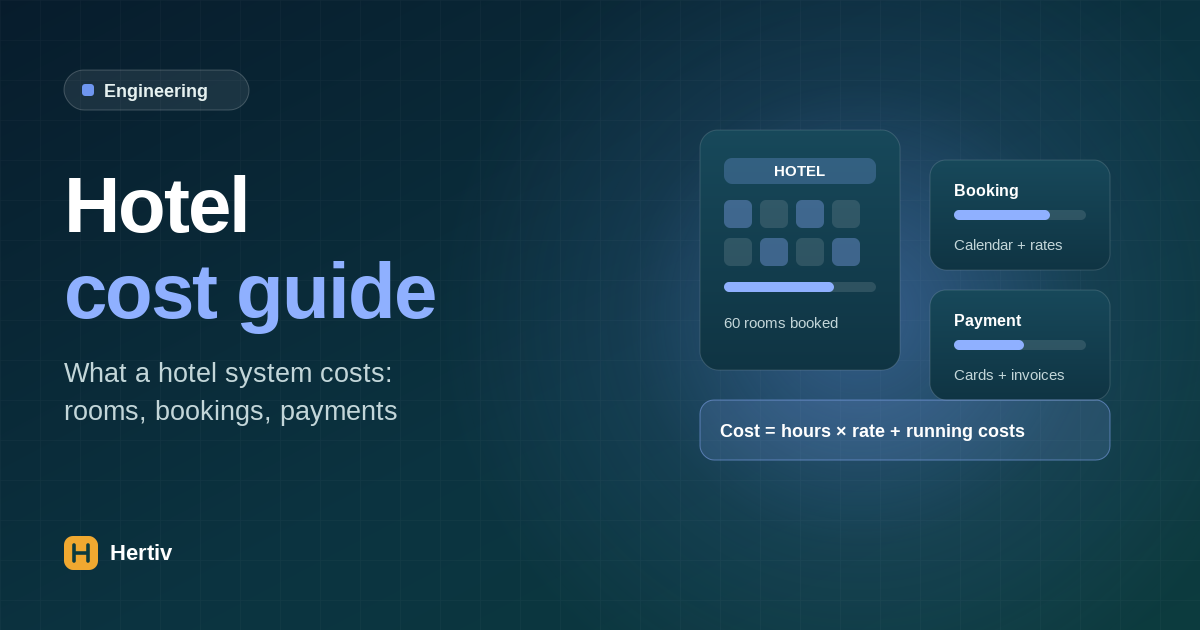
The honest way to think about cost is hours times rate. A team estimates the hours for each part, then multiplies by the hourly rate of the people doing the work. A small system might take a few hundred hours, while a large one for a hotel group can take several thousand.
Should you build or buy hotel software?
Buying ready-made hotel software suits most small hotels. The monthly fee covers the booking engine, the channel links and the updates, and staff can start in days. The trade-off is that the software fits the hotel, not the other way round, and unusual rules may not be possible.
Building custom software suits hotels with needs that ready-made tools cannot meet: unusual rate rules, a specific guest flow, deep links to other systems, or a group that needs one shared platform. The cost is higher and the wait is longer, but the result matches the hotel's way of working.
A middle path is to buy the core and build the rest. Many hotels use a ready-made booking system and add a custom guest app, a loyalty tool or a report that the standard system lacks. That keeps the cost down while solving the one problem that matters most.
Example (hypothetical): a 60-room hotel
Take a hypothetical 60-room hotel that wants its own system: a booking calendar, online payments, a channel link to two booking sites, housekeeping tasks and a simple report page. The team estimates 1,400 hours of development at $85 an hour, which is $119,000.
Design adds $10,000 for the reception, housekeeping and manager screens, and testing adds $12,000 for checks, fixes and a trial run with real bookings. The first version therefore costs $119,000 + $10,000 + $12,000, which is $141,000.
Running costs follow. Hosting, the payment provider fees and support for the first year are separate from the build cost, so the hotel should budget for them too. A staged plan helps: launch the booking core first, then add housekeeping and reports once staff are using it every day.
How do you budget in stages?
Staged budgeting keeps the spend tied to what staff actually use. Start with the core that runs the hotel, prove it works, then add the parts that save time or earn money.
- List the features staff need every day, and put the rest on a later list.
- Get a quote for the core only: booking, rooms, payments and one channel link.
- Set aside a fifth of the budget for fixes, changes and training after launch.
- Launch the core with one property, fix what breaks, then roll it out wider.
- Add one feature at a time, and check that staff use it before paying for the next.
Keep a written record of every change request and its cost. Small additions look cheap alone, but ten of them can double the budget without anyone noticing.
What are the common mistakes?
The most common mistake is copying every feature from a large hotel chain. A small hotel does not need group reporting, loyalty tiers and multi-currency rates on day one, and each extra feature adds cost and delay.
A second mistake is skipping the channel links. If the system does not talk to booking sites, staff must update availability by hand, which leads to double bookings and angry guests. Test the channel link with real bookings before launch.
A third mistake is forgetting housekeeping. The cleaning team needs a simple view of which rooms are ready, and if that view is slow or confusing, rooms stay dirty while guests wait. Build the staff screens with the staff, not just for them.
Finally, teams forget data migration. Old bookings, guest records and rates must move into the new system, and that work takes time. Plan the move early, and check the old data before you switch over.
Another common mistake is skipping staff training. A system that reception finds hard to use will be worked around, not used, and the hotel ends up paying for software that nobody trusts. Train staff on real bookings before launch, and keep a short guide at the desk for the first month.
Key takeaways
- Scope sets the price: rooms, channels, payments and integrations drive cost.
- Buying ready-made software suits most small hotels; building suits unusual needs.
- Budget in stages and launch the booking core before adding extras.
- Channel links and housekeeping views are not optional extras.
- Keep a fifth of the budget aside for fixes, changes and training.
Frequently asked questions
How much does hotel management software cost?
There is no single price. A small system for one hotel costs far less than a platform for a hotel group with several properties, channel links and custom rules. The cost depends on features, integrations and the number of users, so a quote tied to your feature list is the only honest answer.
Is it cheaper to build or buy hotel software?
Buying is cheaper for most small hotels, because the monthly fee covers the booking engine, channel links and updates. Building costs more up front but fits unusual rules and group needs. Many hotels buy the core and build only the extra tool they cannot get ready-made.
What features matter most in hotel software?
The booking calendar, room assignments, check-in and check-out, billing and housekeeping views matter most, because staff use them every day. Channel links and payment support come next, since they stop double bookings and speed up payment.
How long does it take to build hotel software?
A small system with a booking core can take a few months, while a full platform for a hotel group can take a year or more. The time depends on the feature list, the number of integrations and how fast the hotel can test each version.
Do hotels need a mobile app for staff?
Not always. A web panel that works well on a tablet covers reception and housekeeping for most hotels. A phone app helps when staff move around the property all day and need quick updates without returning to a desk.
What are the running costs after launch?
Running costs include hosting, payment provider fees, channel fees and support. They are separate from the build cost and continue every month, so the hotel should budget for them from the start rather than treating launch as the end.


