Haystack vs LangChain: Which Framework Fits Your RAG Project?
Haystack and LangChain both build retrieval-augmented generation apps, but they start from different ideas. Here is how each works and which fits your project.
On this page
Short answer
Haystack is a Python framework built around document pipelines for search and retrieval-augmented generation, while LangChain is a broader framework for chaining language model calls, tools and agents. Haystack suits teams that want a clear pipeline for search over their own documents; LangChain suits teams that want agents, tool use and many integrations.
What is Haystack, and what is LangChain?
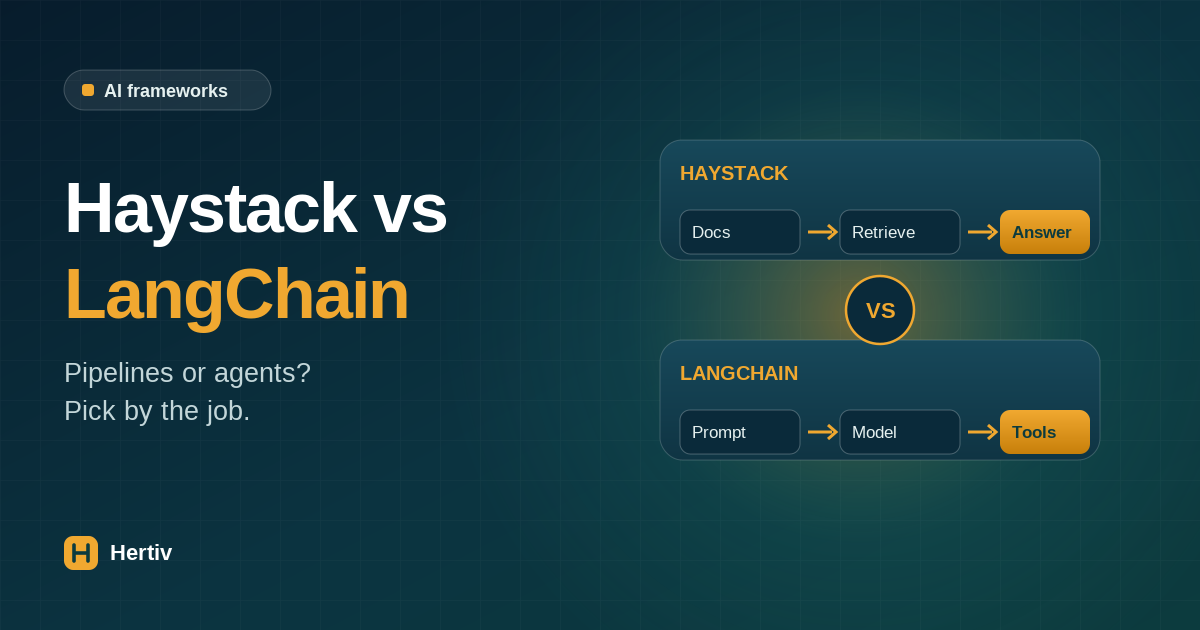
Haystack is an open source Python framework for building search and retrieval-augmented generation (RAG) applications. It organises work into pipelines: a retriever finds relevant documents, a reader or generator turns them into an answer, and each step is a component you can swap.
LangChain is an open source framework for building applications on top of language models. It chains prompts, models, memory, tools and retrievers together, and it supports agents that decide which tool to call next.
The short version: Haystack starts from search and grows towards generation, while LangChain starts from the language model and grows towards everything around it. Both are used for retrieval-augmented generation, but they arrive there from opposite directions.
How does Haystack work?
Haystack works by arranging components into a pipeline that data flows through. A typical RAG pipeline has an indexer that splits documents into chunks and stores them, a retriever that finds the most relevant chunks for a question, and a generator that writes an answer from those chunks.
Each component has a clear job, and you can replace one without rewriting the rest. If you want a different retriever, you swap that component and keep the rest of the pipeline. That makes Haystack easy to reason about: you can draw the pipeline on a whiteboard and follow a question through it.
Haystack also ships tools for document stores, evaluation and converting files into text. It is a good fit when the core problem is search quality over your own documents, and the answer step is a modest part of the system. For more on grounding answers in your own data, see RAG development.
How does LangChain work?
LangChain works by chaining together small building blocks: prompts, language models, memory, retrievers and tools. A chain passes the output of one step into the next, and an agent can decide at run time which tool to call based on what the model plans to do.
That flexibility is the point. The same framework can build a simple question-answering chain, a chatbot with memory, or an agent that searches the web, reads files and calls your own APIs. LangChain has a large catalogue of integrations, so connecting a new model provider or vector store is usually a small change.
The trade-off is complexity. With more moving parts and more ways to combine them, a LangChain application can be harder to debug than a fixed pipeline. When a chain misbehaves, you often need tracing to see which step went wrong.
Haystack vs LangChain: side by side
Haystack and LangChain overlap on RAG, but they differ in focus, structure and the kind of project each one makes easy.
| Area | Haystack | LangChain |
|---|---|---|
| Core idea | Document pipelines for search and RAG | Chains and agents around language models |
| Main strength | Clear, testable retrieval pipelines | Wide integrations and agent support |
| Typical use | Search over docs, RAG answers | Chatbots, agents, multi-tool apps |
| Structure | Fixed pipeline of components | Flexible chains, graphs and agents |
| Learning curve | Smaller surface, quicker to read | Larger surface, more concepts to learn |
| When it wins | Retrieval quality is the main risk | Tool use and agents are the main need |
Neither framework is a finished product. Both are libraries you build on, and both need your own testing for retrieval quality, answer accuracy and cost.
When should you choose Haystack?
Choose Haystack when your main problem is getting the right documents to the model. If you are building a support assistant over help articles, a research tool over PDFs, or an internal search that must cite its sources, a pipeline you can inspect step by step is a real advantage.
Haystack also fits teams that want to compare retrievers and document stores in a controlled way. Because each component is separate, you can run the same questions through different retrievers and see which one returns better passages. That kind of evaluation is harder when retrieval is one step inside a long chain.
Pick Haystack when the answer is mostly a summary of retrieved text, when you want to test each stage on its own, and when your team values a design they can draw and explain. Before committing, run a small proof of concept to check retrieval quality on your own documents — see how to build an AI PoC for a workable plan.
When should you choose LangChain?
Choose LangChain when your application does more than retrieve and answer. If the model needs to call tools, keep memory across turns, branch on the result of a step, or coordinate several agents, LangChain's chains and agents are built for that.
LangChain also fits teams that expect the application to grow. You might start with a simple RAG chain and later add a web search tool, a database query step or an agent that drafts follow-up actions. Adding those steps to a chain is usually easier than rebuilding a fixed pipeline.
Pick LangChain when the workflow is the hard part, when you need many integrations, and when your team is comfortable debugging with tracing. If your project is mostly retrieval, LangChain can still do it — you are simply carrying a larger framework for a smaller job.
Example (hypothetical): a support team picks a framework
Example (hypothetical): a support team has 2,000 help articles and wants an assistant that answers common questions with a link to the source article. Two engineers spend a week testing both frameworks on 100 real past questions.
With Haystack they build a pipeline in a day: the retriever returns the top five passages, the generator writes the answer, and each question can be traced to the passages it used. On their test set, 78 of 100 answers cite the right article. With LangChain they build a similar chain in two days and get 76 of 100 right, but the tracing shows one failure mode where the agent calls the wrong tool first.
The team picks Haystack, because retrieval quality is the whole product and the pipeline is easier to test. They note the decision in writing: if the assistant later needs to open tickets or check order status, they will revisit LangChain for its agent support.
The arithmetic they record is simple — 78 correct out of 100 is a 78% hit rate, and they want 90% before launch, so they plan one more round of chunking and retriever tests.
What are the common mistakes?
The most common mistakes when choosing between Haystack and LangChain are picking on reputation instead of on the job, and skipping retrieval testing either way.
- Choosing the bigger framework by default. A large catalogue of integrations does not help if your project is a search pipeline.
- Testing only with easy questions. Both frameworks look good on simple queries; the differences show up on hard, ambiguous ones.
- Ignoring evaluation. Without a test set of real questions, you cannot tell whether a change helped or hurt.
- Mixing retrieval and agent problems. If answers are wrong because the retriever missed the passage, adding an agent will not fix it.
- Skipping cost checks. Long chains with several model calls can cost far more per question than a single retrieval plus one generation step.
Key takeaways
- Haystack is built around document pipelines; LangChain is built around chains and agents
- Haystack makes retrieval easy to test step by step; LangChain makes tool use and agents easy to add
- Pick Haystack when search quality over your own documents is the main risk
- Pick LangChain when the workflow needs tools, memory or several agents
- Test both on your own questions before choosing — a small PoC beats a long debate
Frequently asked questions
Is Haystack only for search?
No. Haystack started in search, but its pipelines now cover retrieval-augmented generation end to end, including indexing, retrieval and answer generation. Search is still its home ground, and that is where it is strongest.
Can LangChain do retrieval-augmented generation?
Yes. LangChain has retrievers, vector store integrations and RAG chain patterns, and many teams use it for RAG. It is a general framework, so RAG is one of several things it does well rather than its single focus.
Do you need both frameworks in one project?
Usually not. Pick one as the main framework and use the other only if a specific job clearly needs it. Running two frameworks adds setup, dependency and debugging cost that a small team rarely needs.
Which one is easier to learn?
Haystack has a smaller set of concepts, so most developers can read a pipeline and follow it in a day. LangChain has more concepts — chains, agents, memory, tools — so it takes longer to learn, but it covers more kinds of application.
How do you test retrieval quality?
Build a test set of real questions with the passages that should answer them, then measure how often the retriever returns those passages. Track the hit rate as you change chunk size, retriever settings or the document store.
Which framework is better for production RAG?
Neither is better in general. Haystack suits production RAG where retrieval quality is the main risk and the pipeline stays stable. LangChain suits production apps where the workflow grows and agents or tools are central. Test both on your own data.


