Government Data Analytics in Australia: How It Works
Government data analytics in Australia turns records into better services. Here is what agencies analyse, the rules that bind them and how a project starts.
On this page
Short answer
Government data analytics in Australia is the practice of collecting, linking and analysing the administrative data held by federal, state and local agencies to improve services, target spending and report on results. It runs under the Privacy Act 1988, the Data Availability and Transparency Act 2022 and each jurisdiction's own rules.
What is government data analytics in Australia?
Government data analytics in Australia is the practice of collecting, linking and analysing the administrative data held by federal, state and local agencies to improve services, target spending and report on results. It covers everything from hospital waiting lists to road maintenance schedules, and it is done by agency teams, central data units and, in some cases, outside analysts working under data sharing agreements.
The work starts with data the government already holds. Every licence issued, benefit paid, school enrolled and hospital visit creates a record, and those records together describe how services are used. Analytics turns those records into answers: which services are overloaded, which groups are missing out, and where money is spent without effect.
The table below shows the main kinds of data involved and what each one is used for.
| Data type | Who holds it | What it answers |
|---|---|---|
| Service records | Agencies and councils | Who uses a service, how often, and where |
| Health records | Health departments | Demand, waiting times, outcomes |
| Education records | Education departments | Enrolment, attendance, results |
| Transport records | Transport agencies | Routes, congestion, safety |
| Revenue records | Treasury and revenue offices | Compliance, forecasts, fraud |
| Survey and census data | Australian Bureau of Statistics | Population, income, housing |
Analytics is not the same as publishing open data. Open data puts datasets on portals such as data.gov.au for anyone to use. Analytics is the internal work of joining datasets, testing ideas and advising decision makers, and much of it never leaves the agency.
What data do Australian governments hold?
Australian governments hold data on almost every part of daily life, because most services need a record to run. Federal agencies hold tax, welfare, health and immigration records. States hold health, education, transport, policing and land records. Councils hold rates, planning, waste and local service records.
Some of this data is already public in aggregate form. The Australian Bureau of Statistics publishes census and survey results, and agencies publish dashboards on hospital performance, school results and road safety. The raw records behind those figures stay inside government, and access to them is controlled.
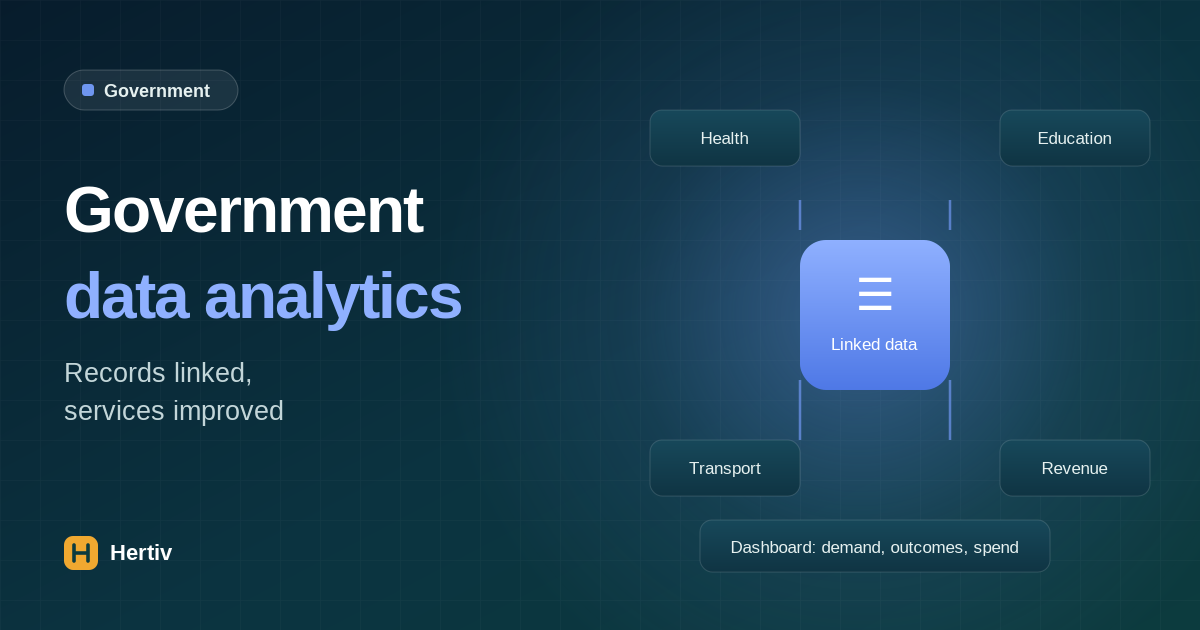
Linking records across agencies is where the value sits. A health department that can see housing, income and hospital data together can find the households most at risk of a preventable admission. A transport agency that can see crash, road and weather data together can find the stretches of road that need work first. For the engineering work behind that linking, see data engineering services.
Linking also raises the risk. A single record on its own may be harmless, but joined records can identify a person even after names are removed. That is why Australian practice treats linked data as sensitive by default and requires a formal agreement before it is shared.
How is analytics used in practice?
Analytics in Australian government falls into four jobs: reporting what happened, explaining why it happened, predicting what will happen next, and recommending what to do. Most agencies start with reporting, because it is the easiest to defend, and move to prediction only when the data is clean enough to trust.
Common uses include forecasting demand for hospital beds and school places, finding the roads with the worst crash rates, checking whether a program reached the people it was meant for, and spotting patterns in tax and benefit claims that need a closer look.
| Use | Example question | Who uses the answer |
|---|---|---|
| Demand forecasting | How many hospital beds next winter? | Health planners |
| Service targeting | Which suburbs miss out on services? | Program managers |
| Fraud and compliance | Which claims look unusual? | Revenue and welfare teams |
| Performance reporting | Are waiting times falling? | Ministers and the public |
| Policy evaluation | Did the program change anything? | Policy teams and auditors |
Evaluation is the use that gets the least attention and matters the most. A program that cannot show it changed an outcome will keep its funding on habit alone. Linking service records to outcomes is the only way to test whether a program worked, and it is the hardest part of the job because outcomes take years to appear.
What rules govern government data sharing?
Government data sharing in Australia is governed by a mix of federal law, state law and agency policy. The Privacy Act 1988 and the Australian Privacy Principles set the baseline: personal information must be collected for a lawful purpose, kept secure, and used only for the purpose it was collected for, unless an exception applies.
The Data Availability and Transparency Act 2022 created a federal scheme for sharing data between Commonwealth bodies and with state bodies and accredited researchers. Under the scheme, data can be shared for three purposes only: delivering government services, informing government policy and programs, and research and development. Sharing is not allowed for compliance or enforcement.
Each state and territory has its own rules as well. New South Wales, Victoria and Queensland each run their own data sharing arrangements, and a project that spans jurisdictions must satisfy each one. Councils have their own obligations under local government and privacy law, which is why local projects often move more slowly than federal ones. For how councils choose their systems, see local government ERP systems in Australia.
The practical rule is simple: before any data moves, there must be a written agreement that states the purpose, the data items, who can see them, how long they are kept, and how they are destroyed. A project without that agreement will be stopped, however good its analysis is.
How does a government analytics project start?
A government analytics project starts with a question a decision maker needs answered, not with a dataset. The question decides which data is needed, who must approve access, and what a useful answer looks like.
- Define the question. Write down the decision the analysis will inform and the date it is needed by.
- Find the data. List the datasets that could answer it and who holds each one.
- Clear the sharing path. Agree the legal basis, the data items and the handling rules before any data moves.
- Check data quality. Test whether the records are complete, current and joined correctly, and fix what is broken.
- Analyse in a safe place. Work in an approved environment, with access limited to the team doing the analysis.
- Report with limits stated. Say what the data can and cannot prove, and who the result applies to.
Step four is where most projects lose time. Administrative data is collected to run a service, not to answer research questions, so it often has missing fields, changed definitions and duplicate records. A project that budgets a week for data cleaning and needs two months will miss its deadline.
Step six matters as much as the analysis itself. A result reported without its limits will be used as if it were certain, and the people affected by the decision will bear the cost of that overconfidence. For the citizen-facing side of the same work, see government services apps.
Example (hypothetical): a council cuts pothole repair time
Example (hypothetical): a council receives 8,400 pothole reports a year. Each report takes a crew supervisor about 45 minutes to check, prioritise and schedule, so the triage work alone takes 8,400 x 45 = 378,000 minutes, or 6,300 hours, a year.
The council joins the reports to road condition surveys, traffic counts and past repair records, and builds a simple rule that scores each report by road type, traffic volume and how long the defect has been open. Reports above the score go straight to a crew; the rest go to a weekly review list.
With the rule in place, a supervisor spends about 20 minutes per report on average, so triage takes 8,400 x 20 = 168,000 minutes, or 2,800 hours, a year. The council saves 6,300 - 2,800 = 3,500 hours of supervisor time, and urgent defects reach a crew days sooner because they no longer wait in a single queue.
The gain depends on the data being right. If the road survey is two years out of date, the score will send crews to roads that have already been fixed. The council checks the survey dates before trusting the score, and it keeps a human review for any report about a school zone or a hospital entrance.
What are the common mistakes?
The most common mistakes in government data analytics are starting with the data instead of the question, sharing data without a written agreement, and reporting results without their limits.
- Starting with the dataset. A project that begins with what data is available usually ends with a report nobody asked for.
- Skipping the sharing agreement. Data moved on a verbal promise will be pulled back when a privacy officer finds out.
- Trusting dirty data. Administrative records have gaps and changed definitions; an analysis that ignores them will be wrong in ways that look confident.
- Overclaiming. A correlation between two datasets is not proof that a program caused a change.
- No plan for the answer. An analysis that arrives after the decision was made is wasted work.
- Forgetting the public. People whose data is used deserve to know what it was used for, in plain language.
Key takeaways
- Government data gives services their memory
- Linking records creates value and risk together
- The DAT Act allows sharing for services, policy and research only
- A written sharing agreement must come before any data moves
- Report results with their limits stated, not as certainties
Frequently asked questions
What is government data analytics?
It is the analysis of administrative records held by federal, state and local agencies to improve services, target spending and report on results. It joins datasets such as health, education and transport records, and it runs under privacy law and data sharing rules.
What is the Data Availability and Transparency Act 2022?
It is the federal law that created a scheme for sharing Commonwealth data with other government bodies and accredited researchers. Data can be shared for delivering services, informing policy and programs, and research and development, but not for compliance or enforcement.
Can government data be shared with researchers?
Yes, under the DAT Act scheme and state arrangements, when the purpose fits and a sharing agreement is in place. The agreement states the purpose, the data items, who can see them, how long they are kept and how they are destroyed.
Does government analytics use personal information?
It can, but personal information is protected by the Privacy Act 1988 and the Australian Privacy Principles. Linked data is treated as sensitive by default, and projects must show a lawful basis and a written agreement before data moves.
Where can I find Australian government open data?
The main federal portal is data.gov.au, and each state and territory runs its own portal, such as data.nsw.gov.au and data.vic.gov.au. These portals publish datasets for anyone to use, while the raw records behind them stay inside government.
How long does a government analytics project take?
A small project with clean data and a clear question can take weeks. Most take months, because agreeing the sharing path and cleaning administrative data usually takes longer than the analysis itself.


