Getting Started with AI in Insurance: A Practical Guide
AI in insurance starts with one small job, not a company-wide programme. Here is how to pick that job, get the data ready and run a pilot.
On this page
Short answer
Getting started with AI in insurance means picking one small job where AI can help and running a short pilot with real data and a clear measure of success. You do not need a large team or a new platform to start. You need clean data, permission to use it, a way to check the AI's work, and a plan to grow or stop the pilot.
What does getting started with AI in insurance mean?
Getting started with AI in insurance means using AI on one small, well-defined job inside an insurer, such as reading claim forms or drafting replies to customers, and proving it works before you spend more. It is a pilot, not a company-wide programme, and it has a clear owner, a small budget and a date when the team decides what happens next.
Insurance work suits this approach because much of it is reading documents, checking details against rules and answering the same questions again and again. Those are jobs where AI can save time, as long as a person still checks the result before it reaches a customer or a payment decision.
Starting small also keeps the risk small. A pilot that reads claim documents affects one team and one process. If it works, the team has proof to ask for more budget. If it fails, the team has learned what went wrong without disrupting the whole company. For a structured first step, an AI readiness assessment covers the data, rules and skills a pilot needs before it starts.
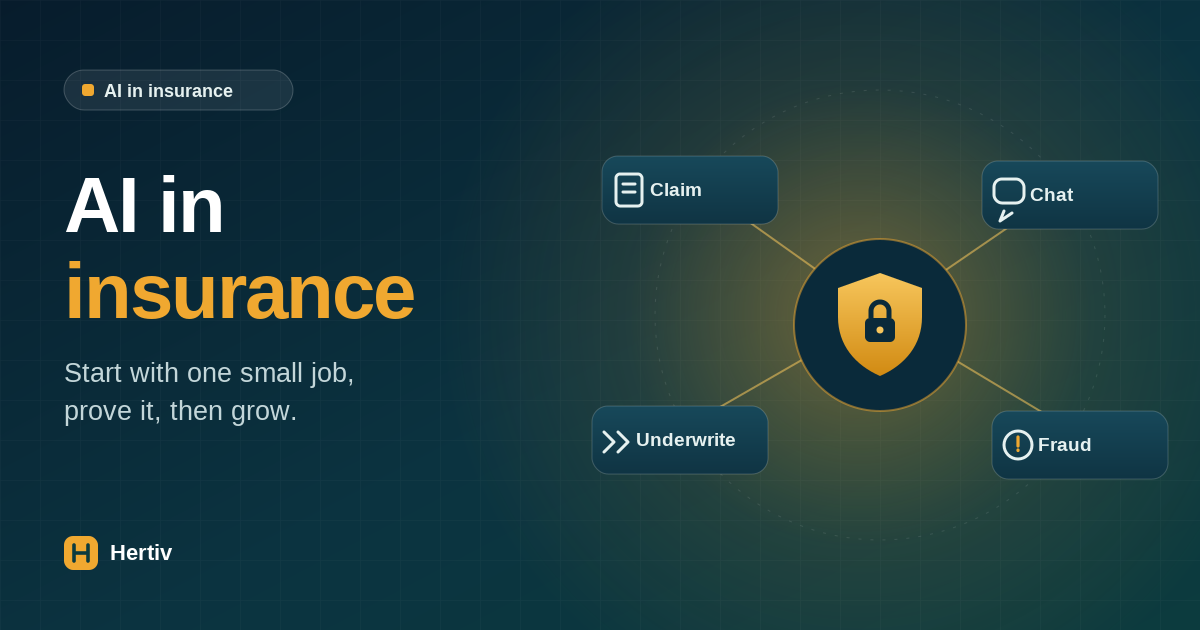
Where does AI help in insurance first?
The best first jobs share three traits: the work is repetitive, the data already exists in digital form, and a person can check the result quickly. Jobs that meet all three are the safest place to start, because the AI helps without taking over a decision that needs human judgement.
| Use case | What the AI does | What to measure |
|---|---|---|
| Claims document sorting | Reads forms and files them by type | Minutes saved per claim |
| First notice of loss | Collects the basic facts of a claim | Time from report to handler |
| Underwriting support | Summarises applications for a person | Applications reviewed per day |
| Fraud signals | Flags claims that look unusual | Share of flags that prove useful |
| Customer questions | Drafts answers for common questions | Replies handled without a call |
| Pricing support | Pulls risk factors into one view | Time to prepare a quote |
Claims work is usually the best first pick. Claims teams handle a high volume of similar documents, the time saved is easy to measure, and the cost of a mistake is contained because a handler still reviews the claim before it is paid. Underwriting and pricing need more care, because they shape the price a customer pays, so they suit a later pilot once the team trusts the process.
What data and rules do you need first?
A pilot needs data that is clean, complete and allowed to be used. Before you build anything, check that the claim forms, policy records and customer messages you plan to use are stored in one place, that the fields are filled in the same way, and that the team has permission to use them for this purpose.
Data protection rules apply to every market, and insurance data is personal by nature. Check with your legal or compliance team before the pilot starts: which data the AI may see, where that data may be processed, and how long it may be kept. A pilot that uses customer data without a clear basis for doing so will be stopped, however good its results are.
Human review is a rule, not a nice extra. No AI output should reach a customer, a payment or a policy decision without a person checking it during the pilot.
Write down who checks what, and keep a log of cases where the AI was wrong. That log is the evidence that tells the team whether the pilot is safe to grow. For the rules that shape the build, AI for insurance covers claims, underwriting and fraud work in more detail.
How do you run a first AI project in insurance?
You run a first AI project by keeping the scope narrow, the team small and the timeline short. A pilot that takes four to eight weeks will teach the team more than a year-long plan that never starts.
- Pick one job. Choose a single process with a clear input, a clear output and a person who owns it today.
- Agree the measure. Write down what success looks like, such as minutes saved per claim or replies answered without a call.
- Check the data and the rules. Confirm the data is usable and the compliance team has approved the pilot.
- Build a small version. Use the simplest tool that does the job, on a small set of real cases.
- Run it beside the old way. Let the AI and the current process run side by side for two to four weeks, and compare the results case by case.
- Decide, then act. Stop the pilot, fix it and run it again, or grow it to the whole team based on the evidence.
Keep the team to three or four people: the process owner, one person who knows the data, one builder and one reviewer from compliance or operations. A larger team slows the pilot down without improving it. If you need help scoping the work, how to build an AI proof of concept covers the same four-to-eight-week pattern in detail.
Example (hypothetical): a claims document pilot
Example (hypothetical): a small insurer's claims team handles 200 claims a day. Each claim takes a handler about 6 minutes to read, sort and file, which adds up to 1,200 minutes, or 20 hours of work a day across the team.
The pilot uses AI to sort the documents. Of the 200 claims, 140 are simple cases the AI sorts correctly and a handler checks in 1 minute each, which is 140 minutes. The other 60 are complex cases that still take the full 6 minutes each, which is 360 minutes. Added together, 140 + 360 equals 500 minutes, or about 8 hours and 20 minutes a day.
The saving is 1,200 minus 500, which equals 700 minutes, or about 11 hours and 40 minutes a day. The team uses the freed time to work on the complex claims, where human judgement matters most, instead of sorting paper. The pilot is judged on two numbers: whether the AI sorted the simple cases correctly, and whether the handlers found the work easier.
What does a first AI project cost?
A first AI project costs mostly team time, not software. The process owner, the data person and the builder will spend several weeks on the pilot, and that time is the largest cost. Tool costs depend on which vendor you choose, so check the vendor site for current pricing rather than budgeting from a list price you saw elsewhere.
Keep the budget in two parts: the pilot, and the cost of running the tool if the pilot grows. The pilot budget covers the build, the test and the review time. The running cost covers the tool's monthly fee, the time to check its output and the time to keep it working as data changes.
A useful rule is to budget for a second pilot as well. The first pilot often shows that the data needs more cleaning than expected, or that the job needs a different split between the AI and the person. A team that plans for a second round can fix what it learned instead of abandoning the work. Never sign a long contract before the pilot has proved its value on real cases.
What are the common mistakes?
The most common mistakes are picking too big a job, skipping the data check, and letting the AI decide without a human in the loop.
- Starting too big. A pilot that tries to automate all of claims at once will take too long and prove nothing.
- Skipping the data check. Messy, incomplete or unapproved data will stop a pilot faster than any technical problem.
- No human review. Letting AI output reach a customer or a payment without a check is a risk no pilot should take.
- No measure of success. A pilot with no agreed measure cannot be judged, so it drifts on without a decision.
- Buying before proving. Signing a long vendor contract before the pilot has results locks the team into a tool it may not need.
- Ignoring the team. A pilot built without the handlers who do the work today will be resisted, however good its results are.
Key takeaways
- Start with one small job, not a company-wide programme
- Claims document work is usually the safest first pilot
- Clean, approved data and human review come before any building
- Run the pilot beside the old process for two to four weeks
- Judge the pilot on one agreed measure, then stop, fix or grow it
- Budget team time first; tool costs come second
Frequently asked questions
What is the best first AI use case in insurance?
Claims document sorting is usually the best first use case, because the work is repetitive, the data already exists, and a handler can check the result quickly. Customer question drafting is a close second for the same reasons.
Do I need a data science team to start with AI in insurance?
No. A first pilot needs a process owner, someone who knows the data, one builder and a reviewer from compliance. A large data science team is only needed when the pilot grows into a larger system.
How long does a first insurance AI pilot take?
A first pilot usually takes four to eight weeks from choosing the job to deciding what happens next. Two to four weeks of that time is the pilot running beside the current process, so the team can compare the results.
Can AI decide insurance claims on its own?
No, and it should not during a pilot. AI can sort, summarise and flag, but a person should check the result before it reaches a customer or a payment. Human review is the safety rule that keeps the pilot trustworthy.
What data does an insurance AI pilot need?
It needs clean, complete records for the job being piloted, such as claim forms or customer messages, stored in one place and used with permission. Messy or unapproved data should be fixed before the pilot starts, not during it.
How much does a first AI pilot in insurance cost?
The largest cost is team time, since a small team works on the pilot for several weeks. Tool costs vary by vendor, so check the vendor site for current pricing. Never sign a long contract before the pilot has proved its value.


