Generative AI in Pharma: Use Cases That Work Today
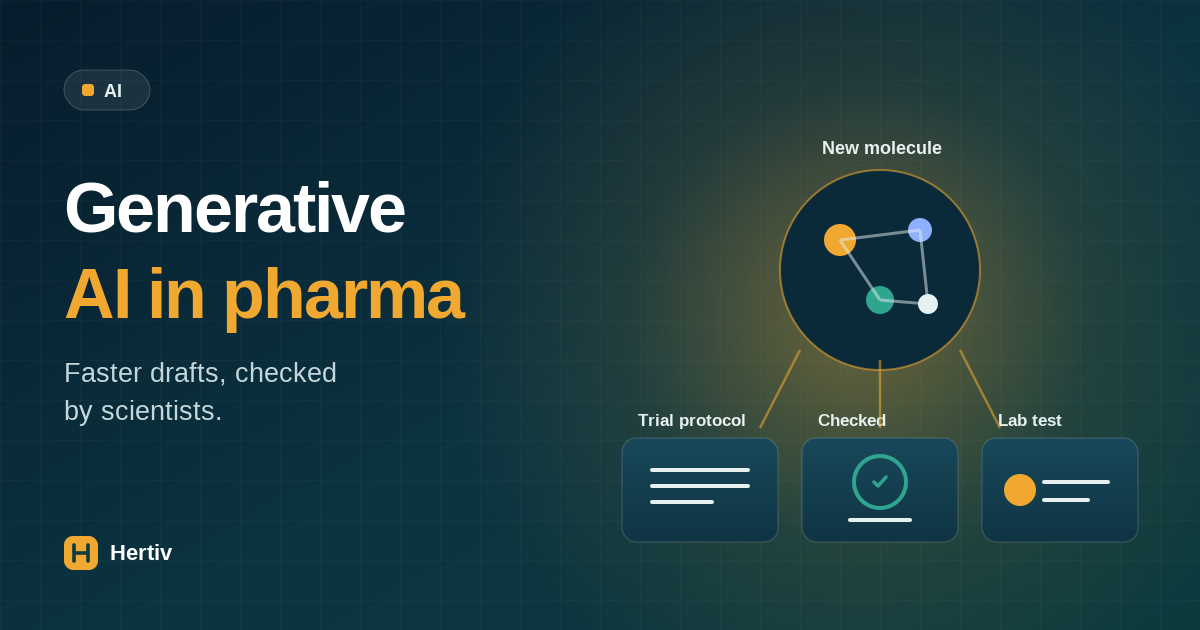
Generative AI drafts molecules, protocols and regulatory documents in pharma, with scientists checking every output. Here are the use cases that work.
On this page
Short answer
Generative AI in pharmaceuticals is the use of models that create new content to help drug teams work faster: designing candidate molecules, drafting trial documents, summarising research and answering questions from company data. A human checks every output, because the cost of a wrong one in pharma is high.
What is generative AI in pharmaceuticals?
Generative AI in pharmaceuticals is the use of models that create new content to help drug teams work faster: designing candidate molecules, drafting trial documents, summarising research and answering questions from company data. Unlike general AI, which mostly classifies or predicts, generative AI produces new text, structures and images that a human then checks.
Pharma is a good fit because the work is document-heavy, data-rich and slow. A drug can take a decade to reach patients, and much of that time goes to reading, writing and checking. Generative models speed the drafting and the searching, while scientists keep the decisions.
The limits matter as much as the uses. A generated molecule still needs lab testing, a drafted protocol still needs a statistician, and a summarised paper still needs its sources checked. The model is a fast draft, not a decision-maker.
Where does generative AI help in drug discovery?
Generative AI helps in drug discovery by proposing new molecule structures, predicting how they might behave, and searching the literature for what is already known about a target. It shortens the early stage, where teams test many ideas before choosing a few to take into the lab.
Molecule design is the clearest use. A model trained on known compounds can suggest new structures with properties the team asks for, such as binding to a target or dissolving well. Each suggestion is still a guess until it is made and tested, but the guesses are better aimed than random screening.
Literature search is the quieter win. A researcher can ask a model to summarise what is known about a protein across hundreds of papers, with sources attached, instead of reading them one by one. The summary must be checked against the sources, because a confident wrong summary is worse than no summary.
None of this replaces the lab. A model can propose a thousand candidates in a day, and the lab can only test a handful. The value is in ranking the candidates so the lab tests the best ones first.
How is it used in clinical trials?
Generative AI is used in clinical trials to draft protocols, write patient-facing documents, match patients to trials and summarise trial data. Trials are the slowest and most expensive part of drug development, and much of the delay is paperwork.
Protocol drafting is the biggest use. A model can draft a first version of a trial protocol from the study design, the endpoints and the rules, and a team of statisticians and clinicians then corrects it. The draft saves weeks of writing, but the review is where the quality is decided.
Patient matching is another. Trial criteria are long and detailed, and matching a patient record to them by hand is slow. A model can read a record and flag likely matches, and a clinician confirms each one. The check matters, because a wrong match wastes a patient's time and a trial slot.
Patient documents are a third use. Consent forms and trial summaries can be drafted in plain language at different reading levels, then reviewed by the trial team. Clearer documents help patients understand what they are joining, which is a real benefit, not just a convenience.
What are the main use cases across pharma?
The main generative AI use cases across pharma span discovery, trials, manufacturing and commercial work. Each one has a human check built in, because the cost of a wrong output in pharma is high.
The table below maps the uses to what the model produces and who checks it.
| Area | What the model makes | Who checks it |
|---|---|---|
| Drug discovery | Candidate molecules, target summaries | Medicinal chemists, lab tests |
| Clinical trials | Protocol drafts, patient matches | Statisticians, clinicians |
| Regulatory writing | Submission drafts, summaries | Regulatory affairs teams |
| Manufacturing | Deviation reports, batch summaries | Quality teams |
| Commercial | Medical content drafts, rep briefings | Medical affairs teams |
| Research | Literature summaries with sources | Researchers |
Regulatory writing is growing fast because submissions are long, structured and repetitive. A model can draft the routine sections from the trial data, and the regulatory team checks every claim against the source data. A wrong number in a submission is a serious problem, so the review is the product, not the draft.
Manufacturing uses are narrower but valuable. When a batch deviates from the plan, a model can draft the deviation report from the logs, and the quality team verifies it. Speed matters here, because a held batch costs money every day.
Example (hypothetical): drafting a trial protocol
Example (hypothetical): a pharma team plans a trial with 400 patients across 20 sites, testing a new treatment against a standard one. Writing the first protocol draft by hand takes the team 6 weeks, or 30 working days.
With a generative model, the team drafts the protocol in 5 days, then spends 10 days reviewing and correcting it with statisticians and clinicians. The total is 15 days, which is 30 minus 15, or 15 days saved, half the original time.
The review finds 12 errors in the draft, mostly in the dosing schedule and the eligibility wording. Fixing them takes 3 of the 10 review days. The team still saves 15 days overall, and the errors show why the review cannot be skipped: the draft is fast, and the review is what makes it safe. The numbers are invented to show the arithmetic, not a real trial.
What are the common mistakes?
The most common mistakes with generative AI in pharma are trusting the output without checking it, feeding it data it should not see, and measuring speed instead of quality.
- Skipping the human check. A generated summary or protocol that nobody reviews will eventually contain a wrong fact in a document that matters.
- Wrong data in the model. Patient data and unpublished trial data must not go into a general-purpose model. Use a system that keeps data inside the company's control.
- Measuring speed only. A draft that is twice as fast but needs twice as much correction saves nothing. Measure review time too.
- Starting with the hardest use. Molecule design is the hardest place to prove value. Start with documents and summaries, where the check is straightforward.
- No audit trail. Regulators will ask what the model produced and who checked it. If that record does not exist, the use cannot be defended.
Each mistake has the same shape: the model was treated as an answer instead of a draft. In pharma, the draft is the cheap part; the check is the valuable part, and it must be staffed and recorded.
How should a pharma team start?
A pharma team should start with one document-heavy workflow, one checked use, and a clear record of what the model produced and who reviewed it.
- Pick one workflow. Literature summaries or regulatory drafts are good first choices, because the check is clear.
- Fix the data rules. Decide what data the model may see, and use a system that keeps it inside the company.
- Define the check. Name who reviews the output, what they check, and where the review is recorded.
- Run a small pilot. One team, one workflow, one month, with review time measured alongside drafting time.
- Review the audit trail. Confirm the record would satisfy a regulator before expanding to more teams.
This is general information, not medical or legal advice, and any use in a regulated workflow should be reviewed with the relevant experts. For the wider AI picture in this sector, see AI use cases in biopharma.
For the healthcare angle, see AI for healthcare.
Teams planning a first use case can start with generative AI consulting.
Key takeaways
- Generative AI creates drafts, molecules and summaries; scientists keep the decisions
- Drug discovery, trial protocols and regulatory writing are the strongest uses today
- Every output needs a named human check and an audit trail
- Patient and unpublished trial data must stay inside company-controlled systems
- Start with documents and summaries, where the check is straightforward
Frequently asked questions
What is the difference between generative AI and other AI in pharma?
Other AI in pharma mostly classifies or predicts, such as flagging a risky patient or predicting a molecule property. Generative AI creates new content: a molecule structure, a protocol draft or a summary. The difference matters because generated content must be checked as a draft, not trusted as a measurement.
Can generative AI design a drug on its own?
No. A model can propose candidate molecules and rank them, but each one must be made and tested in the lab. The model shortens the early stage by aiming the search, while chemists and biologists decide which candidates are worth testing.
Is generative AI allowed in regulated pharma work?
It can be used, but the use must be documented: what the model produced, what data it saw, and who checked it. Regulators will ask for that record. Teams should involve regulatory and quality experts before using it in a workflow that feeds a submission.
What data can a pharma team safely give a model?
Only data the system is approved to hold, inside company-controlled systems. Patient data and unpublished trial data must not go into a general-purpose model. The data rules should be fixed before the first pilot, not after it.
How do you measure whether it is working?
Measure drafting time saved and review time spent together, plus the error rate found in review. A draft that is twice as fast but needs twice as much correction saves nothing. Also track whether the audit trail would satisfy a regulator.
Where should a pharma team start with generative AI?
Start with one document-heavy workflow, such as literature summaries or regulatory drafts, where the human check is clear. Run a small pilot with one team for a month, measure drafting and review time, and confirm the audit trail before expanding.


