Generative AI Meets Quantum Computing: What Changes
Quantum computing may speed up parts of generative models, while generative models help design quantum circuits. Here is where that convergence stands.
On this page
Short answer
Generative AI and quantum computing converge in two directions: quantum hardware may one day speed up parts of generative models, such as sampling and optimisation, while generative models already help researchers design quantum circuits and correct quantum errors. The work is early and mostly experimental, but the two fields are now shaping each other's research agendas.
What is the convergence of generative AI and quantum computing?
The convergence of generative AI and quantum computing is the meeting point of two technologies: generative models that create text, images, code and molecules, and quantum computers that process information with qubits instead of bits. Researchers are asking what each can do for the other.
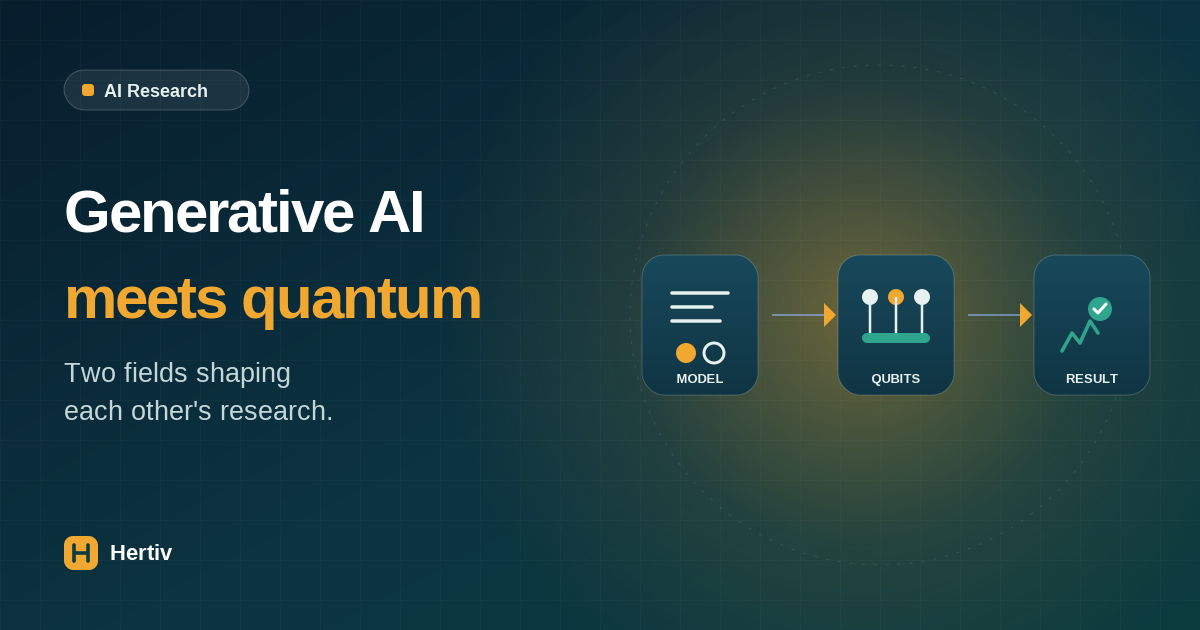
The meeting runs in two directions. In one, quantum computing is applied to generative models, for example by sampling from probability distributions or searching large design spaces faster than classical hardware. In the other, generative AI is applied to quantum computing itself, for example by proposing quantum circuits or spotting error patterns.
Four areas describe the overlap today:
| Area | What happens there | Stage today |
|---|---|---|
| Quantum-enhanced generation | Quantum circuits sample or optimise inside a model | Small experiments |
| Generative AI for quantum design | Models propose circuits and error fixes | Active research |
| Scientific simulation | Models and quantum simulation of molecules | Early pilots |
| Hybrid workflows | Classical models call quantum steps for hard parts | Prototypes |
This is a research frontier, not a product category. For the broader picture of quantum AI in business, see quantum AI for enterprises.
How can quantum computing help generative models?
Quantum computing may help generative models where the hard step is sampling from a large probability distribution or searching a huge space of options. Many generative models spend most of their effort on exactly those steps, so even a modest quantum speed-up would matter.
One idea is quantum sampling. A generative model must draw samples that match a learned distribution, and quantum circuits can produce certain distributions in ways that are hard to copy classically. Researchers test this on small models first, because current quantum hardware handles only a limited number of qubits and adds noise to every operation.
Another idea is optimisation. Training a large model means searching for settings that reduce error, and quantum optimisation methods may find good settings with fewer steps for some problem shapes. Whether that advantage survives on real hardware at real scale is still an open question.
A third idea is new kinds of generative models built directly on quantum circuits. These quantum generative models learn patterns in data encoded as quantum states. They are research prototypes, and their results so far come from small datasets and few qubits, so claims about them should be read with care.
How does generative AI help quantum computing?
Generative AI helps quantum computing by doing what it already does well: proposing candidates, spotting patterns in noisy data, and drafting designs that a human then checks. Quantum researchers use it as an assistant, not as a replacement for physics.
Circuit design is the clearest use. A quantum program is a circuit of gates, and finding a short circuit that does a given job is a search problem. Generative models trained on known circuits can propose new ones, which researchers then test on simulators before trying them on real hardware.
Error correction is another. Quantum hardware is noisy, so results need decoding and correction. Models trained on error patterns can suggest corrections faster than hand-written rules, which matters when a computation runs thousands of operations and each one can introduce an error.
Generative models also help with experiment design. A lab deciding which measurements to run can use a model to suggest the most informative next experiment, then run it and feed the result back. That loop is the same pattern used in drug discovery and materials research, applied to quantum experiments.
Where is this convergence used today?
The convergence is used today in research labs and in early pilots inside large companies, not in production products. The typical setting is a team with access to both a generative AI stack and a quantum computer, testing whether the combination beats either technology alone on a narrow problem.
Molecular and materials simulation is the most active area. Generative models propose candidate molecules, and quantum simulation checks their properties. The quantum step is still limited to small molecules, so the work is about learning the workflow rather than shipping results.
Finance is a second area, where teams test quantum optimisation on portfolio and risk problems and use generative models to draft and explain the results. These are pilots with small datasets, run to learn what the hardware can and cannot do.
Drug discovery follows a similar pattern: generative models propose compounds, and quantum methods estimate properties that are expensive to compute classically. No medicine has been developed this way yet, and honest reporting treats every result as a research signal, not a product claim.
What are the limits?
The limits are set by quantum hardware. Current machines have a modest number of qubits, each operation adds noise, and results must be repeated many times to be trusted. That makes large generative models, which need billions of reliable operations, far beyond reach for now.
Data movement is another limit. Generative models work on huge datasets, while quantum computers accept only small inputs that must be encoded qubit by qubit. Moving data between classical and quantum parts of a workflow costs time, and that cost can erase any speed-up the quantum step provides.
Measurement is a third limit. Reading the result of a quantum computation collapses the state, so you get one sample per run. A generative model that needs thousands of samples must run the circuit thousands of times, which is slow and expensive on shared hardware.
Finally, there is a skills limit. Few teams have both generative AI expertise and quantum expertise, and hiring for both is hard. Most progress comes from partnerships between AI teams and quantum labs, which takes time to set up and manage.
Example (hypothetical): a six-week research pilot
Example (hypothetical): a research team of three people runs a six-week pilot to test whether a quantum step improves a small generative model. Each person gives 10 hours a week, so the pilot has 180 hours in total.
The team spends the first two weeks reading: 12 papers at about 2 hours each, or 24 hours, plus setup of the classical model and the quantum simulator. Weeks three and four run two small experiments at about 30 hours each, or 60 hours, comparing the quantum-assisted model against the classical baseline on the same small dataset.
Weeks five and six go to analysis and writing: 40 hours checking results, repeating the key runs, and writing an internal note. The remaining hours cover meetings and the final review. The pilot ends with a clear answer: the quantum step helped on one narrow test and made no difference on the other, so the team knows exactly what to try next.
The point of the example is the discipline, not the result. A pilot with a fixed question, a baseline to beat and a written decision at the end teaches more than an open-ended exploration with no stopping rule.
What are the common mistakes?
The most common mistakes are treating a research result as a product, ignoring the cost of moving data to quantum hardware, and starting without a classical baseline to beat.
- Reading a small experiment as a breakthrough. Results on few qubits and small datasets rarely transfer to production scale.
- No classical baseline. Without a classical model doing the same job, you cannot tell whether the quantum step added anything.
- Ignoring data movement. Encoding data for a quantum step and reading results back can cost more time than the quantum step saves.
- Chasing hype use cases. The strongest pilots start from a narrow problem with a measurable outcome, not from a headline.
- Underestimating the skills gap. A team needs both AI and quantum expertise, and one without the other stalls.
- No stopping rule. A pilot without a fixed end date and a written decision drifts into open-ended research.
Key takeaways
- Generative AI and quantum computing meet in two directions: quantum for models, models for quantum
- Quantum sampling and optimisation are the most promising uses, but only on small problems so far
- Generative models already help design quantum circuits and correct quantum errors
- Hardware noise, small qubit counts and data movement costs are the real limits
- A pilot needs a classical baseline, a fixed question and a written decision at the end
Frequently asked questions
What is quantum AI?
Quantum AI is the use of quantum computing methods inside AI workflows, for example in optimisation, sampling or simulation. It is a research field, and most work today runs on small quantum hardware or on classical simulators of quantum systems.
Can quantum computers train large language models?
Not today. Training a large language model needs billions of reliable operations on huge datasets, while current quantum hardware handles a modest number of noisy qubits. Research explores whether quantum steps could help parts of training, but no large model is trained on quantum hardware.
What is a hybrid quantum-classical workflow?
A hybrid workflow splits a job: classical computers handle data, training loops and most of the model, while a quantum computer runs the specific step that is hardest classically, such as sampling or optimisation. The two parts pass data back and forth.
How does generative AI help quantum error correction?
Quantum hardware is noisy, so results need decoding. Generative models trained on error patterns can suggest corrections faster than hand-written rules, which helps when a computation runs thousands of operations and each can introduce an error.
Is quantum computing a threat to generative AI?
No. Quantum computing is a tool that may speed up some AI steps, and generative AI is a tool that helps quantum research. They are complementary, and the realistic near-term story is partnership between the two fields, not replacement.
How should a team start exploring this convergence?
Start with a narrow question, a classical baseline and a short pilot with a fixed end date. Read the recent research, partner with a quantum lab if you lack the expertise, and write down the decision the pilot must produce before you begin.


